

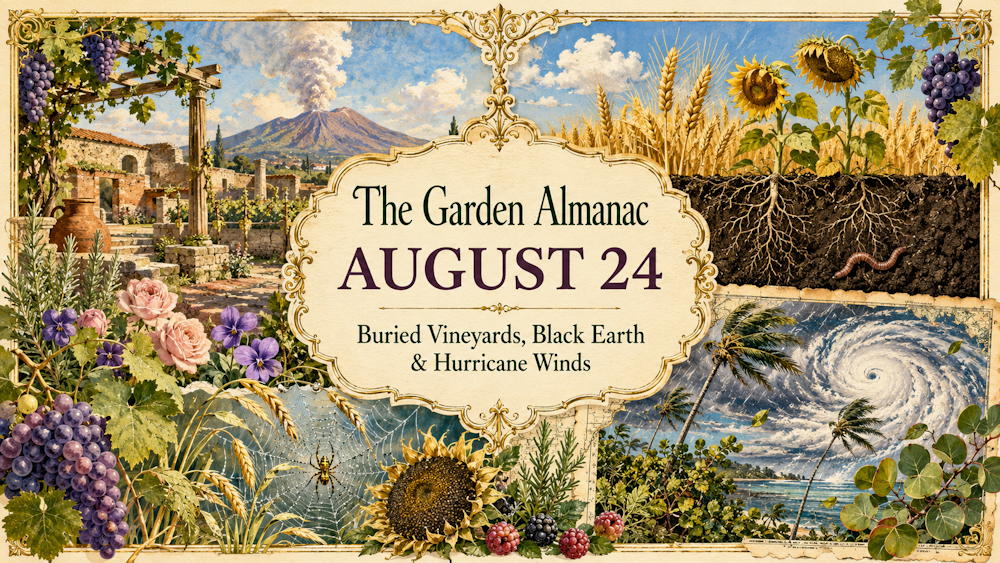

Late August is a season of abundance edged with uncertainty. Fruit is ripening, seed heads are filling, and soils still hold the memory of summer heat – yet storms, drought and shortening days remind us that no landscape is ever truly fixed.
On this day, an ancient volcano preserved gardens beneath ash, a modern hurricane redrew the green map of southern Florida, and an independent Ukraine placed some of the world’s richest farmland within the borders of a new state. Together, these stories reveal how closely human history is rooted in soil, plants and our ability to care for living landscapes.
August 24, AD 79 – The Gardens Buried by Vesuvius
According to the date traditionally preserved in the writings of Pliny the Younger, Mount Vesuvius began its catastrophic eruption on August 24, AD 79. Ash and pumice fell across Pompeii, while deadly surges overwhelmed settlements around the Bay of Naples. The precise date remains debated – archaeological clues have also suggested an autumn eruption – but August 24 has been associated with the disaster for centuries.
Pompeii was not simply a city of temples, baths and painted villas. It was also a city of productive green spaces. Archaeologists have identified kitchen gardens, orchards, vineyards, ornamental courtyards and plots where flowers may have been raised for perfume. Root cavities, pollen, seeds, fruit remains and impressions of planting structures have allowed researchers to reconstruct parts of this cultivated landscape with remarkable detail.
These discoveries show that Roman urban gardening mixed usefulness with pleasure. Vines grew beside buildings, fruit trees offered food and shade, and enclosed gardens could contain herbs, flowers and small-scale crops. In some properties, planting beds were carefully arranged around paths and water features. The garden was at once pantry, workshop, retreat and display – roles that many small domestic gardens still combine today.
Volcanic destruction also carries a geological paradox. An eruption can erase a living landscape, yet weathered volcanic material may eventually produce mineral-rich soils. Such ground is not automatically fertile – its productivity depends on particle size, organic matter, water and time – but volcanic regions around the world often support vineyards and intensive cultivation. The lesson from Pompeii is therefore not that catastrophe is beneficial, but that soils are continually created, disturbed and rebuilt through both geological and biological processes.
Garden Science – Why can volcanic soil support productive gardens?
Fresh volcanic ash contains minerals but very little usable organic matter. As it weathers, plant roots, fungi and microorganisms help release nutrients and build soil structure. Gardeners working with mineral-heavy soil can imitate part of this slow process by adding compost, keeping the surface covered and avoiding unnecessary disturbance.
Wildlife Note – What lives beneath an undisturbed soil surface?
A garden bed may look quiet, but its upper layers can contain earthworms, springtails, mites, beetle larvae, fungal threads and vast communities of bacteria. These organisms break down dead material, create channels for water and air, and return nutrients to plant roots.
To protect this hidden wildlife:
- leave healthy roots in the ground when annual plants finish;
- cover bare soil with compost, leaves or other organic mulch;
- avoid digging when the ground is waterlogged;
- keep pesticides away from areas where they are not genuinely needed.
August 24, 1992 – Hurricane Andrew Redraws a Florida Landscape
In the early hours of August 24, 1992, Hurricane Andrew made landfall near Homestead in southern Florida as a Category 5 hurricane. Its extreme winds destroyed homes, damaged agricultural land and stripped vegetation across a wide area. Nurseries, orchards and the region’s important tropical-fruit industry suffered alongside communities, while trees that had shaped streets and gardens for decades disappeared within hours.
The storm became a lesson in the difference between a tree that merely grows in a region and one that can withstand its weather. Species choice matters, but so do root space, branch structure, planting depth and maintenance. Trees with restricted roots, weak forks or dense, badly managed crowns are more vulnerable in strong winds. Groups of well-chosen trees may also fare better than isolated specimens exposed on every side.
For gardeners in storm-prone climates, resilience begins long before a warning is issued. Young trees should be allowed to develop one strong framework rather than repeatedly being topped. Large branches should not overhang roofs, drains should remain clear, and loose pots, tools and garden furniture need a secure storage place. After a storm, damaged trees should be assessed carefully – a leaning trunk, exposed roots or major split can require professional attention, while indiscriminate cutting may make a recoverable tree less stable.
Garden Reminder – How can a garden be prepared for severe weather?
- Check trees for dead wood, cracks and weak branch unions.
- Move or secure containers, hanging baskets and lightweight furniture.
- Clear gutters, channels and surface drains before heavy rain.
- Do not add fertiliser immediately before a major storm.
- After flooding, wait until the soil drains before walking on beds or working around roots.
Garden Science – Why do waterlogged plants wilt?
Wilting does not always mean that a plant needs more water. Flooded soil contains too little oxygen for roots to function normally, so they may be unable to absorb water even while surrounded by it. Adding more irrigation makes the problem worse. Improve drainage where possible, keep feet and machinery off saturated ground, and allow the root zone to regain air naturally.
August 24, 1991 – Ukraine, Sunflowers and the Responsibility of Rich Soil
On August 24, 1991, Ukraine declared independence from the Soviet Union, a decision later confirmed by a nationwide referendum. The date became the country’s Independence Day. Although the holiday is political and national in meaning, the Ukrainian landscape is inseparable from the country’s identity – from broad grasslands and forest belts to wheat fields and expanses of sunflowers.
Much of Ukraine lies within the great belt of chernozem, or black earth. This deep, dark soil developed under grassland vegetation, whose dense roots repeatedly returned carbon-rich material to the ground. Chernozem can store substantial organic matter and support highly productive agriculture, but its fertility is not inexhaustible. Intensive cultivation, erosion, compaction and the loss of protective vegetation can gradually weaken even the richest soil.
The practical lesson reaches far beyond Ukrainian farmland. Fertile ground should be treated as living capital rather than an endless supply of nutrients. Gardeners can protect their own small share of soil by keeping it covered, returning composted plant material, rotating demanding crops and allowing roots to remain in place whenever possible. A sunflower may be the visible emblem of a summer field, but the deeper story lies below it – in the soil community that makes growth possible.
Seasonal Tips – Caring for late-summer soil
- Sow a green manure where vegetable beds are becoming empty.
- Add finished compost as a surface layer rather than burying it deeply.
- Leave crop residues only when they are free from serious disease.
- Water slowly and deeply so moisture reaches the main root zone.
- Use mulch to reduce evaporation, erosion and soil-temperature extremes.
What to Observe Right Now – Signs that summer is turning
Late August rarely announces autumn in a single dramatic moment. Instead, the change appears through small signals that vary with climate and latitude.
Look for seeds darkening in sunflower heads, grasses drying from green to gold, spiders building more conspicuous webs and birds investigating berries. Notice where morning dew lingers longest and which plants recover slowly after hot afternoons. Watch, too, how water behaves during rain – whether it disappears into crumbly soil, runs from compacted ground or collects in low places. These observations can guide autumn planting, drainage improvements and future choices of drought-tolerant plants.
Looking Ahead
August 24 reminds us that gardens exist within forces much larger than a fence or property line. Volcanoes build and bury soils, storms test the structure of planted landscapes, and fertile farmland connects national history with global food security. A resilient garden begins with the same principles at every scale – protect the soil, choose plants for the conditions, encourage diversity and observe before intervening. The better we learn to read a landscape, the better prepared we become to care for whatever grows there next.