

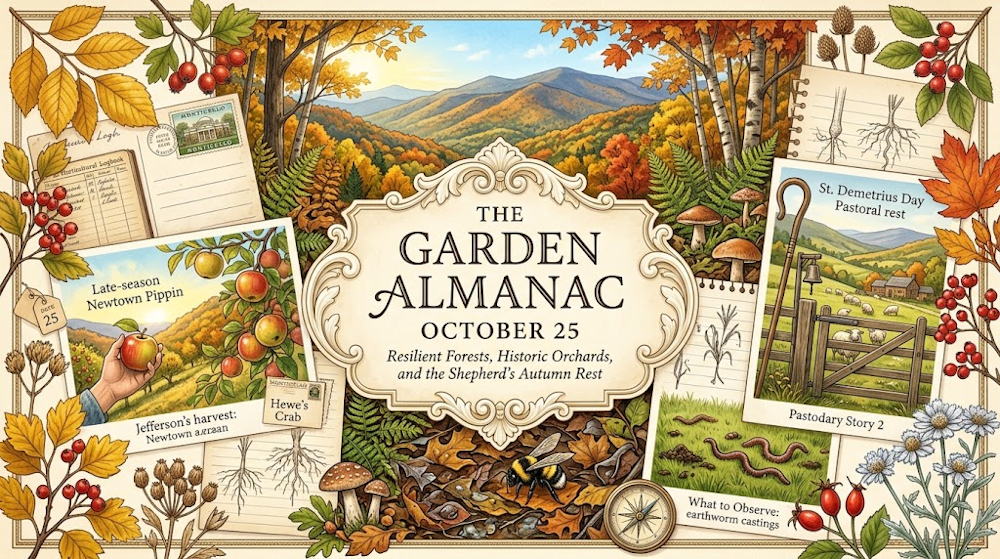

As late October settles across the temperate world, the landscape undergoes a quiet, irreversible shift. The final golden canopy of broadleaf trees gives way to damp leaf litter, while the morning air acquires a sharp, frost-tinged clarity that signals the true end of the growing season. It is a moment when the garden ceases its outward expansion and turns its energy inward, focusing on root development, soil protection, and structural endurance.
October 25 marks a fascinating threshold in environmental history and rural tradition. On this date, human decisions have repeatedly intersected with the natural world – from ambitious public conservation projects born out of degraded timberlands to historic orchard harvests and age-old pastoral calendars. Looking closely at this single autumn day reveals how landscape recovery, microclimate selection, and seasonal rest shape the sanctuaries we cultivate outside our back doors today.
October 25, 1940 – The Wilderness Reclaimed from the Ax
When President Franklin D. Roosevelt stood at Newfound Gap on October 25, 1940, to formally dedicate the Great Smoky Mountains National Park, he was not celebrating an untouched primeval forest. Unlike the vast western reserves carved out of pristine public lands, this new sanctuary comprised more than 6,000 individual private tracts, many heavily scarred by aggressive clear-cut logging and overgrazing. The miracle of the Smokies was not that a wilderness was preserved, but that an exhausted, eroded landscape was allowed the time and protection needed to heal itself into one of North America’s richest biodiversity hotspots.
The early restoration efforts demonstrated that nature’s regenerative capacity relies heavily on structural complexity and biological diversity. Foresters and early conservationists observed how native hardwoods – such as sugar maples, American beeches, and yellow birches – gradually re-established fungal networks in the disturbed topsoil. As organic debris accumulated, the forest floor regained its sponge-like ability to absorb heavy rainfall, preventing disastrous downstream erosion and re-creating microclimates suitable for delicate understory ferns, native orchids, and hundreds of woodland fungi.
This historical turnaround highlights a fundamental truth about cultivated land: soil degradation is rarely permanent if natural biological processes are allowed to take the lead. The recovery of the Smoky Mountains was driven not by massive chemical interventions, but by stopping active destruction, protecting surviving native seed banks, and allowing organic matter to build up undisturbed. Decades of unhindered leaf fall gradually rebuilt depleted humus layers, demonstrating how patience and native biomass can rebuild complex, self-sustaining ecosystems from the ground up.
For modern home gardeners, the legacy of October 25, 1940, offers a radical shift in perspective regarding disturbed or neglected plots. Rather than attempting to instantly transform stubborn clay or exhausted soil with heavy tilling and synthetic fertilizers, real soil health is built by mimicking forest succession. Leaving autumn leaf mulch in place, planting diverse native perennials, and minimizing deep soil disturbance allows beneficial mycorrhizal networks to rebuild, turning even the most tired backyard corner into a thriving, resilient ecosystem.
Wildlife Note
How do overwintering pollinators survive under late autumn leaf litter?
- Mourning Cloak Butterflies: Overwinter as fully formed adults tucked beneath loose bark and dense leaf piles, relying on natural anti-freeze proteins in their blood.
- Queen Bumblebees: Burrow 2–5 centimeters into damp, shaded soil beneath woodland duff to hibernate safely until early spring warmth arrives.
- Native Solitary Bees: Remain sheltered inside hollow plant stems or underground chambers, vulnerable to premature garden cleanup and deep tilling.
- Lace Bugs and Ladybugs: Aggregate in dry seed heads, fallen leaves, and rock crevices, providing immediate biological pest control when spring temperatures rise.
Historic Orchards and the Science of the Late Apple Harvest
Long before modern cold storage, October 25 marked a crucial deadline for fruit growers across the Northern Hemisphere. On his Monticello estate, Thomas Jefferson kept meticulous weather logs and horticultural journals, frequently noting that late October brought the final harvest of prized heirloom cider apples such as ‘Hewe’s Virginia Crab’ and ‘Newtown Pippin’. Picking these late-ripening varieties required precise timing: harvested too early, the starches had not yet converted into sugars; left too late, a sudden hard freeze would rupture the cell walls, rendering the fruit soft and prone to rot.
Jefferson’s extensive trial plantings revealed that fruit quality depended heavily on tiny variations in terrain – what we now recognize as microclimates. Apple trees planted on elevated, south-facing slopes escaped late spring frosts and accumulated enough heat units throughout September and October to fully finish their sugar development. Conversely, trees planted in low-lying cold spots suffered early leaf drop and poor fruit storage capacity. Understanding how cold air settles like water into low pockets transformed fruit growing from a gamble into an exacting agricultural science.
This historical focus on harvest timing underscores how ambient air temperatures directly govern the biochemical transformation of autumn fruit. As nighttime temperatures hover near freezing, trees slow down water intake and concentrate sugars within their cells as a natural frost protection mechanism. This biochemical shift explains why late-harvest apples, pears, and winter squashes gathered after the first light frosts possess a far richer flavor profile and superior storage life compared to those picked early in the autumn season.
Garden Science
Why do late-autumn cold nights make winter squash and root crops sweeter? As ambient temperatures drop toward freezing, cold-tolerant plants activate a physiological survival strategy known as osmotic adjustment. They produce enzymes that break down stored starch molecules into simple soluble sugars, such as glucose and fructose. Sugar lowers the freezing point of cellular fluids within the roots and fruit tissues, preventing ice crystals from damaging cell membranes. This natural anti-freeze mechanism yields sweeter, more flavorful harvests of carrots, parsnips, kale, and winter squashes after exposure to crisp October frosts.
Garden Reminder
Essential Late-October Soil and Equipment Care
- Drain and store outdoor hoses: Disconnect all hoses from exterior spigots to prevent trapped water from freezing and cracking non-frost-proof faucets.
- Mulch bare vegetable beds: Cover exposed soil with a 5-to-10-centimeter layer of shredded leaves or clean straw to protect beneficial soil microbes from severe temperature swings.
- Clean and oil hand tools: Scrape dried sap and soil from pruners and spades, sharpen cutting blades, and wipe metal parts with plant-based mineral oil to prevent rust over winter.
- Lift delicate summer bulbs: Dig up dahlias, cannas, and gladioli after their foliage turns brown, dry them in a well-ventilated space, and pack them in dry peat moss or sawdust inside a frost-free shed.
St. Demetrius Day and the Shepherd’s Autumn Rest
In traditional European agricultural calendars, October 25–26 marks the festival of St. Demetrius, historically celebrated as the “Shepherd’s New Year.” This date marked the definitive end of the summer grazing period, when livestock were driven down from high mountain pastures back into valley barns and village enclosures. Land leases were settled, seasonal farm laborers were paid, and pasture gates were closed to give communal fields a vital period of rest before winter set in.
The pastoral rule forbidding late-autumn grazing was not merely social tradition; it was an essential land management practice developed through centuries of trial and error. Grazing livestock on wet autumn soil destroys root zones through hoof compaction and strips plants of the green top growth needed to store crown reserves for spring emergence. By clearing pastures in late October, traditional farmers allowed the turf to consolidate, ensuring that root systems remained intact and resistant to frost heaving throughout the freeze-thaw cycles of winter.
This ancient shepherd’s calendar reminds us that natural systems require clear seasonal boundaries to remain productive over the long term. Continuous exploitation of land without a dedicated period of dormancy leads to soil compaction, nutrient depletion, and root rot. By honoring the natural cessation of growth in late autumn, traditional agriculture safeguarded the structural integrity of the landscape for the coming spring.
Modern gardeners can adopt this same wisdom by recognizing that autumn is a time to cease aggressive soil manipulation, heavy fertilizing, and excessive pruning. Forcing late vegetative growth with nitrogen-rich fertilizers in late October prevents plants from hardening off properly, leaving delicate stem tissues vulnerable to winter kill. Respecting the seasonal pause by allowing garden beds to rest undisturbed under organic mulches protects soil structure and preserves essential plant reserves until warm weather returns.
What to Observe Right Now
- Anthocyanin Pigment Accumulation: Watch how dogwoods, viburnums, and maples shift from orange to intense burgundy as lingering sunny days convert sugars trapped in leaves into protective red pigments.
- Earthworm Castings on Lawns: Look for tiny, nutrient-rich mounds of soil on wet lawn surfaces, indicating that deep-burrowing earthworms are actively aerating the root zone before soil freezes.
- Evergreen Needle Shedding: Observe how white pines and arborvitae shed their inner, two-to-three-year-old yellowed needles while keeping their outer tips green – a completely natural internal cleanup process.
- Migratory Bird Feeding Patterns: Note how thrushes, robins, and waxwings flock to berry-laden native shrubs like winterberry (Ilex verticillata) and hawthorn to refuel during south-bound flights.
Looking Ahead
The historical threads of October 25 reveal that sustainable land stewardship is built on patience, observation, and respect for natural cycles. Whether observing the dramatic natural recovery of once-forested mountains, the precise microclimate requirements of heirloom fruit, or the ancient pastoral wisdom of seasonal rest, each story emphasizes that working with nature yields far greater resilience than forcing immediate results. As we prepare our own gardens for the cold months ahead, tucking beds under fallen leaves and leaving seed heads for wildlife, we participate in an enduring tradition of land care. Taking time today to protect our soil and honor the seasonal pause ensures that our green spaces will awaken with vigor when spring returns.