
By mid-August, a garden can look settled while quietly preparing for change. Fruit is swelling, seed is ripening, late flowers are feeding insects, and the first tired leaves are beginning to admit that summer will not last forever.
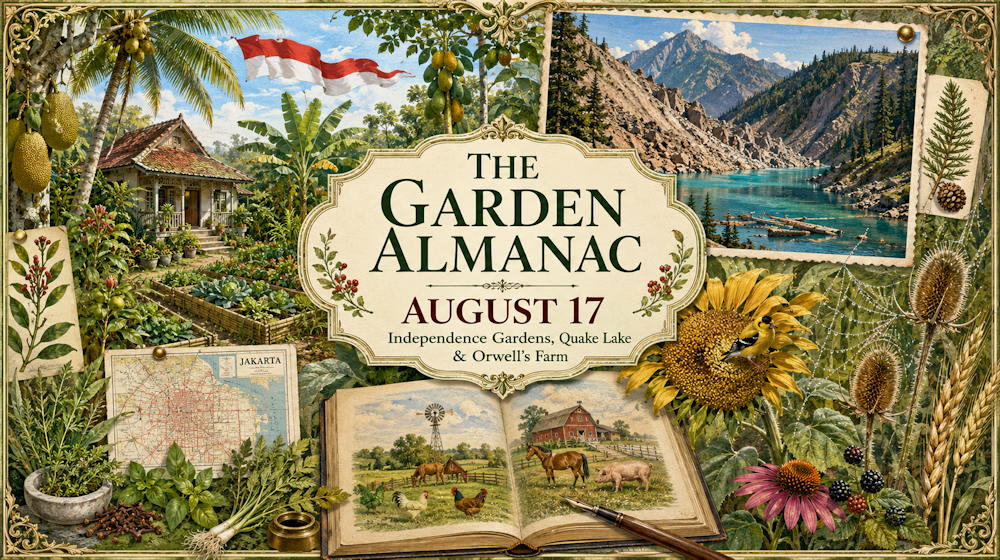
In the Garden Almanac, August 17 opens three very different gates: an Indonesian independence anniversary rooted in one of the world’s richest cultivated landscapes, a mountain lake created in a single violent night, and a famous fictional farm that still asks who controls the land and how its resources are shared. Together, they turn an ordinary summer date into a lesson in diversity, disturbance and stewardship.
August 17, 1945 – Independence in a Landscape of Living Gardens
On August 17, 1945, Sukarno and Mohammad Hatta proclaimed Indonesia’s independence in Jakarta. The country it addressed encompassed thousands of islands, volcanic soils, monsoon climates, rainforests, rice terraces and spice-growing regions. Its national story cannot be separated from crops such as rice, coconut, cloves, nutmeg, coffee and rubber, which shaped local livelihoods and global trade.
One quieter expression of this relationship is the pekarangan, the traditional Indonesian home garden. Many arrange fruit, vegetables, herbs, ornamentals and useful trees in layers. Coconut, jackfruit or other trees may form an upper canopy; bananas, papayas, citrus and shrubs occupy the middle; spices, medicinal plants and vegetables fill the spaces below. Poultry, fish ponds and composting may also belong to this small, managed ecosystem.
This layered structure makes excellent use of light, vertical space and organic matter. It can supply food at different times of year, shelter soil from hard rain, moderate heat around the home and preserve a broad range of cultivated plants. Diversity does not make a garden immune to drought, pests or market pressure, but it reduces dependence on a single crop. That principle travels well: a temperate garden can also combine a fruit tree canopy, berry shrubs, perennial herbs, seasonal vegetables and flowering ground cover instead of asking one exposed patch of soil to do everything.
The lesson is not to imitate tropical species in an unsuitable climate, but to borrow the design logic. Assess sun, shade, rainfall, soil depth and space, then choose plants with different heights, roots, flowering seasons and harvest times. A small garden becomes more resilient when its plants do not all demand the same resources at once.
Garden Science – Why Does Plant Diversity Make a Garden More Resilient?
A diverse planting spreads risk. Species respond differently to heat, excess rain, drought, pests and disease, so one setback is less likely to stop the entire garden from functioning.
- Mix shallow-rooted crops with deeper-rooted perennials where spacing allows.
- Extend the flowering season so pollinators find nectar and pollen before and after the main summer flush.
- Keep several plant families in rotation rather than repeatedly growing close relatives in the same soil.
- Use trees and shrubs carefully to create partial shade, wind shelter and cooler pockets for heat-sensitive plants.
Diversity is most useful when it is planned. Crowding many species together without regard to mature size, airflow or water demand can increase stress rather than reduce it.
August 17, 1959 – The Night a Mountain Made a Lake
Late on August 17, 1959, a powerful earthquake struck near Hebgen Lake in Montana. It triggered a huge landslide into the Madison River canyon, burying part of a campground, blocking the river and creating Earthquake Lake, or Quake Lake. In moments, rock, water and forest were rearranged.
The site reminds us that landscapes are not fixed scenery. Landslides expose mineral soil, bury ground and redirect water. Disturbance then begins a new ecological sequence: seeds arrive, roots resprout, pioneer plants stabilise loose ground, organic matter accumulates, and shrubs and trees follow. Recovery is neither instant nor an exact restoration of what came before.
Garden soil after construction, flooding, erosion or a fallen tree undergoes a smaller version of the same challenge. The first job is to understand what changed before reaching for fertiliser: has the soil been compacted, buried, washed away or left waterlogged? Protect exposed ground with mulch or suitable cover plants, slow runoff across slopes, and replant in stages. Where stability is uncertain, deep-rooted grasses, locally appropriate shrubs and professional drainage advice may matter more than decorative planting.
Nature Watch – What Can Pioneer Plants Tell You?
Plants that appear first on disturbed ground are not merely “weeds with good timing”. They can reveal bare soil, compaction, moisture patterns and repeated disturbance. Observe where they grow, how water moves after rain and whether the soil forms a crust before deciding what to remove or plant. On vulnerable ground, keeping living roots in place is often safer than clearing everything at once.
August 17, 1945 – When Animal Farm Opened the Gate
George Orwell’s Animal Farm was first published in England on August 17, 1945. Its farm animals and fields formed a political allegory rather than an agricultural handbook, yet the setting was no accident. A farm is an immediately understandable world of work, food, ownership, dependence and unequal access to resources. Every harvest has a history, and every rule about who labours, who eats and who decides leaves a mark on both community and land.
For a modern gardener, the connection lies in seeing the plot as a system. Soil organisms break down residues; flowers support insects; insects feed birds; compost returns nutrients. Choices about water, fertility, shelter and space govern even a tiny garden. If produce leaves while little organic material returns, the soil eventually shows the imbalance.
The practical response is thoughtful circulation. Compost healthy plant waste, leave useful stems or seed heads, and avoid pesticides that remove predators along with pests. Where garden livestock are kept, rotate access to prevent bare, nutrient-loaded ground, compost manure safely and provide clean water, shade and secure housing. A productive garden works best when none of its living parts is treated as limitless.
Wildlife Note – Should You Leave Seed Heads Standing in Late Summer?
Yes – provided the plants are healthy and not spreading unwanted seed. Seed heads can feed finches and other birds, while stems shelter insects. Leave selected clumps of sunflower, teasel, coneflower or native meadow plants, then watch who visits.
Avoid leaving heavily diseased material in place. Remove and dispose of infected leaves or stems according to local guidance, and do not add persistent disease problems to a cool home compost heap.
Garden Reminder – What Should You Do in the Garden in Mid-August?
- Water deeply in the morning when the soil is dry, directing water to roots rather than routinely wetting foliage.
- Harvest courgettes, beans, cucumbers and other fast-growing crops frequently so plants continue producing.
- Collect ripe seed only from healthy, open-pollinated plants, and label it immediately with the plant and year.
- Support fruit-laden branches and remove damaged windfalls before rot and wasps become a problem.
- Keep birdbaths and shallow wildlife water dishes clean, topped up and fitted with a stone or sloping edge for safe escape.
- Leave some fading flowers and undisturbed corners for insects while removing diseased growth promptly.
What to Observe Right Now – The Garden’s First Signs of Seasonal Change
Mid-August is not autumn, but the garden is already registering shorter days and the accumulated effects of summer weather. Take five quiet minutes to look for:
- spiders rebuilding webs in the cooler morning air;
- berries colouring in hedges and fruit softening more quickly after warm nights;
- late bees concentrating on the remaining nectar-rich flowers;
- birds testing seed heads and moving through the garden in looser groups;
- stressed trees shedding a few leaves early, especially after heat or drought;
- dew lingering longer in shaded grass and low planting.
These signs are observations, not automatic instructions. Early leaf fall may reflect normal seasonal change, drought stress, root damage or disease, so check the whole plant and recent weather before choosing a remedy.
Looking Ahead
August 17 reminds us that resilience is not the same as resisting every change. Indonesian home gardens show the strength of useful diversity, Quake Lake shows how life recolonises altered ground, and Orwell’s farm keeps the questions of power and stewardship firmly in view. The practical future begins close to home: build layered plantings, keep soil covered, return organic matter and leave room for wildlife. A garden managed this way does more than survive the season – it becomes better prepared for the next one.