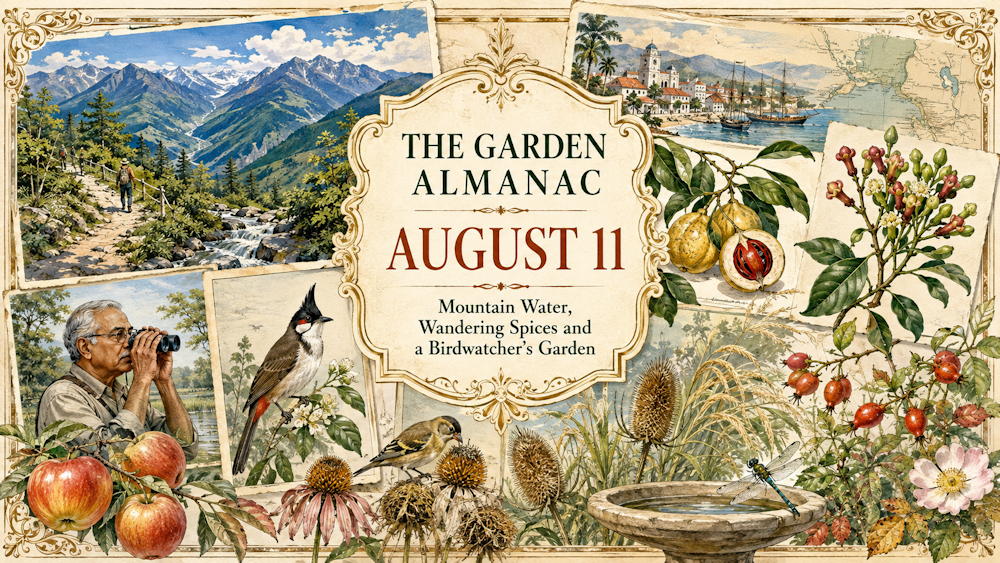

By mid-August, summer has begun to reveal what every garden is really made of. Heat exposes shallow roots, dry spells redraw the lawn, seed heads replace flowers, and birds become conspicuously interested in every available drop of water.
August 11 opens three very different windows onto this seasonal landscape. In Japan, it is a day for recognising the gifts of mountains. In Malaysia, the date recalls the beginning of a colonial chapter that transformed Penang into an experimental home for valuable spice trees. It is also the anniversary of the death of an Indian conservationist who showed generations of readers that watching birds is one of the best ways to understand the health of a landscape.
August 11 – Japan’s Mountain Day and the Gardens Below the Peaks
Japan observes Mountain Day on August 11, a national holiday created to encourage people to become familiar with mountains and appreciate their blessings. The holiday was established in law in 2014 and first celebrated in 2016. Mountains cover roughly 70 per cent of Japan, so this is more than a celebration of dramatic scenery – upland forests shape the country’s water supplies, wildlife habitats, rural livelihoods and cultural identity.
A mountain’s influence extends far beyond its summit. Rain and snow captured at higher elevations feed streams, replenish groundwater and carry moisture towards farms, towns and gardens below. Forest soils slow runoff, while roots help stabilise slopes and leaf litter creates a living layer that stores water. When upland vegetation is damaged, the consequences may appear downstream as erosion, poorer water quality, flash flooding or longer periods of summer dryness.
Mountains also compress several climates into a relatively small horizontal distance. Temperature generally falls with elevation, while wind, snow cover, exposure and slope direction create a mosaic of habitats. Plants adapted to cool alpine conditions may survive only within narrow climatic bands, making mountain vegetation especially sensitive to warming. As those bands move uphill, species already living close to summits can simply run out of higher ground.
The gardener’s version of a mountain landscape is the microclimate. A south-facing wall, shaded hollow, exposed balcony and damp corner may experience remarkably different temperatures and moisture levels even when separated by only a few metres. Before moving an unhappy plant, observe where morning sun reaches, where rainwater collects and where soil dries first. Matching plants to these small variations is often more effective than trying to make every part of the garden behave in the same way.
Garden Science – Why do slopes and raised beds dry out so quickly?
Gravity draws water through large soil pores, so steep ground and sharply raised beds may lose moisture faster than level soil. Runoff makes the problem worse when the surface is bare or compacted.
Terracing a slope, planting across rather than directly down it, covering exposed soil and adding organic matter all help slow water. Deep-rooted perennials and densely planted groundcover can also reduce erosion while creating cooler conditions at soil level.
August 11, 1786 – Penang and the Great Experiment with Spice Trees
On August 11, 1786, Francis Light formally took possession of Penang for the British East India Company and established a settlement on an island already connected to the Malay world through local communities and regional trade. The agreement with the Sultanate of Kedah was shaped by colonial ambition and disputed promises of protection. Penang soon became a strategic port from which the Company hoped to challenge Dutch influence over the enormously profitable spice trade.
Plants became part of that contest. From the 1790s, experimental spice gardens were established on Penang, and nutmeg and clove plants were brought from the Moluccas. Tens of thousands of young trees passed through these gardens and nurseries. The island was gradually transformed by plantations, with commercial crops replacing parts of the existing tropical landscape. Nutmeg became particularly important, although the industry later suffered from uncertain yields, changing markets, disease and competition from other growing regions.
This history is an early lesson in the power and danger of moving plants. Botanical exchange has given gardeners countless treasured crops and ornamentals, but commercial enthusiasm often overlooked ecological limits, genetic diversity and the knowledge of local growers. A plant may flourish in a new climate yet fail as a crop, carry an unseen pest or escape into natural habitats. Modern gardeners can apply the same lesson on a smaller scale: choose plants suited to local conditions, inspect new purchases for pests, avoid known invasive species and grow several varieties rather than relying on a single vulnerable cultivar.
Garden Inspiration – What can spice plants teach us?
- Nutmeg comes from the seed of Myristica fragrans, while mace is the red, lacy covering around that seed.
- Nutmeg trees are normally male or female, so fruit production requires compatible flowering trees and suitable pollination.
- Cloves are unopened flower buds harvested from the evergreen tree Syzygium aromaticum.
- Both species require warm, humid, frost-free conditions and cannot simply be treated like hardy temperate herbs.
- In cooler climates, flavour is usually easier to grow through container herbs such as ginger, lemongrass, scented pelargoniums and Vietnamese coriander.
August 11, 2013 – Zafar Futehally and the Landscape Seen Through Birds
Indian ornithologist and conservationist Zafar Futehally died on August 11, 2013. He helped make birdwatching accessible to a wide public, notably through the long-running Newsletter for Birdwatchers. Rather than treating birds as isolated objects to be identified and listed, he encouraged people to notice their behaviour, habitats and dependence on trees, wetlands and open countryside.
That approach changed the scale of observation. A declining bird population may indicate disappearing nesting places, pesticide pressure, polluted water or a shortage of insects and seeds. Lakes cannot be protected only as sheets of water, nor can trees be valued only for their appearance. Birds reveal the connections between vegetation, water, food and shelter – the same relationships that determine whether a garden becomes a functioning habitat or remains merely decorative.
A gardener does not need specialist equipment to adopt this method. Spend ten quiet minutes watching which plants birds actually use. Note whether they search bark for insects, feed among seed heads, shelter in dense shrubs or visit shallow water. These observations can guide planting more effectively than a generic list of “wildlife-friendly” species. If birds repeatedly ignore a garden, the missing ingredient may be cover, natural food, clean water or freedom from disturbance rather than another feeder.
Wildlife Note – How can you help garden birds in hot weather?
- Provide a shallow dish of clean water in an open place with nearby cover, but not so close to dense shrubs that a cat can ambush bathing birds.
- Add a rough stone or gently sloping edge so insects and small birds can climb out safely.
- Replace the water daily in hot weather and scrub the container regularly to reduce algae and disease.
- Leave some sunflower, coneflower, teasel and ornamental-grass seed heads standing.
- Keep part of the garden untidy enough to support insects, which remain essential food for many birds and fledglings.
Garden Reminder – What Needs Attention in the Mid-August Garden?
Late summer is not the moment to force exhausted plants into fresh growth. The most useful work now is careful harvesting, selective watering and preparation for the next seasonal turn.
- Water containers, recent plantings and fruiting crops first. Established borders usually benefit more from a thorough soaking at longer intervals than from frequent surface sprinkling.
- Water early in the morning when possible, directing it towards the soil rather than the leaves.
- Harvest courgettes, beans, cucumbers and tomatoes regularly so plants do not spend energy on oversized or overripe produce.
- Continue deadheading plants wanted for repeat flowering, but allow selected flowers to form seeds for birds and future sowing.
- Check apples and plums for damaged or rotting fruit, removing affected material before decay spreads.
- Avoid heavy feeding during extreme heat or drought. Fertiliser cannot compensate for dry roots and may increase stress.
- Add mulch where soil is exposed, but water thoroughly before applying it and keep the material away from stems and trunks.
What to Observe Right Now – The First Signs of Late Summer
August still looks generous, yet the garden is already changing direction. Instead of searching only for flowers, watch how plants and animals prepare for what comes next.
Look for the first ripening berries in hedges, the deepening colour of apples, papery seed capsules and the evening activity of moths. Notice which parts of the garden retain dew and which are dry soon after sunrise. You may also see birds becoming quieter while they moult, swallows gathering more visibly, or young birds learning to feed without their parents.
These are not signs that the gardening year is ending. They mark the gradual transfer of energy from flowers to fruit, seeds, roots and stored reserves. Recognising that transition helps a gardener decide what to cut, what to water and what should be left alone.
Looking Ahead
The stories attached to August 11 all point towards the same practical truth: no garden exists in isolation. Mountain forests influence distant water, transported plants reshape landscapes, and birds make hidden ecological changes visible. The most resilient gardens work with these connections by protecting soil, using water carefully, choosing plants responsibly and providing several layers of habitat. A few minutes of close observation today may reveal the most useful task for tomorrow – and sometimes the wisest decision is to let the garden complete its own late-summer work.