
Late July is a revealing time in the garden. The first rush of summer growth has softened, seedheads are forming, fruit is swelling, and the gardener begins to see which choices made in spring are now holding up under heat, insects, drought and sudden rain.
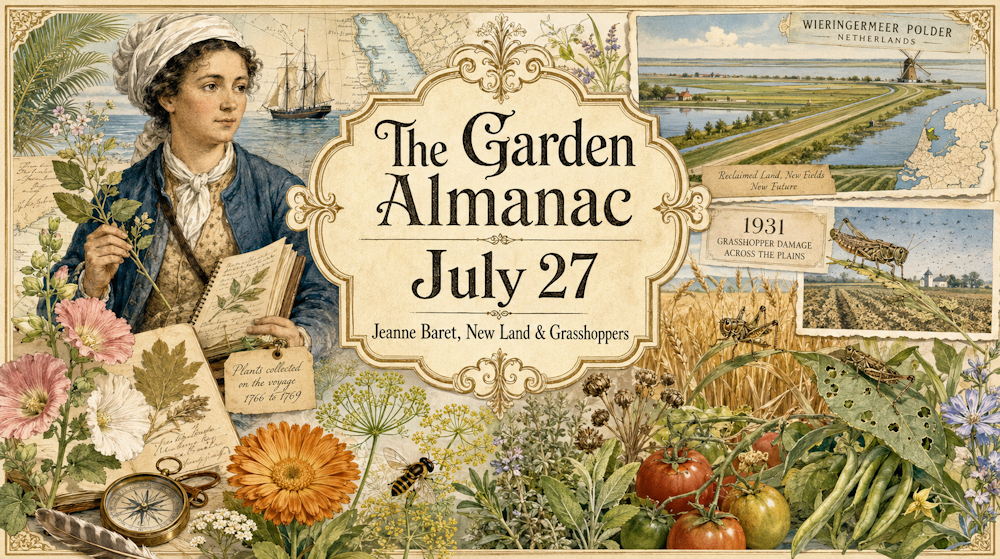
July 27 brings together several stories about looking closely at the living world. One begins with a woman who knew plants well enough to cross oceans with them. Another takes us to the Netherlands, where sea became farmland through engineering and patience. A third opens on the American plains, where grasshoppers reminded farmers that no field exists outside ecology.
Together, they make this date feel like a small lesson in attention. Gardens, after all, are never just planted spaces. They are collections, experiments, shelters, weather records and negotiations with everything that eats, roots, flowers, flies or dries.
July 27, 1740 – Jeanne Baret and the Plants That Travelled the World
Jeanne Baret was born on July 27, 1740, in Burgundy, France. She would later become known as the first woman to complete a voyage around the world, travelling as part of Louis Antoine de Bougainville’s expedition in the 1760s. Disguised as a man, she served as assistant to the naturalist Philibert Commerson and helped collect plants during one of the great botanical journeys of the age.
Her story belongs not only to exploration history, but to garden history too. Many plants that now feel familiar in ornamental gardens reached Europe through voyages like these, carried as seeds, cuttings, pressed specimens or careful descriptions. Bougainvillea, with its vivid papery bracts, is one of the best-known names linked to that expeditionary world.
For modern gardeners, Baret’s life is a reminder that plant knowledge has often lived outside formal institutions. It has belonged to field workers, growers, collectors, herbalists, seed savers and observant people who knew how to notice leaf shape, scent, habit, soil preference and seasonal timing.
The practical lesson is simple but powerful: a garden becomes richer when we learn plants as living beings, not just as labels. Knowing where a plant comes from helps us understand what it needs – sun or shade, sharp drainage or moisture, shelter or airflow, winter protection or summer dryness.
Garden Science – Why Does Plant Origin Matter?
A plant’s native habitat often gives clues to its garden behaviour.
- Mediterranean plants usually prefer free-draining soil and dislike winter wet.
- Woodland plants often grow best in humus-rich soil with filtered light.
- Prairie plants are commonly adapted to deep roots, open sun and periods of drought.
- Tropical climbers may need warmth, humidity and protection from cold winds.
This does not mean every plant must be grown exactly as it grows in the wild. But the closer we come to understanding its original conditions, the less we have to force it.
July 27, 1929 – The Wieringermeer and the Making of New Soil
On July 27, 1929, the dike around the Wieringermeer polder in the Netherlands was closed. It was one of the great land reclamation projects of the twentieth century, part of a wider Dutch effort to turn water into usable land. After draining, the new polder would eventually become farmland, settlement and carefully managed landscape.
For gardeners, this story is fascinating because it begins where every garden begins: with soil. Reclaimed land is not instantly fertile garden ground. It must be drained, sweetened, structured and brought into biological life. Salts may need to leach away, organic matter must build up, and soil organisms have to establish themselves before crops can truly thrive.
The Wieringermeer also shows that water management is not a technical footnote. It shapes everything. Too much water suffocates roots; too little stops nutrient movement and growth. A productive garden depends on the same principle as a polder, only at a smaller scale: water must be slowed, stored, drained or directed according to the needs of plants.
In late July, this lesson becomes very practical. Many gardens are either thirsty from heat or stressed by heavy summer downpours. Soil that contains organic matter behaves better in both situations: it holds more moisture during dry spells and has a more stable structure when rain arrives suddenly.
Garden Reminder – What Should Gardeners Check in Late July?
Late July is a good moment to make small adjustments before late summer stress builds.
- Water deeply and less often where possible, so roots grow downward instead of staying near the surface.
- Mulch around vegetables, shrubs and young trees, leaving space around stems and trunks.
- Check containers daily in hot weather; pots dry much faster than open ground.
- Remove yellowing lower leaves from tomatoes and cucumbers to improve airflow.
- Sow quick late crops such as salad leaves, radishes or herbs where climate allows.
- Keep newly planted perennials shaded or well-watered until they establish.
The aim is not to overwork the garden in the heat. It is to help soil, roots and leaves stay resilient.
July 27, 1931 – Grasshoppers and the Fragility of a Field
On July 27, 1931, reports from the American Midwest described grasshoppers destroying thousands of acres of crops in Iowa, Nebraska and South Dakota. Such outbreaks were especially feared in farming regions where drought, exposed soil and simplified landscapes could turn ordinary herbivores into agricultural disaster.
Grasshoppers are not simply villains. They are part of grassland ecology, food for birds and other wildlife, and recyclers of plant material. The problem comes when conditions allow their numbers to rise beyond balance. Hot, dry weather can favour survival of eggs and young hoppers, while stressed crops are less able to recover from feeding damage.
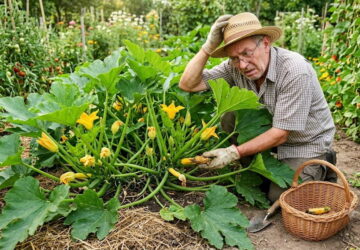
For gardeners, this is a useful distinction. Not every chewed leaf signals a crisis. A few grasshoppers, caterpillars or beetles are part of a living garden. But repeated feeding on seedlings, vegetables or young ornamentals needs attention, especially when plants are already drought-stressed.
The best defence is not panic spraying, but observation and balance. Encourage birds, ground beetles and other predators. Keep young plants vigorous with steady watering. Use fine mesh or row covers for vulnerable seedlings. In vegetable beds, remove weeds that shelter large numbers of pests close to crops, while still preserving flowering areas that support beneficial insects.
Wildlife Note – When Is Insect Damage a Problem?
A garden can tolerate some leaf damage without losing health or beauty. The key is to look at the whole plant.
If new growth continues, flowers open normally and fruit is developing, a few holes are usually acceptable. If young plants are being stripped, stems are weakened or growth has stopped, action is needed. Early morning is often the best time to inspect plants, because many insects are slower and easier to find before the day heats up.
This approach protects both the crop and the wider garden food web.
July 27, 1890 – Van Gogh’s Fields and the Art of Looking at Crops
On July 27, 1890, Vincent van Gogh suffered the gunshot wound that led to his death two days later in Auvers-sur-Oise. The date is tragic, but his final months were also filled with intense looking: wheat fields, gardens, tree roots, cottages, orchards and moving skies became some of the most memorable landscapes in modern art.
For a garden almanac, the strongest connection is not the drama of the biography, but the way Van Gogh saw ordinary cultivated land. Wheat was not just a crop in his paintings. It was weather, labour, colour, motion and season. A field could hold wind, ripeness, threat, abundance and human vulnerability all at once.
Gardeners understand this kind of attention. A vegetable bed in late July is never only productive or unproductive. It shows heat stress, pollination, soil moisture, pest pressure, seed maturity and the gardener’s timing. The visual clues are everywhere: curled leaves, pale new growth, sudden wilting, heavy seedheads, bees changing flowers as nectar sources shift.
Van Gogh’s fields invite us to look again at familiar plants. Ripening grasses, fading poppies, seed pods, dry stems and late-summer shadows are not signs that the garden is “over”. They are the next chapter of the season.
What to Observe Right Now – The Late July Garden
These days are especially good for noticing transitions.
- Which plants stay upright and fresh after a hot afternoon?
- Where does the soil crack, crust or stay evenly moist?
- Which flowers still attract bees, hoverflies and butterflies?
- Are birds visiting seedheads, berries or insects in the borders?
- Which vegetables recover overnight after wilting, and which do not?
Observation now helps next year’s planning. The best late-July plants in your garden are often the ones worth repeating, dividing, saving seed from or using more widely.
A Date About Attention, Not Just Anniversaries
July 27 gathers very different stories, but they all turn on the same skill: noticing what the living world is telling us. Jeanne Baret noticed plants closely enough to make knowledge travel. Dutch engineers and farmers learned that new land is only useful when water and soil are understood together. Midwestern grasshopper outbreaks showed how quickly ecological balance can turn into agricultural pressure. Van Gogh’s fields remind us that even a crop can be a landscape of feeling, weather and time.
For gardeners, this makes late July less of a pause and more of a reading lesson. The garden is full of evidence now. Some of it is beautiful, some inconvenient, some quietly urgent. The work is to notice before reacting.
Looking Ahead
The future of gardening will depend on this kind of practical attention: choosing plants that suit the place, building soil that can handle extremes, and making room for wildlife without giving up the harvest. July 27 reminds us that gardens are shaped by exploration, engineering, weather, insects, art and memory. A resilient garden is not a perfectly controlled one, but a well-observed one. If we learn to read the signs in late summer, we can plant more wisely, water more thoughtfully and create spaces that are productive, beautiful and alive.