
By November 23, many Northern Hemisphere gardens have entered their quietest season. Leaves lie beneath the hedges, the last flowers are fading, and the first serious frosts may already have arrived. Yet beneath this stillness, plants continue to respond to their surroundings in ways we rarely notice.
Today’s almanac travels from a laboratory in India to the date-palm groves of Egypt, before boarding a ship carrying thousands of Christmas trees across a stormy American lake. These are three very different stories, each revealing something unexpected about plants and our relationship with them.
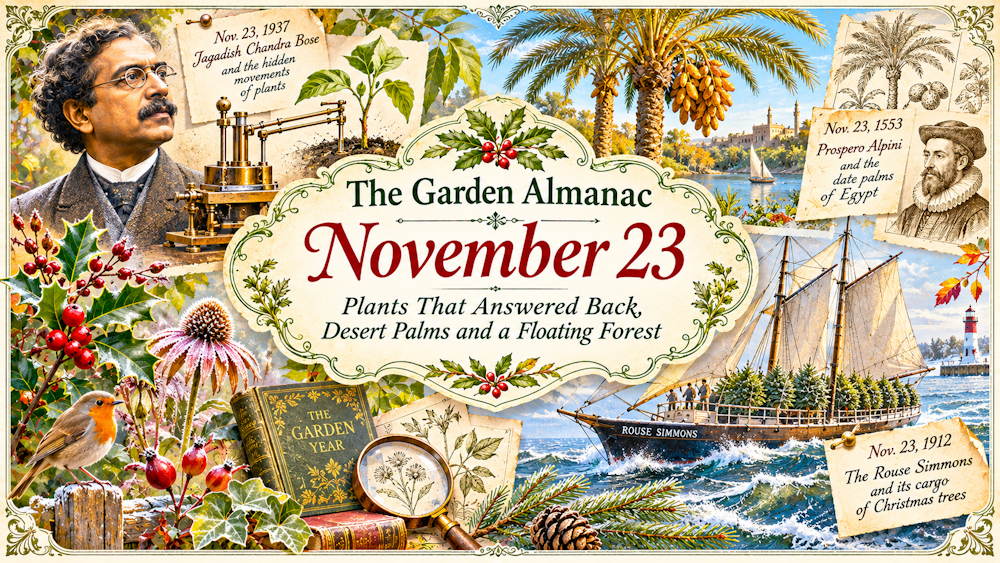
November 23, 1937 – The Scientist Who Made Plants Reveal Their Secret Movements
What if a plant could produce a record of its own growth, showing precisely how it responded to light, warmth or even the gentlest touch? Indian scientist Jagadish Chandra Bose, who died on November 23, 1937, devoted much of his career to making such invisible processes measurable. At a time when plant growth was generally studied through observations made over hours or days, Bose wanted to capture changes unfolding almost from moment to moment.
His remarkable invention, the crescograph, magnified tiny movements in growing plant tissues and recorded variations that were far too small for the human eye to detect. Some versions achieved magnifications of thousands of times. Using these instruments, Bose investigated how plants responded to changes in light, temperature and mechanical stimulation. A growing stem, seemingly motionless on a laboratory table, could suddenly reveal a changing rate of growth.
The significance went beyond ingenious equipment. Bose helped demonstrate that plants respond dynamically to their environment rather than simply growing at an unchanging pace. His experiments also encouraged comparisons between electrical responses in plant and animal tissues, although such similarities do not mean plants possess animal-like feelings or nervous systems. His work belonged to a developing field of plant physiology that would transform the scientific understanding of how living plants function.
For gardeners, this invisible activity is especially fascinating in late November. A houseplant leaning towards a window, a seedling growing differently under changing light, or a perennial responding to falling temperatures offers a small-scale demonstration of the same principle: plants constantly adjust their development to environmental conditions. Even when visible growth slows, roots, buds and living tissues may remain physiologically active.
Garden Science – Why Do Plants Grow Towards Light?
The familiar bending of a young shoot towards a window is called phototropism.
When light reaches a shoot mainly from one direction, the plant hormone auxin is redistributed, encouraging greater cell elongation on the shaded side. The shoot consequently curves towards the light.
This response helps growing plants position their leaves where they can receive more light for photosynthesis.
In late autumn, shorter days and lower light levels make window placement particularly important for houseplants. Move light-loving plants closer to a suitable bright window, while protecting them from cold glass and draughts.
November 23, 1553 – The Desert Palms That Helped Explain Plant Reproduction
Centuries before plant physiology became a modern science, a remarkable observation was waiting in the date-palm groves of Egypt.
Prospero Alpini, the Italian physician and botanist born on November 23, 1553, travelled to Egypt in the 1580s. There he studied unfamiliar plants and agricultural practices, eventually publishing his influential work De Plantis Aegypti in 1592. One observation was particularly important: Egyptian growers deliberately transferred pollen from male date palms to female palms to improve fruit production.
For local farmers, this was established agricultural knowledge. For European botanical scholarship, however, Alpini’s account provided valuable evidence that male and female reproductive functions could occur on separate plants. His observations helped advance understanding of plant sexuality long before the classification systems associated with Carl Linnaeus became established. The surprising part is that an important botanical insight emerged not from an elaborate laboratory experiment, but from observing what experienced growers already knew.
Date palms (Phoenix dactylifera) are dioecious: individual trees produce either male or female flowers. Only female trees bear dates, and successful fruit development depends on receiving compatible pollen. Commercial growers still use controlled pollination to secure reliable harvests. The same distinction matters when choosing garden plants such as holly, kiwi or certain sea buckthorns. A healthy plant may produce flowers but no fruit simply because it lacks a suitable pollination partner.
What to Observe Right Now – Which Plants Still Carry Fruit?
Late autumn is an excellent time to notice the results of pollination that took place months earlier.
- Holly: Female plants may carry red berries if suitable male plants provided pollen earlier in the year.
- Rosehips: Their colourful fruits develop after successful pollination of rose flowers.
- Crabapples: Small apples can remain on branches well into winter, adding colour and providing food for wildlife.
- Ivy: Mature ivy may still be flowering in mild weather, while its berries typically develop and ripen later.
Look closely at the relationship between flowers, fruit and the plants growing nearby. A garden’s winter appearance often tells the story of its previous growing season.
November 23, 1912 – The Floating Forest That Never Reached Chicago
Imagine a sailing ship so heavily loaded with evergreen trees that observers compared it to a floating forest.
On November 22, 1912, the three-masted schooner Rouse Simmons departed Thompson, Michigan, carrying an estimated 3,000–5,000 Christmas trees towards Chicago. Its captain, Herman Schuenemann, had spent years supplying trees to city families, earning the affectionate nickname “Captain Santa.” The following afternoon, November 23, the vessel was spotted on Lake Michigan displaying a distress signal. A violent storm prevented rescuers from reaching it, and the ship disappeared with everyone aboard.
The tragedy reveals a nearly forgotten chapter in the relationship between forests and cities. Before modern road transport transformed seasonal commerce, trees harvested in northern forests were shipped across the Great Lakes to meet urban demand. Schuenemann’s vessel was both a working cargo ship and a floating Christmas-tree market. Its loss became part of regional folklore, while the trade gradually shifted towards rail and road transport. The wreck itself was not discovered until 1971.
Today, Christmas trees are generally grown as agricultural crops on specialised plantations rather than cut from natural forests. Their environmental impact depends on how they are cultivated, transported and disposed of. Choosing a locally grown tree, keeping a cut tree supplied with water and recycling it into mulch after the holidays can make a familiar seasonal tradition more environmentally responsible. The story of the Rouse Simmons is a reminder that even a festive decoration has a surprisingly substantial history of land use, cultivation and transport.
Wildlife Note – Why Are Evergreens So Important in Winter?
When deciduous trees lose their leaves, dense conifers become valuable shelter for birds and other small animals.
- Evergreen branches provide cover from wind, rain and snow.
- Dense shrubs and hedges offer protected roosting places and hiding spots.
- Conifer cones and seeds provide food for some finches and other seed-eating birds.
- Mixed evergreen and deciduous planting creates a wider range of habitats than a garden dominated by one species.
Before pruning a dense evergreen hedge in winter, check carefully for roosting wildlife. Keeping some sheltered corners undisturbed can make a real difference during cold weather.
Garden Reminder – What Should Gardeners Do in Late November?
For gardens entering winter in temperate Northern Hemisphere regions, this is an excellent time for a few carefully chosen tasks.
- Protect vulnerable pots: Raise containers on pot feet or bricks to improve drainage, and insulate pots containing frost-sensitive roots when necessary.
- Mulch exposed soil: Apply approximately 5 cm of compost or suitable organic mulch around established plants, keeping it away from stems and crowns.
- Check drainage: Empty waterlogged saucers and make sure winter rain can escape freely from containers.
- Leave healthy seedheads standing: Echinacea, teasel and other seed-bearing plants may provide winter food for birds.
- Inspect stored bulbs and tubers: Remove any that are soft, mouldy or rotting before decay spreads.Protect tender plants: Move vulnerable container plants to a sheltered, appropriate frost-free location before hard freezes arrive.
Avoid the temptation to make every flower bed perfectly tidy. Healthy fallen leaves beneath shrubs provide insulation for the soil and overwintering habitat for insects and other small creatures. Remove diseased material where necessary, but allow some natural structure to remain.
Looking Ahead
As November moves towards winter, the garden offers fewer spectacular flowers but many opportunities for closer observation. Bose’s experiments invite us to notice the slow responses of living plants, while Alpini’s date palms reveal how much practical knowledge can emerge from careful attention to nature. The story of the Christmas Tree Ship adds another perspective, encouraging us to consider the landscapes and resources behind familiar traditions. Whether adjusting a houseplant’s light, protecting a patch of winter habitat or choosing a locally grown evergreen, small decisions can help us build gardens that are more resilient, thoughtful and welcoming to wildlife.