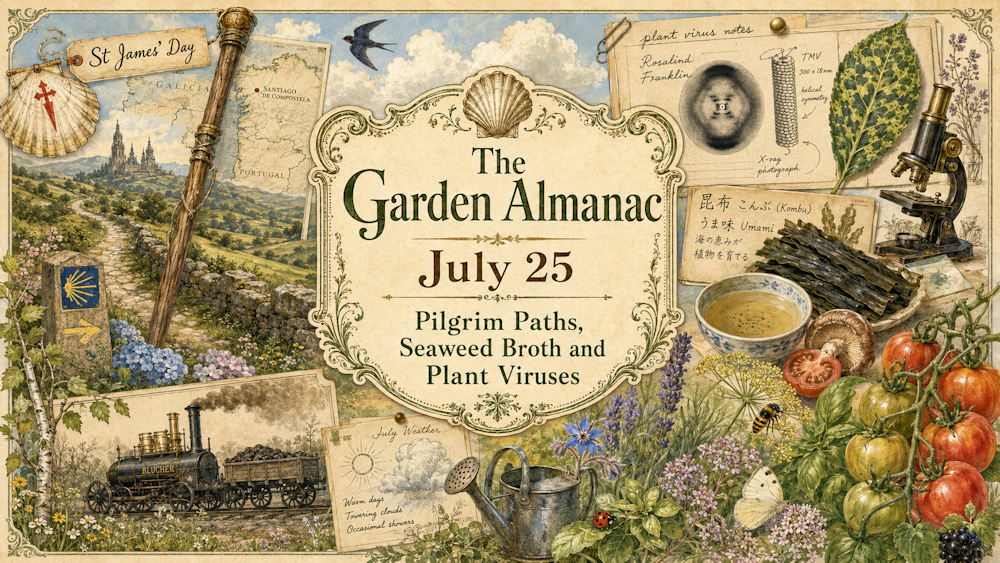

By July 25, summer has settled into its full voice. In northern gardens, borders are often generous but thirsty, tomatoes are swelling, herbs are running to flower, and the sky can change from blue stillness to towering cloud in less than an hour. It is a day that belongs to heat, movement and watchfulness.
The stories attached to July 25 travel widely: to the green routes of Galicia, to a London-born scientist who helped reveal the hidden architecture of life, to Japanese kombu broth and the discovery of umami, and even to an early steam locomotive moving coal through an English industrial landscape. At first, they seem far apart. Look again, and they all ask a gardener’s question: how do we live with the systems that feed us, move us, shade us and surround us?
July 25 – Saint James’ Day and the Landscapes of Pilgrimage
July 25 is Saint James’ Day, one of the great dates in the calendar of Santiago de Compostela and Galicia. For centuries, pilgrims have walked the Camino routes through fields, forests, villages, river valleys and upland tracks toward the cathedral city. The day is religious and cultural, but it is also deeply tied to landscape: a pilgrimage is never only a line on a map. It is a long, bodily conversation with weather, soil, water, trees and human settlement.
For gardeners, the Camino offers a useful way of looking at paths. A good path is not just a way to get from one place to another. It shapes what we notice. It decides where we slow down, where we pause, where shade matters, where water collects, and where plants survive the pressure of feet, carts, animals or bicycles.
The landscapes of pilgrimage also remind us that edges are often the richest parts of a place. Hedgerows, stone walls, ditch banks and track margins can support wildflowers, insects, birds and seed-dispersing animals. In a garden, the same principle applies on a smaller scale. The strip beside a path, the base of a wall, the edge of a vegetable bed or the margin between lawn and shrub planting can become a miniature wildlife corridor if it is managed with care.
Garden Reminder – Make Paths Work Harder
In late July, paths can reveal exactly how well a garden is functioning.
- If plants flop over paths, cut back selectively rather than clearing everything. Many flowering stems still feed pollinators.
- Where soil is compacted beside a path, add mulch and avoid repeated foot traffic after watering or rain.
- Let low-growing thyme, chamomile, clover or self-seeded annuals soften informal path edges where they will not create a slipping hazard.
- Watch where you naturally pause in shade. That may be the best place for a seat, water bowl, herb pot or small wildlife-friendly planting.
July 25, 1920 – Rosalind Franklin and the Hidden Geometry of Living Things
Rosalind Franklin was born on July 25, 1920. She is best known for her work on the structure of DNA, but her scientific story also reaches into the world of plants through her later research on viruses, especially tobacco mosaic virus. This plant virus had already become a crucial scientific model because it was relatively simple, stable and connected to visible disease in crops.
Tobacco mosaic virus causes mottling and distortion in leaves of tobacco and related plants, and it helped scientists understand that disease could be carried by agents smaller than bacteria. Franklin’s X-ray crystallography brought extraordinary precision to the study of viral structure. For gardeners, this is a reminder that plant health is not always visible at first glance. A yellowing leaf may be telling a story about water, nutrients, heat, insects, fungi or viruses – and the correct response depends on careful observation.
Late July is a particularly important time to watch for plant stress. Heat, irregular watering and dense growth can weaken plants and make problems harder to interpret. Tomatoes, peppers, cucumbers, beans and ornamentals may show leaf spotting, curling, mottling or stunted growth. Not every mark is a disaster, but patterns matter.
Garden Science – Why Do Plant Viruses Spread So Easily?
Plant viruses often move through sap. That means they can be spread by insects such as aphids and whiteflies, by contaminated tools, by handling infected plants and sometimes by seed or plant material.
A practical rule follows from this: hygiene matters most when plants are actively growing and being pruned, tied, pinched out or harvested. Clean cutting tools, remove seriously infected plants rather than composting them, wash hands after handling suspect foliage, and control sap-feeding insects early. In vegetable gardens, giving plants good spacing and steady watering will not “cure” a virus, but it can reduce stress and make other problems less likely to pile on.
July 25, 1908 – Kombu, Umami and the Taste of the Sea Garden
On July 25, 1908, Kikunae Ikeda’s patent connected modern food chemistry with an ancient ingredient: kombu, the kelp used in Japanese dashi. By identifying glutamate as the source of the broth’s deep savory taste, Ikeda helped give a scientific name to umami. For a garden almanac, this is more than a culinary footnote. It opens a door into seaweeds, minerals, flavor, fermentation and the way plants and algae shape human food culture.
Kombu is not a garden vegetable, but its story belongs beside tomatoes, peas, beans, mushrooms and aged cheeses – all foods in which savory depth matters. Gardeners know this instinctively. A sun-ripened tomato has a fullness that a pale, hurried fruit does not. Soil, variety, ripeness, watering and harvest timing all influence flavor. Taste is not decoration added at the end of growing; it is the result of plant chemistry.
Seaweed has also long been used in coastal agriculture and gardening as a soil amendment, mulch or liquid feed. It can contribute trace elements and organic matter, though it should be used thoughtfully. Fresh seaweed may contain salt and should usually be rinsed or composted before use. Commercial seaweed extracts are often used as biostimulants, but they are not a substitute for compost, balanced nutrition or good soil structure.
Seasonal Tips – Growing for Better Flavor
Late July is a good time to think about flavor, not just yield.
- Pick tomatoes when fully colored and slightly fragrant, unless heavy rain is expected and splitting is likely.
- Harvest herbs in the morning after dew has dried but before strong heat drives off too much aroma.
- Keep basil, mint and parsley productive by cutting stems back to a leaf pair rather than removing single leaves at random.
- Water fruiting vegetables deeply and consistently. Irregular watering can reduce quality and increase cracking, bitterness or blossom-end problems.
July 25, 1814 – Blücher, Coal and the Garden After Industry
On July 25, 1814, George Stephenson’s early steam locomotive Blücher was put to work at Killingworth Colliery in northern England. It hauled coal slowly by modern standards, but it belonged to a transformation that would reshape landscapes across the world. Railways changed how food, timber, coal, livestock, plants and people moved. They also brought smoke, extraction, embankments, cuttings, disturbed soils and new corridors through countryside and cities.
What does this have to do with gardens? Quite a lot. Modern gardening is full of inherited industrial landscapes: former rail lines turned into greenways, old quarries restored as habitats, urban soils altered by ash and rubble, canals and sidings softened by buddleia, birch, grasses and wildflowers. Nature is not untouched in these places, but it is often persistent.
The lesson is not to romanticize pollution or extraction. It is to understand recovery. Disturbed ground can become valuable habitat when it is not sealed under concrete or tidied into lifelessness. Many wild bees like bare, sunny soil. Pioneer plants stabilize poor ground. Grasses and deep-rooted perennials begin rebuilding structure. In urban gardens, this means we should test suspect soils, grow food safely in raised beds where needed, and still recognize that post-industrial spaces can be made biologically generous.
Nature Watch – Tall Clouds and Summer Signals
Old weather lore for July 25 says that tall, puffy clouds on this day foretell a snowy winter. As forecasting, that belongs more to folklore than science, but the observation itself is valuable. Towering cumulus clouds often reveal warm, rising air and atmospheric instability – exactly the kind of sky gardeners learn to respect in high summer.
If clouds build rapidly in the afternoon, it may be wise to finish staking tomatoes, secure lightweight pots, pause overhead watering and check that gutters, drains and water butts can handle a sudden downpour. In summer, the sky is part of the garden’s practical equipment. Learning to read it can save seedlings, blossoms and soil.
Wildlife Note – What Are Pollinators Doing in Late July?
By late July, many pollinators are working long days. Bees visit herbs, clover, lavender, marjoram, borage, sunflowers and open-centered annuals. Butterflies often seek nectar in warm, sheltered spots, while hoverflies may appear around umbellifers such as dill, fennel and coriander flowers.
The best help is simple: keep something blooming, avoid spraying during active foraging, provide shallow water with landing stones, and leave a few seed heads and hollow stems later in the season. A garden does not need to be wild everywhere to support wildlife. It needs continuity – food, shelter and fewer sudden interruptions.
What to Observe Right Now
Late July rewards gardeners who look closely rather than hurry through chores.
- Which plants wilt in afternoon heat but recover by evening? They may be coping, not failing.
- Are bees choosing certain flowers again and again? Those are your garden’s current nectar anchors.
- Do tomatoes split after rain? Mulch and steadier watering may help reduce the cycle.
- Are birds visiting seed heads, berrying shrubs or damp soil? Their routes show where the garden is already alive.
- Where does shade fall at the hottest hour? That map is useful for future planting.
Looking Ahead
July 25 brings together pilgrimage, plant science, food chemistry, industry and weather watching, but its message is surprisingly practical. Gardens are living systems, shaped by movement, microbes, flavor, disturbance, climate and care. The more carefully we observe those systems, the better our decisions become – where to plant, when to water, what to leave standing, and when to intervene. A future-friendly garden is not one that freezes nature in place, but one that learns from it, season after season.