
Early July is a season of abundance. Roses are still blooming, vegetables are swelling on the vine, pollinators move tirelessly from flower to flower, and gardens seem to change almost overnight. It is also a time when people across many countries gather outdoors – not only to celebrate, but to appreciate the landscapes that shape their communities.
July 4 is widely recognised for one historic event, yet the date tells a much broader story. It speaks of independence, engineering, renewable energy, and the ways people have learned to work with – rather than simply against – the forces of nature. Whether through rivers, sunlight, steam rising from deep underground, or carefully cultivated gardens, this day reminds us that lasting progress often begins with understanding the natural world.
For gardeners, that message feels especially timely. Every healthy garden is built on observation, patience and respect for living systems – qualities that have quietly influenced some of history’s greatest achievements.
A Declaration That Changed More Than Politics
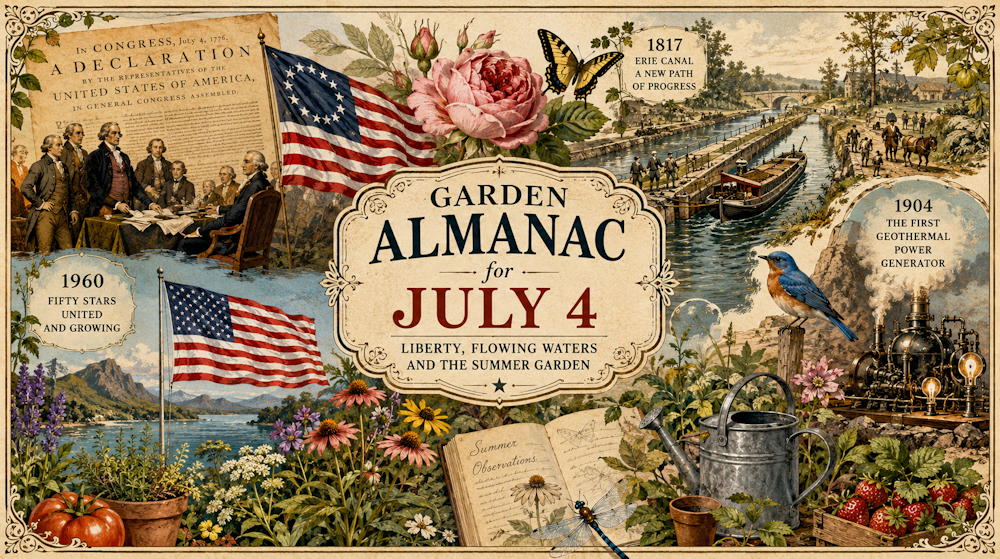
On July 4, 1776, the Declaration of Independence was formally adopted, creating what would become the United States. While remembered primarily as a political milestone, its timing also reflected the rhythms of the agricultural calendar. Early July allowed delegates and farmers alike to travel more easily, with roads dry, crops established, and the busiest spring work already completed.
The ideals expressed in the Declaration would eventually influence conservation movements, public parks, land stewardship and scientific exploration. Although these developments came much later, they grew from a society increasingly interested in managing its landscapes as carefully as its institutions.
Today, many Fourth of July celebrations take place in parks, gardens and natural spaces – a reminder that freedom is often experienced outdoors, surrounded by trees, rivers and open skies.
Garden Inspiration
If you’re celebrating outdoors today, take a few moments before the festivities begin to simply observe your garden. Watch which flowers attract the most bees, notice where butterflies pause, or enjoy the changing light across your borders. These small observations often inspire better gardening decisions than any manual.
The Erie Canal – When Water Became a Gardener’s Ally
Ground was broken for the Erie Canal on July 4, 1817, launching one of the greatest engineering projects of its age. Completed eight years later, the canal transformed trade across North America, linking farms, forests and growing towns through an inland waterway.
Its influence reached far beyond commerce. Better transport meant that seeds, fruit trees, ornamental plants and new crop varieties could travel faster and farther than ever before. Nurseries expanded, regional horticultural knowledge spread, and gardeners gained access to plants that had once been difficult to obtain.
Water has always been the gardener’s greatest partner. Canals, irrigation systems and reservoirs demonstrate how thoughtful management of water can enrich entire landscapes rather than simply control them.
Seasonal Tip
Early July often brings extended dry spells. Water deeply but less frequently to encourage roots to grow downward, and replenish organic mulch around vegetables and shrubs to reduce evaporation.
Four Light Bulbs That Started a Renewable Revolution
On July 4, 1904, at Larderello in Italy, engineer Piero Ginori Conti successfully demonstrated the world’s first geothermal power generator. The experiment famously produced enough electricity to illuminate four light bulbs – a modest beginning for an energy source now used around the world.
For gardeners, geothermal energy highlights an important truth: nature often provides solutions that are both elegant and sustainable. Today’s greenhouses increasingly rely on renewable heating systems, while compost piles, rainwater harvesting and solar-powered irrigation all follow the same principle – working with natural processes rather than exhausting them.
Every thriving garden is, in its own way, a miniature renewable ecosystem, recycling nutrients, storing carbon and supporting countless forms of life.
Nature Watch
Notice how warm the soil feels beneath a layer of mulch compared with bare ground. Even simple temperature differences can influence earthworm activity, moisture retention and root growth throughout the summer.
The Flag That Grew With a Nation
On July 4, 1960, the 50-star flag of the United States was officially flown for the first time following Hawaii’s admission as the fiftieth state the previous year.
While primarily a national symbol, the story also reflects something familiar to every gardener: healthy systems continue to grow. A garden is never truly finished. New plants are introduced, old favourites make way for fresh ideas, wildlife populations change, and every season adds another chapter.
Rather than aiming for perfection, successful gardeners learn to welcome thoughtful evolution.
Garden Reminder
July is one of the busiest months for pollinators.
Today is a good opportunity to:
- refill shallow water dishes for bees and butterflies,
- avoid spraying insecticides while flowers are in bloom,
- deadhead spent flowers to encourage continued flowering,
- harvest vegetables regularly to keep crops productive,
- leave a few herbs such as dill, fennel or coriander flowering for beneficial insects.
Small actions taken now can support wildlife for the rest of the growing season.
The Quiet Magic of Early July
There is another reason July 4 feels special in many gardens: midsummer has settled into a comfortable rhythm. The frantic burst of spring growth has eased, yet the richness of late summer harvests still lies ahead.
This is when tomatoes begin colouring, berries ripen, lavender perfumes the air, and evenings stretch long enough for unhurried walks through the garden. Dragonflies patrol ponds, swallows skim low across meadows, and the chorus of insects grows louder as dusk approaches.
The garden asks less for urgency now and more for attention – watering wisely, harvesting regularly and simply noticing how each week reshapes the landscape.
Looking Ahead
The stories connected with July 4 remind us that progress rarely comes from a single dramatic moment. Whether it is a declaration that reshapes history, a canal that carries new plants across a continent, or a small geothermal experiment that points toward cleaner energy, meaningful change often begins with careful observation and practical action.
Gardens teach the same lesson every season. Healthy soils, reliable water, biodiversity and patient stewardship create resilience that lasts far beyond one summer. As July unfolds, each thoughtful decision – planting for pollinators, conserving water or simply spending more time observing nature – becomes part of a much larger story, one that continues to grow with every passing season.