

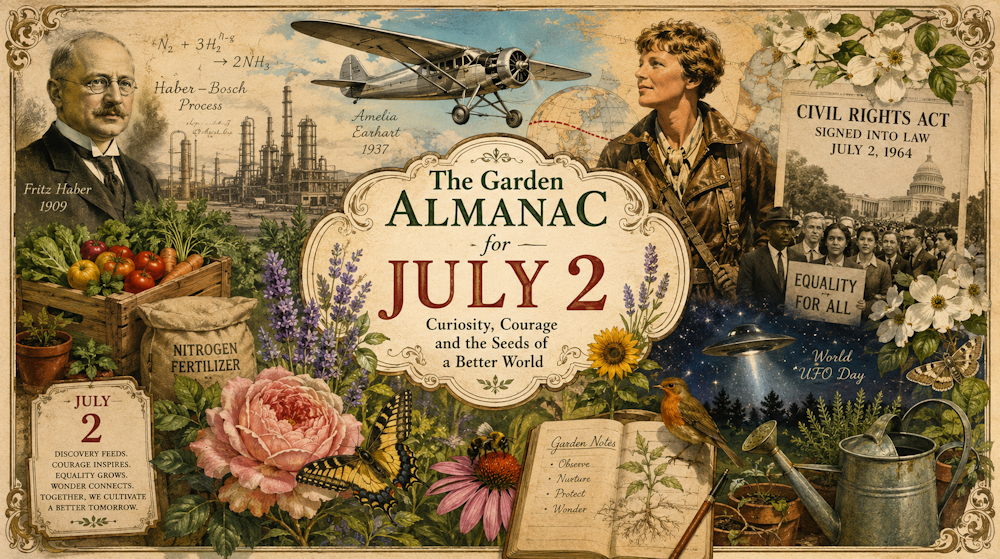

There is something quietly remarkable about the second day of July. By now, summer has settled into the garden with confidence. Roses are entering their second flush, vegetables are swelling in the warmth, pollinators are busy from sunrise until dusk, and every morning reveals something new that seemed impossible only a week before.
It is also a date that reminds us how curiosity has shaped both gardens and civilisation. July 2 brings together stories of scientific breakthroughs, bold exploration, social progress and our endless desire to understand the world around us. Whether we are studying the soil beneath our feet or looking up at the stars, the same instinct drives us – to ask questions, to learn and to leave the world a little better than we found it.
Feeding the World – The Discovery That Changed Agriculture
One of the most important agricultural milestones associated with July 2 took place in 1909, when German chemist Fritz Haber successfully demonstrated the chemical process for producing ammonia directly from atmospheric nitrogen. Carl Bosch later transformed the laboratory discovery into an industrial process, creating what we now know as the Haber–Bosch process.
The significance of this achievement is difficult to overstate. Nitrogen is essential for plant growth, yet most plants cannot use the abundant nitrogen floating in the air around us. The Haber–Bosch process made large-scale nitrogen fertiliser possible, dramatically increasing crop yields across the globe.
Modern gardeners understand both sides of this story. Fertilisers have helped feed billions of people, but excessive use has also contributed to water pollution, biodiversity loss and greenhouse gas emissions. Today’s best gardening practices focus on balance – enriching soil with compost, encouraging healthy microorganisms and applying nutrients only where they are truly needed.
Garden Inspiration
Healthy soil is still the greatest fertiliser. Before reaching for extra nutrients, improve soil structure with compost, mulch and organic matter. Plants growing in living, healthy soil often need far less additional feeding.
Amelia Earhart – A Journey That Still Inspires Exploration
On July 2, 1937, pioneering aviator Amelia Earhart disappeared over the Pacific Ocean while attempting to become the first person to fly around the world close to the equator. Her fate remains one of aviation’s greatest mysteries.
Although her final flight ended tragically, Earhart became a lasting symbol of courage, determination and curiosity. She challenged expectations, embraced uncertainty and inspired generations to venture beyond familiar horizons.
Gardeners know this feeling well.
Every season involves small acts of exploration. We experiment with unfamiliar plants, test new growing methods, observe insects we’ve never noticed before or discover that a forgotten corner of the garden has become a refuge for wildlife.
Nature rewards those willing to observe carefully and keep learning.
Nature Watch
Take ten quiet minutes in your garden today.
Instead of working, simply watch.
You may notice a bee visiting the same flowers in sequence, a spider rebuilding its web after rain, or butterflies choosing only certain blooms. Observation is one of the most valuable gardening skills.
A Law That Helped Open More Gardens to Everyone
On July 2, 1964, the Civil Rights Act was signed into law in the United States, becoming one of the most significant milestones in modern civil rights history. While primarily remembered for ending legal segregation and strengthening equal rights, its wider legacy also touches parks, public gardens and access to shared green spaces.
Across the world, community gardens have long shown how nature can bring together people from different backgrounds, cultures and generations. A vegetable patch rarely asks where someone comes from. A flowering border welcomes every visitor equally.
Many of today’s most successful urban gardens are built on exactly this principle – creating places where people grow food, share knowledge and strengthen neighbourhoods together.
In an increasingly urban world, accessible green spaces are not merely attractive amenities. They improve health, support biodiversity and create stronger communities.
Garden Reminder
If your neighbourhood has a community garden, consider visiting or volunteering this summer.
Even a few hours spent helping with planting, watering or harvesting can create new friendships while supporting local biodiversity.
Looking Up – World UFO Day and the Value of Wonder
July 2 is also widely observed as World UFO Day, inspired by the famous Roswell incident of 1947. Whether viewed as popular culture, scientific curiosity or simply a celebration of imagination, the day encourages people to look up at the night sky and ask questions about the unknown.
Gardeners have always been sky-watchers.
Long before weather apps existed, people learned to read clouds, winds, stars and moonlight. Planting, harvesting and predicting rainfall often depended on careful observation of the heavens.
Even today, many of our best gardening decisions begin by simply paying attention – noticing changing weather patterns, the movement of pollinators or the first appearance of migrating birds.
Wonder is one of nature’s greatest gifts. Whether we are watching constellations or fireflies, curiosity keeps us connected to the living world.
Seasonal Tip
If the evening is warm and clear, spend a little time outdoors after sunset.
Listen for bats hunting insects overhead, watch moths visiting fragrant flowers, and enjoy the cooler air that many nocturnal pollinators prefer. A garden changes character completely after dark.
What to Observe Right Now
Early July offers countless signs that summer has reached full strength:
- Tomatoes begin shifting from green to their first blush of colour.
- Lavender attracts bees, hoverflies and butterflies throughout the day.
- Young birds are becoming independent and can often be seen learning to forage.
- Compost heaps become especially active during warm weather and may need additional moisture.
- Newly planted shrubs benefit from deep watering rather than frequent light sprinkling.
Small daily observations now often prevent larger gardening problems later in the season.
Looking Ahead
July 2 reminds us that progress rarely comes from standing still. A scientific discovery can transform agriculture. A courageous explorer can inspire generations. A commitment to fairness can make green spaces more welcoming for everyone. Even a simple habit of looking more closely at the garden can reveal wonders we might otherwise overlook.
As summer unfolds, let curiosity guide your gardening just as much as experience. Healthy soil, careful observation and an open mind remain among the most valuable tools any gardener can cultivate. After all, every thriving garden begins with someone willing to ask a simple question: What might grow here next?