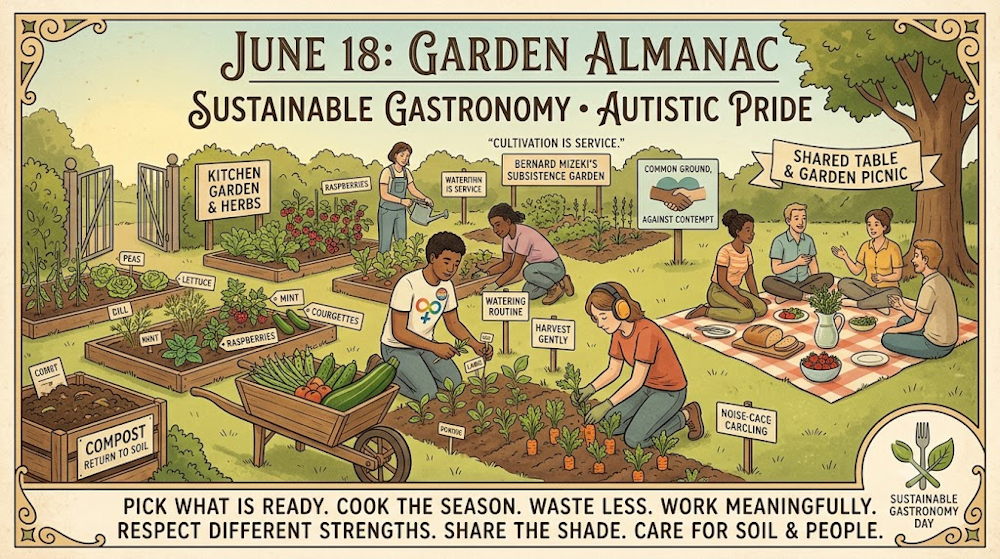

June 18 brings food, dignity, meaningful work, shared tables and garden rhythms into the Garden Almanac.
It is Sustainable Gastronomy Day, a reminder that food is not only nourishment, but culture, season, biodiversity, local knowledge and responsibility. It is also Autistic Pride Day, distinct from World Autism Awareness Day on April 2. This day emphasizes autistic identity, dignity, acceptance and autistic-led voice.
Placed together in a garden almanac, these observances tell a powerful story: a garden can feed the table, reduce waste, teach seasonal cooking, and also become a place where different strengths are recognized through meaningful work.
Sustainable Gastronomy Begins in the Soil
Sustainable gastronomy may sound like a modern phrase, but its roots are old.
Eat what is in season.
Use what the garden gives.
Waste less.
Respect local ingredients.
Preserve surplus.
Return organic matter to the soil.
Understand that food carries culture.
These are not fashionable ideas only. They are the old logic of kitchen gardens, household economies and seasonal cooking.
A garden does not produce abstract ingredients. It produces moments: peas at their sweetest, herbs at their brightest, lettuce before it bolts, cucumbers before they become too large, berries before they spoil, courgettes before they turn into household furniture.
Sustainable cooking begins by noticing the right moment.
The June Garden Basket
Around June 18, many kitchen gardens begin to fill the basket more regularly.
There may be peas, lettuce, spring onions, dill, parsley, mint, lemon balm, basil, coriander, early cucumbers, courgettes, chard, young potatoes, the last strawberries or the first raspberries. Each garden is different, but the question is the same:
What is ready now?
This is one of the most useful questions a gardener-cook can ask. Instead of forcing a recipe onto the garden, we can let the garden lead.
A handful of herbs becomes butter, sauce or tea.
A few peas become soup.
Cucumbers become salad or pickles.
Overgrown courgettes become fritters, soup or grated base for another meal.
Soft fruit becomes compote, jam or cake before it becomes waste.
Freshness is not only flavor. It is timing.
Waste Less, Return More
The sustainable garden kitchen does not end at the table.
Pea pods, vegetable trimmings, herb stems, healthy plant waste and clean kitchen scraps can return to compost. Compost returns to soil. Soil grows the next meal. What is not eaten may still feed the living system.
This does not make waste disappear magically. It asks us to sort, think and act with care. Diseased material, cooked scraps, oils and unsuitable waste do not belong everywhere. But the principle matters: the garden is a cycle, not a one-way street.
A sustainable meal has a memory of soil behind it and a path back to soil after it.
Autistic Pride and the Garden
June 18 is Autistic Pride Day. Its emphasis is not pity, cure or outside interpretation, but pride, dignity, acceptance, self-advocacy and the recognition that autistic people are part of human diversity.
Gardens can matter here in a very practical way.
Horticulture can offer structured tasks, visible results, predictable routines, sensory-aware environments, plant knowledge, independence, skill-building and meaningful work. Sowing, watering, labeling, transplanting, sorting, harvesting, pruning, composting, seed saving and plant care can all be organized clearly and respectfully.
The point is not to romanticize gardening as a universal solution. Not every autistic person wants to garden, and not every garden is automatically accessible. The point is that with proper support, clear expectations, respectful communication and sensory awareness, horticulture can become a real opportunity.
A good inclusive garden does not ask every worker to be the same. It notices strengths.
Careful observation.
Pattern recognition.
Deep plant interest.
Precise routines.
Patience with repeated tasks.
Attention to small changes.
Satisfaction in visible results.
These are garden strengths.
Work, Dignity, and Real Roles
Meaningful work is different from being kept busy.
An inclusive garden or horticultural workplace should not offer tasks out of pity. It should offer real roles, fair expectations, clear communication and respect. It should recognize skill, pay attention to sensory load, avoid unnecessary chaos, and make the work understandable.
This matters far beyond autism. Many people do better when tasks are clear, environments are calmer, instructions are concrete and the purpose of work is visible.
The garden can be a place of dignity when it values contribution rather than forcing everyone into one model of usefulness.
A person sorting seeds carefully is contributing.
A person noticing plant stress early is contributing.
A person keeping a watering routine precise is contributing.
A person harvesting gently is contributing.
A person who works best in quiet is still working.
The garden has room for more than one kind of mind.
Garden Picnics and Shared Tables
June 18 is also marked in some modern calendars as International Picnic Day. It is a lighter observance, but it fits the day beautifully.
A picnic does not need to be elaborate. Bread, herbs, cucumbers, fruit, a salad, a jar of tea, a shaded place and enough time can become a feast. Eating outdoors reconnects the meal to its place. The food does not feel anonymous. It belongs to soil, weather, hands and season.
A shared table will not solve every conflict, but it can resist the habit of turning others into strangers.
Food can become welcome.
A garden can become hospitality.
A meal can become a way of saying: there is room here.
Bernard Mizeki and the Subsistence Garden
On June 18, Anglican and Episcopal calendars remember Bernard Mizeki, catechist and martyr in Africa. His remembered life included teaching, translation, language learning, friendship with local people, faithfulness in danger — and the tending of a subsistence garden.
That detail belongs in the Garden Almanac.
A subsistence garden is not ornamental. It is rooted service. It is food, survival, household care and relationship to place. It shows that gardens often stand quietly beside human stories of courage, learning, faith, migration, labor and community.
A garden may not be the headline of a life, but it can be one of its foundations.
Countering Hate With Common Ground
June 18 is also connected with the International Day for Countering Hate Speech. In a garden almanac, this can be held gently rather than loudly.
Gardens do not automatically make people kinder. But they can create common ground: shared work, shared food, shared shade, shared responsibility, shared waiting.
To grow food with others is to practice a small form of trust. Someone waters. Someone weeds. Someone harvests. Someone cooks. Someone eats. Someone saves seed.
The language of the garden can resist the language of contempt because it asks us to notice dependence.
None of us grows alone.
What June 18 Teaches
June 18 teaches that sustainability is not only environmental. It is also cultural, practical and human.
Sustainable gastronomy asks us to respect food, season, soil, water and waste.
Autistic Pride Day asks us to respect different minds, dignity, voice and meaningful work.
Garden picnics remind us that food is also relationship.
Bernard Mizeki’s remembered garden reminds us that cultivation can be part of service and survival.
Countering hate begins, in part, by refusing to make other people disposable.
In the Garden Almanac on this day, the garden becomes a table, a workplace, a compost cycle, a place of pride, and a lesson in belonging.
Pick what is ready.
Cook what the season gives.
Waste less.
Make work meaningful.
Leave room for different strengths.
Share the shade.
A garden is sustainable only when it cares for soil and people together.