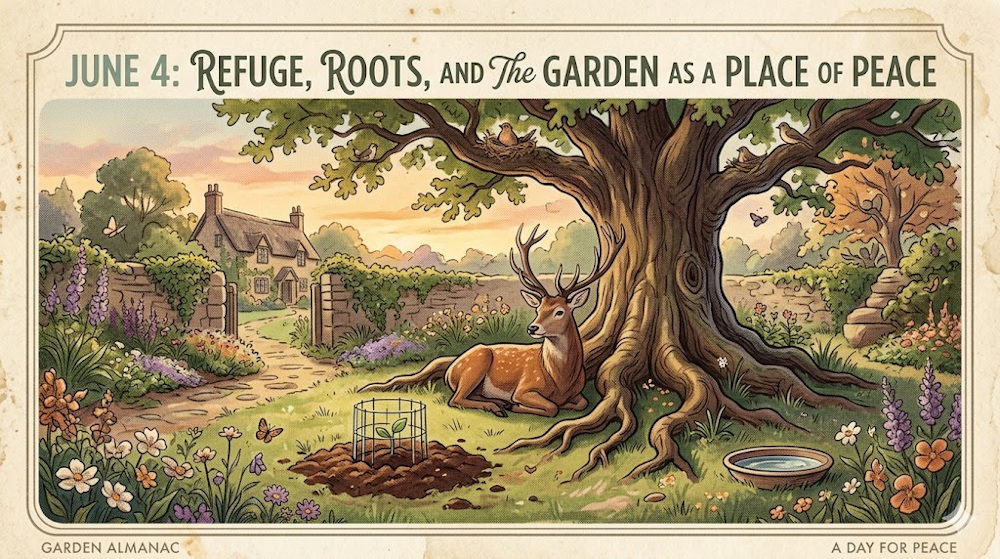

June 4 brings a quiet and serious mood to the Garden Almanac. It is a day for thinking about refuge, children, roots, peace and the living spaces where safety becomes possible.
The international calendar marks June 4 as the International Day of Innocent Children Victims of Aggression. It is a painful observance, but an important one. It asks the world to recognize the suffering of children harmed by violence, conflict and cruelty, and to remember that childhood needs protection before it can grow.
A garden cannot solve such wounds. But it can offer a language for understanding what safety means.
A seedling needs shelter. A child needs safety. A young tree needs time. A frightened animal needs somewhere it will not be chased.
The Garden as Refuge
A garden is often described as a place of beauty, productivity or rest. But it can also be a refuge. For people, it may be a place to breathe, grieve, recover or feel grounded. For wildlife, it may be water, shade, shelter, food or a safe passage through a harsher landscape.
A refuge does not have to be grand. It can be a hedge left uncut during nesting season. A shallow bowl of water in dry weather. A tree kept standing. A patch of longer grass. A flowering border for insects. A quiet corner where life is not constantly disturbed.
The garden teaches that safety is often made from small acts repeated with care.
Saint Petroc and the Deer
June 4 is also associated with Saint Petroc of Cornwall. One of the loveliest legends connected with him tells of a hunted deer that sought refuge near him. Petroc protected the animal from the hunters and gave it safety.
Whether read as history, legend or symbol, the story is powerful. It turns the saint into a guardian of the vulnerable. It places mercy above possession. It reminds us that the living world is not made only for human use.
In the Garden Almanac, Petroc’s deer becomes a beautiful image for the wildlife-friendly garden: a place where a creature in need can pause without being driven away.
Children, Seedlings, and the Need for Safety
The International Day of Innocent Children Victims of Aggression brings the theme of refuge into human terms. Children cannot thrive in fear. Like young plants exposed to constant damage, they need protection, stability and care before they can become strong.
The comparison is simple, but not shallow.
A seedling bent by wind may recover if sheltered in time. A young tree needs support before its roots are deep. A garden bed must be protected from trampling if seeds are to rise.
Human lives are infinitely more complex, yet the principle remains: growth requires safety.
This is one reason gardens can matter so deeply after difficult times. They create routines of care. They invite hands back to soil. They offer signs of continuity: roots, seasons, regrowth, flowering, fruit.
Roots and Belonging
Roots are one of the garden’s strongest images of belonging. They are mostly hidden, yet everything visible depends on them. A plant may flower far above the soil, but its real holding is below.
People also need roots: language, memory, family, place, community, stories, food, songs, rituals, names for plants and seasons. These roots may be interrupted, damaged or transplanted, but they remain part of how people understand home.
The garden is a place where roots can be seen indirectly. In the health of a plant. In the persistence of a tree. In the return of a perennial. In a cutting shared from one household to another.
Belonging often grows quietly.
A Garden of Peace Is Not Empty
Peace in a garden does not mean nothing happens. Quite the opposite. A peaceful garden is full of life: birds nesting, insects feeding, fungi working, roots exploring, leaves opening, water moving, seeds germinating.
Peace is not emptiness. It is relationship without constant destruction.
That is a useful thought for June 4. The garden becomes peaceful not because everything is controlled, but because enough space is allowed for different forms of life to continue.
A hedge shelters birds. Flowers feed pollinators. Soil organisms work unseen. A deer in a legend is spared. A child is protected. A tree is allowed to root deeply.
These are all different scales of the same moral imagination.
What June 4 Teaches
June 4 teaches that refuge is one of the oldest needs of living things.
A child needs it.
A hunted animal needs it.
A seedling needs it.
A community needs it.
A garden can help us understand it.
In the Garden Almanac on this day, Saint Petroc’s deer stands beside the wider human call to protect children from harm. Both ask us to notice vulnerability and respond not with possession, but with care.
The garden cannot mend the whole world. But it can train the heart in the right direction: toward shelter, patience, gentleness and room for life to grow.