

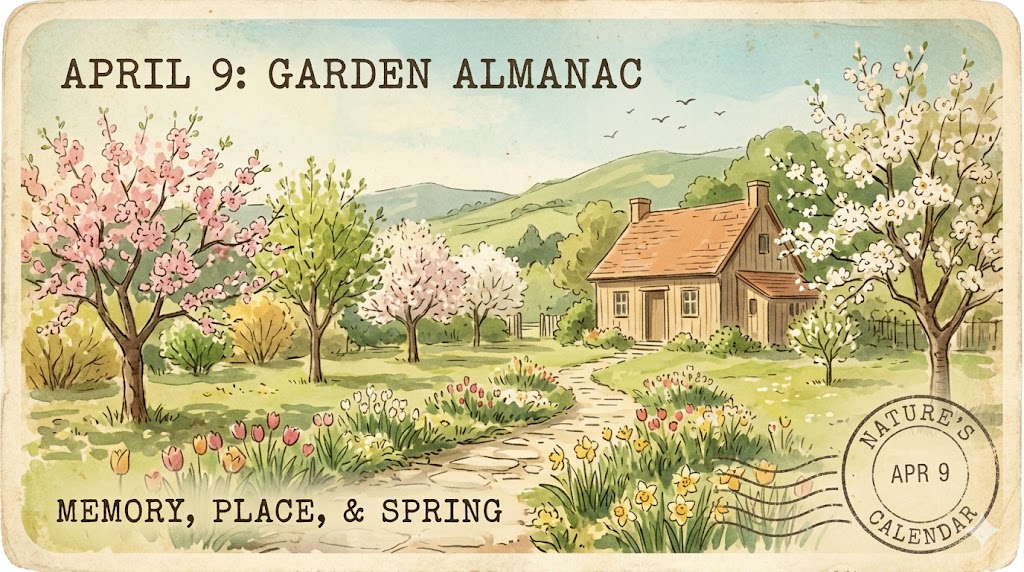

A Date That Holds More Than It First Reveals. April 9 is one of those spring dates that seems modest at first, yet opens into several powerful directions at once. It carries the memory of war ending, a landscape being named, a defining public performance, and the birth of a man who helped preserve an entire people’s poetic inheritance. It is an almanac day with unusual depth.
In seasonal terms, this fits early April beautifully. Spring is no longer only a promise. It is becoming structured, visible, and legible. The world is not merely waking up; it is beginning to declare what kind of year it intends to become.
Elias Lönnrot and the Saving of Oral Worlds
Elias Lönnrot was born on April 9, 1802. He was a Finnish physician, botanist, folklorist, and philologist who compiled the Kalevala, the Finnish national epic, from oral poetry, short ballads, lyric songs, and incantatory tradition. In doing so, he did far more than edit texts. He gathered a dispersed cultural memory and gave it durable form.
This makes him especially resonant for an almanac. Gardening, too, depends on the preservation of scattered knowledge: remembered weather patterns, inherited methods, unwritten warnings, the old timing of sowing and thinning, the practical wisdom that rarely begins in books. A garden often survives because someone remembered what to notice.
Lönnrot’s birthday therefore belongs naturally to a day concerned with memory, continuity, and the value of what communities keep alive by repeating.
La Salle, Louisiana, and the Power of Naming a Place
On April 9, 1682, René-Robert Cavelier, sieur de La Salle, claimed the Mississippi basin for France and named it Louisiana. The event belongs to the history of exploration and empire, but it also raises a more universal almanac theme: the act of naming a landscape.
To name a place is to begin a relationship with it, whether that relationship becomes stewardship, possession, misunderstanding, intimacy, or all four at once. Gardeners know this instinctively. No plot remains anonymous for long. We call areas by habit, light, function, memory, and affection: the warm border, the shaded strip, the apple corner, the old bed behind the shed.
April 9 is therefore a good day to think about how land becomes meaningful, and how naming is one of the first human ways of making a place legible.
Marian Anderson and the Strength of a Public Voice
On April 9, 1939, Marian Anderson gave her historic concert on the steps of the Lincoln Memorial after she had been barred from performing elsewhere because of racial discrimination. The event became one of the defining public moments in the long struggle for civil rights in the United States.
For an almanac, this matters because it shows how a single human voice can reshape the meaning of a public space. A garden teaches a related lesson in quieter form: presence matters, clarity matters, and what is true does not need noise to endure. One strong blossom can change a border; one clear act can change the historical atmosphere around it.
This gives April 9 a quality of moral springtime as well as seasonal springtime. It is a day about emergence with dignity.
Appomattox and the Meaning of Ending Well
On April 9, 1865, Confederate General Robert E. Lee surrendered to Union General Ulysses S. Grant at Appomattox Court House, effectively ending the American Civil War. The date is remembered not for triumph alone, but for finality — for the moment when continuation gave way to conclusion.
This is deeply relevant to the logic of the garden. Growth is only one part of wise cultivation. Equally important are pruning, clearing, finishing, withdrawing, and knowing when a cycle must end in order for a better one to begin. Every healthy garden contains endings as well as beginnings.
That is why Appomattox belongs surprisingly well in a Garden Almanac. It reminds us that closure is not the opposite of life. Sometimes it is the condition that makes renewed life possible.
What To Notice In The Garden Today
April 9 is a particularly good day for reading the garden with both memory and judgment.
- Which plant is most clearly announcing the season?
- Where is vigorous growth already visible, and where is patience still required?
- What should be restrained now so that it becomes stronger later?
- Which part of the garden already reflects long experience rather than this week’s effort?
- What old lesson is the season repeating for anyone willing to notice?
An almanac date is never only about what happened elsewhere. It is also about what the day reveals at home.
The Meaning Of April 9
April 9 gathers together four themes that belong naturally to spring reflection: memory, place, dignity, and closure. Through Lönnrot, La Salle, Marian Anderson, and Appomattox, the day becomes larger than a square on the calendar.
It becomes a reminder that what lasts is not only what grows. What lasts is also what is named well, sung clearly, remembered faithfully, and ended wisely.
That is a worthy lesson for any season.