

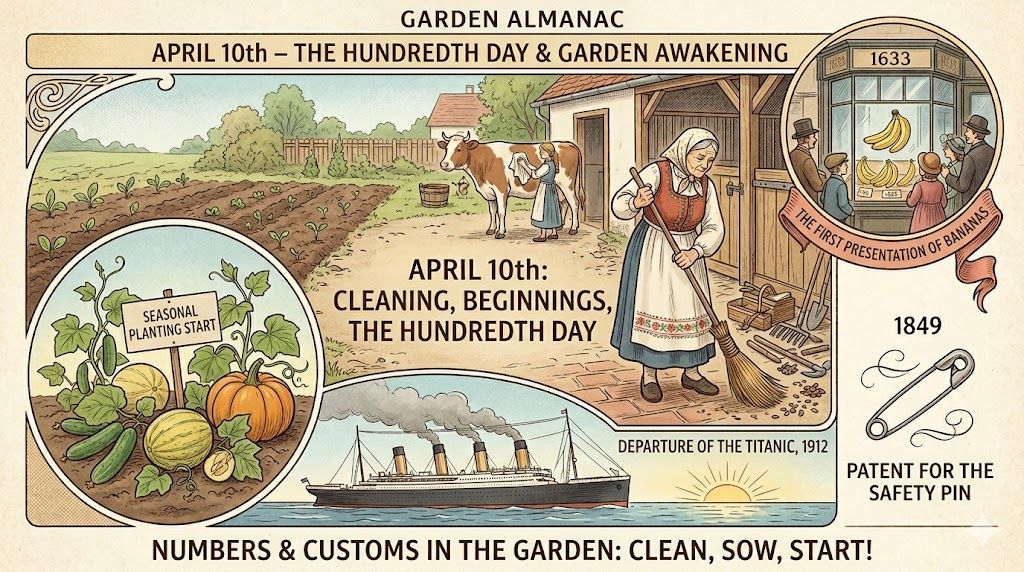

A Date That Marks a Threshold. April 10 is the 100th day of the year in common years, which gives it a natural symbolic pull even before folklore enters the picture. A round-number day always invites people to pause, measure, tidy, and begin again. By this stage of spring, the shift is no longer theoretical. The year has momentum.
In Hungarian folk tradition, this day carried ideas of cleansing, driving out pests, washing animals, cleaning houses and farm buildings, and preparing for more serious outdoor work. But the date also opens outward into a broader international almanac frame. April 10 is a day that connects practical spring labour with invention, travel, display, and the movement of living things across the world.
Cleansing, Water, and the Human Need To Reset
Many traditional spring customs are built around the same instinct: before a season of growth can fully begin, something stale must be removed. Dirt, winter residue, illness, vermin, clutter, and bad luck are treated almost as one category. April 10 belongs naturally to that family of days.
What matters in an almanac is not whether every old belief should be taken literally. What matters is the pattern of thought behind it. Spring is not only a time of sowing. It is also a time of clearing space. The swept threshold, the washed stable, the rinsed animal, the sorted seed packets, the cleaned tools — these are all part of the same seasonal grammar.
That is why the Hungarian Hundredth Day tradition speaks so clearly even beyond Hungary. Nearly every culture has some version of the spring reset.
A Good Day for Warm-Season Sowing
The gardening logic behind the date is surprisingly practical. In Hungarian horticultural tradition, April 10 became associated with sowing cucurbits — cucumbers, melons, pumpkins, and related trailing crops. Modern gardening guidance still preserves part of that wisdom: these warmth-loving plants should not be rushed into cold soil, and the hundredth day often falls close to a more reliable threshold for sowing them outdoors.
This gives the day a satisfying double life. It is symbolic because the hundredth day feels important, but it is also useful because it roughly matches a real seasonal shift. Almanac dates are at their best when folklore and field observation briefly agree.
Bananas in a London Window
One of the most unexpectedly vivid international associations for April 10 comes from 1633, when bananas were first displayed in a London shop window. The scene has exactly the kind of strangeness an almanac loves: people stopping to stare at a fruit that would one day become ordinary.
This small moment belongs beautifully in a spring almanac. It is about curiosity, plants on the move, and the moment when something foreign becomes imaginable, then familiar. Gardeners understand this transformation very well. Many plants that now feel entirely at home in one place began as marvels from somewhere else.
The Safety Pin and the Practical Imagination
April 10 also marks the patenting of Walter Hunt’s modern safety pin in 1849. It was a small invention, but a brilliant one: a practical improvement in form that solved an everyday problem with elegant simplicity.
That feels right for this date. Spring work depends not only on weather and growth, but on useful human ingenuity — the small tools and clever devices that make labour safer, neater, and more manageable. Some days belong to empires or battles; others belong to a bent piece of wire that quietly enters daily life around the world.
Titanic and the Meaning of Departure
On April 10, 1912, the Titanic set sail from Southampton on her maiden voyage to New York. The date would later be overshadowed by catastrophe, but in an almanac it also carries the deeper meaning of departure itself: the moment when a journey finally leaves possibility and becomes reality.
Spring carries that same emotional structure. Seeds are committed to the ground. Beds are planted before outcomes are known. New growth is trusted before it is proven. A season moves forward because something is finally set in motion.
What To Notice In The Garden Today
April 10 is a particularly good day for combining clearing and beginning.
- What in the garden still belongs to winter, and should now be removed?
- Which tools, corners, or containers need cleaning before heavy use begins?
- Is the soil warm enough yet for the more tender sowings?
- Which part of the plot is ready for action, and which still asks for patience?
- What signs suggest that spring has crossed from promise into commitment?
A true almanac day is never only about events elsewhere. It is also about what the date makes visible in one’s own garden.
The Meaning Of April 10
April 10 gathers together a remarkably coherent set of themes: cleansing, threshold, practical wisdom, movement, and the courage to begin. Through Hungarian folk custom, warm-season sowing, bananas in London, the safety pin, and Titanic’s departure, the day becomes larger than it first appears.
Its lesson is simple and durable. Before growth, make ready. Before the journey, prepare well. And when the season finally opens, step into it with both care and curiosity.