
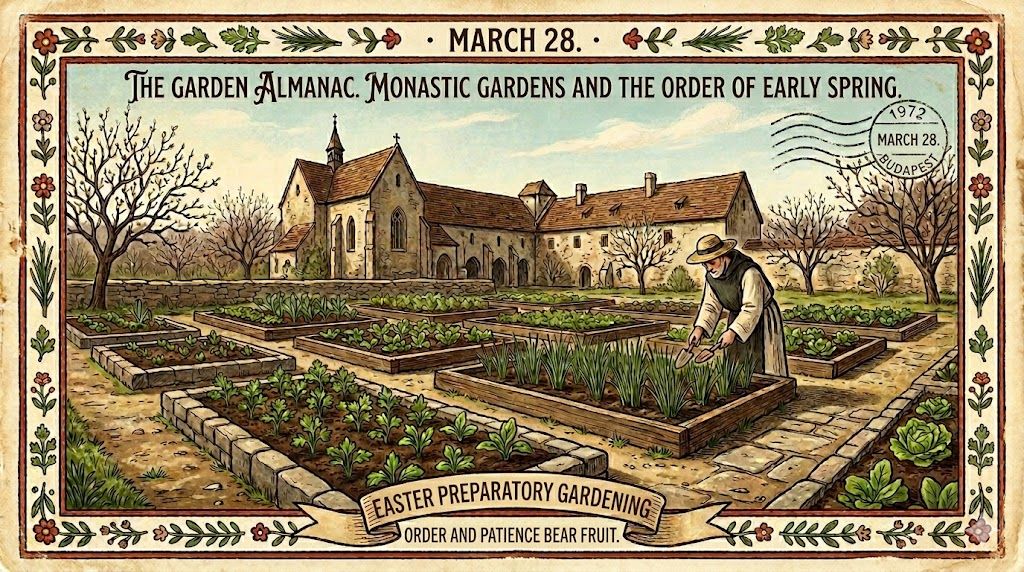

March 28 opens surprisingly well onto an international garden theme through Saint Stephen Harding, who died on this date in 1134 and was one of the founding figures of the Cistercian order. He matters here not because of one specific gardening legend, but because monastic culture across medieval Europe preserved and organized a powerful model of useful cultivation: orchards, kitchen plots, physic gardens, herb beds, and enclosed spaces shaped by work, season, and disciplined care.
This gives the date a wider frame than a local custom alone could offer. The monastic garden was never only decorative. Across Europe it served food, healing, prayer, learning, and household order all at once.
The Enclosed Garden as a Way of Thinking
Scholars of medieval garden history often return to the idea of the enclosed garden, the hortus conclusus. In monastic settings, enclosed plots could combine practical and symbolic functions: protection, clarity, self-sufficiency, medicinal use, and spiritual reflection. Whether planted with vegetables, orchard trees, or useful herbs, these gardens expressed a way of living in which cultivation meant far more than production alone.
That wider idea still feels relevant in spring. Many gardeners reach late March full of urgency, but the best gardens are not built by urgency alone. They are shaped by placement, rhythm, repeated care, and the intelligent use of limited space.
Herbs, Greens, and the Useful Garden
For a modern garden reading of the day, the most fitting plants are the useful ones: parsley, chives, sorrel, spinach, salad leaves, and the first medicinal or culinary herbs that begin to matter in earnest as spring settles. These are not always the most dramatic plants, but they are often the ones that restore the closest connection between garden and daily life.
That is one of the enduring lessons of monastic horticulture. A good garden is not merely admired; it is inhabited, harvested, and relied upon.
Order Without Rigidity
Saint Stephen Harding is associated with the disciplined simplicity of early Cistercian life. That principle translates well into the garden, not as severity for its own sake, but as thoughtful structure. Beds need not be formal to be ordered. A herb patch can be generous without becoming chaotic. The point is not tidiness as ornament, but arrangement that supports growth, access, and use.
What the Day Holds
In the Garden Almanac, March 28 becomes a day for useful beauty: for herbs before flowers, for patient arrangement before abundance, and for gardens that feed both household and attention. It is a reminder that spring is not only about what bursts forth, but about what is quietly put in order.