
A handful of fallen leaves, a weathered tree stump and the last seeds clinging to a garden flower may seem like ordinary sights in late November. Yet each holds clues to stories that stretch far beyond a single growing season.
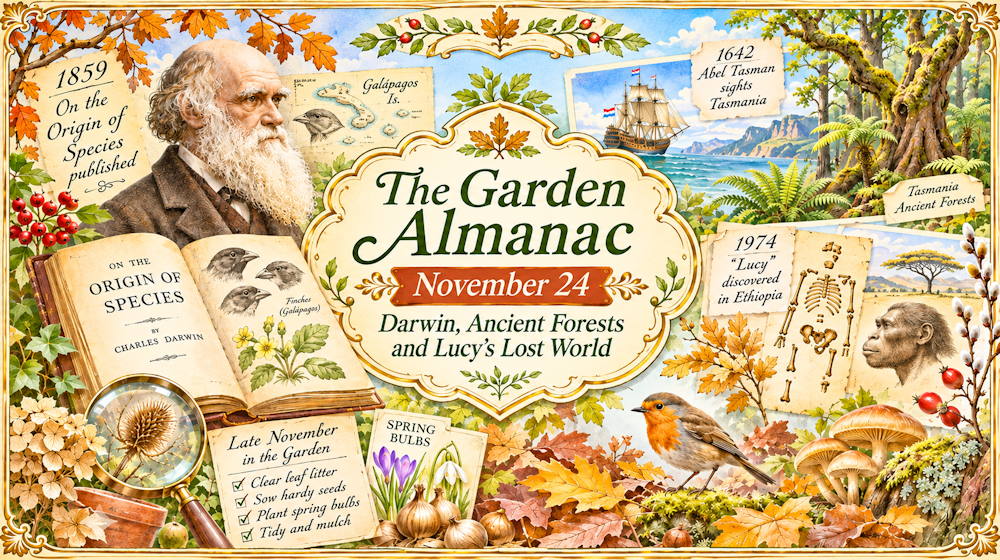
November 24 is an especially remarkable date in the history of our understanding of nature. It marks the publication of a book that transformed biology, a European explorer’s first glimpse of an island with extraordinary plant life, and a discovery in Africa that changed the story of our earliest ancestors. Together, they offer some surprising ways to look at the living world around us.
November 24, 1859 – The Book That Changed How We See Every Garden
On this day in 1859, Charles Darwin’s On the Origin of Species was published in London. Its first printing of 1,250 copies was sold out on publication day. The book challenged one of the most deeply established assumptions about the natural world: that species existed as fixed, unchanging forms. Darwin proposed instead that living things gradually change over generations through natural selection.
What makes the story particularly fascinating for gardeners is how much Darwin learned from familiar plants and domesticated animals. He studied how people selected desirable characteristics in pigeons and cultivated varieties, then considered how something comparable might happen in nature without a human breeder. Small inherited differences could influence survival and reproduction, gradually reshaping populations over immense periods of time.
The implications extended far beyond the nineteenth-century debate over evolution. Flowers, pollinating insects, seed dispersers and their environments could now be understood through long histories of adaptation. A flower’s shape might influence which insects could reach its nectar. A plant producing abundant seeds might still depend on the right soil, climate or animals to establish the next generation. The garden was no longer simply a collection of separate organisms, but a place where relationships had developed over countless generations.
Darwin himself remained an enthusiastic observer of garden life, later investigating climbing plants, orchids, flower reproduction and earthworms. His work encourages a particularly rewarding habit: looking beyond a plant’s appearance to ask how it lives. Why does one flower attract bees while another is visited by moths? Why do some seeds travel on the wind while others cling to animal fur? Questions like these can turn even a small garden into a fascinating place of discovery.
Garden Science – Why Are Some Flowers So Selective About Their Pollinators?
Flowers do not all offer the same rewards, and pollinating animals are not equally equipped to reach them.
- Flower shape matters: Deep tubular flowers may be especially accessible to insects with long tongues, while open flowers often provide easier access to a wider range of visitors.
- Timing matters: Some flowers release scent or nectar at particular times of day, matching the activity of their pollinators.
- Diversity matters: A garden with different flower shapes and overlapping flowering periods can support a broader range of insects than one dominated by a single ornamental variety.
These relationships are not always exclusive. Many flowers attract several pollinator species, and their visitors can change with the season, weather and location.
November 24, 1642 – Tasmania Appears Beyond the Southern Ocean
At approximately four o’clock in the afternoon on November 24, 1642, Dutch navigator Abel Tasman and his crew spotted high land rising from the sea. They were looking at the island now known as Tasmania, south of mainland Australia. Tasman named it Van Diemen’s Land, unaware of the extraordinary ecological history contained within its mountains and forests.
For the island’s Aboriginal inhabitants, this was not a discovery at all. Their ancestors had lived in Tasmania for tens of thousands of years, developing detailed knowledge of its landscapes and managing vegetation through practices including carefully controlled burning. European maps would eventually change, but the island’s human and ecological history was already ancient.
Tasmania remains home to temperate rainforests containing remarkable survivors of the distant past. Among them are pencil pines (Athrotaxis cupressoides), trees capable of living for more than 1,200 years. Some ancient plant communities are highly vulnerable to fire and recover only very slowly after disturbance. Their survival reveals something important about gardening and conservation: plants are adapted not simply to a climate, but to particular combinations of moisture, soil, competition and disturbance. A species that flourishes in one environment may struggle when moved to another, even if temperatures appear suitable.
Wildlife Note – Why Leave Some Fallen Leaves in the Garden?
A layer of autumn leaves can support a surprisingly rich community of organisms.
- Beetles, spiders and other small invertebrates find shelter beneath leaf litter.
- Earthworms and decomposing organisms gradually incorporate dead plant material into the soil.
- Birds may search sheltered leaf litter for insects and other food during colder months.
In temperate gardens, keep some healthy leaves beneath shrubs or in quiet corners, while clearing thick accumulations from lawns and paths. Remove leaves carrying persistent plant diseases where appropriate.
A garden need not look neglected to provide useful winter habitat.
November 24, 1974 – Lucy and the Landscape of Our Ancient Ancestors
More than three million years ago, a small early human relative moved through the landscapes of East Africa. On November 24, 1974, researchers Donald Johanson and Tom Gray discovered the first fragments of her fossil skeleton at Hadar, Ethiopia. The approximately 3.2-million-year-old individual became famous as Lucy, named after a Beatles song playing during the team’s celebrations.
Lucy belonged to the species Australopithecus afarensis. Her skeleton, about 40 percent complete, offered unusually detailed evidence of an early hominin capable of walking upright while retaining anatomical features associated with climbing trees. The discovery complicated the familiar image of human ancestors simply leaving the trees behind and beginning life on open grasslands. Lucy’s species could make use of a variety of environments, including wooded habitats.
Plants are essential to understanding that ancient world. Trees, shrubs, grasses, changing rainfall patterns and available food all shaped the environments in which early hominins lived. Fossil discoveries become more meaningful when considered alongside evidence from vegetation, sediments and climate. Modern gardeners can observe a smaller-scale version of this relationship wherever trees create shade, shrubs offer shelter and open spaces support different communities of plants and animals. The variety of habitats within a landscape often matters as much as the number of species it contains.
Garden Reminder – What Should You Do in the Garden in Late November?
For gardeners in the Northern Hemisphere’s temperate regions, late November is a useful time to prepare for winter without clearing away everything nature has produced.
Plant spring bulbs: Tulips can still be planted where the soil is workable and not waterlogged. Choose well-drained positions.
Protect vulnerable roots: Apply an appropriate mulch around tender perennials, keeping it away from crowns and woody stems.
Check young trees: Inspect stakes and ties before winter winds arrive. Loosen anything beginning to constrict the trunk.
Save healthy fallen leaves: Collect some for leaf mould, a valuable soil conditioner that improves moisture retention and soil structure.
Avoid working saturated soil: Walking or digging on wet soil can damage its structure and reduce the air spaces roots need.
In the Southern Hemisphere, where November brings late spring, priorities are different: maintaining mulch, monitoring soil moisture, supporting young plants and watching for emerging pest populations.
What to Observe Right Now – Small Signs of a Changing Season
Late November offers plenty to notice, even where the garden appears to be slowing down.
- On bare branches: Look for the buds already formed for next spring. Their size, shape and arrangement can help identify trees in winter.
- Among fallen leaves: Notice how damp, shaded areas encourage decomposition, while leaves in exposed, dry places may remain intact much longer.
- Around evergreen shrubs: Watch how dense foliage provides shelter when deciduous trees have lost their leaves.
- After rain: Look for fungi emerging from soil, mulch or decaying wood. Many are decomposers rather than threats to living plants.
In Southern Hemisphere gardens, look instead for newly emerging flowers, active pollinators and the different ways plants respond to increasing warmth and daylight.
The most interesting observation is often the one that makes you return the following day to see what has changed.
Looking Ahead
Darwin’s work reminds us that the smallest differences between living things can matter. Tasmania’s ancient forests show why protecting the right conditions is essential for the survival of vulnerable species, while Lucy’s discovery reveals how closely life is connected to its changing surroundings. In our gardens, we can put these ideas into practice by choosing plants suited to their locations, preserving varied habitats and allowing more room for natural processes. Even as another season draws to a close, there is plenty still to discover.