

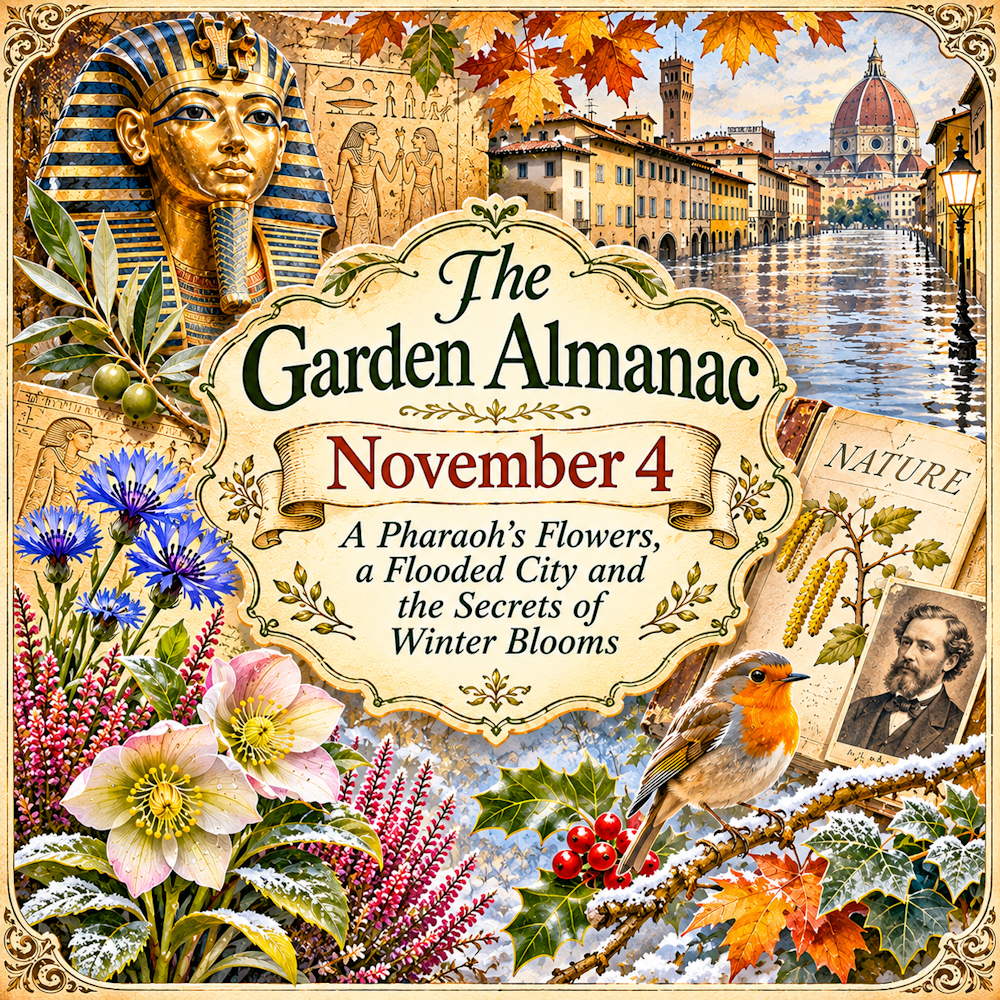

November 4 may seem like an ordinary day in the fading light of autumn, but history has left some remarkable botanical clues on this date. A hidden staircase in the Egyptian desert, a river rising through the streets of Florence, and a scientific question about flowers blooming in winter all reveal unexpected connections between people and the natural world.
As gardens in the Northern Hemisphere prepare for colder months, these stories invite us to look beyond fallen leaves and bare branches. They reveal how plants preserve memories, how landscapes respond to water, and why even the smallest winter flower deserves a closer look.
November 4, 1922 – The Pharaoh’s Tomb That Preserved a 3,000-Year-Old Garden
On November 4, 1922, Howard Carter’s excavation team uncovered the first step of a staircase beneath the desert floor in Egypt’s Valley of the Kings. It led to the tomb of Tutankhamun, one of archaeology’s most extraordinary discoveries. The golden treasures would eventually attract worldwide attention, but among the objects preserved inside were something far more delicate: flowers, leaves, seeds and botanical arrangements from ancient Egypt.
Some of the most revealing discoveries were funeral wreaths made from olive leaves, cornflowers and blue water-lily petals. One small wreath had been placed on the young king’s coffin. Its olive leaves were arranged with alternating green and silvery surfaces, creating a deliberate decorative pattern. The flowers were so fragile that even touching them could cause them to crumble, yet the dry conditions had preserved enough material for botanists to identify the plants.
These remains offer a surprising glimpse into ancient horticulture. Flowers were not merely decorative luxuries: they played important roles in religious ceremonies, remembrance and royal life. Other botanical finds included pomegranate leaves, safflower seeds, fenugreek, barley, emmer wheat and lentils. Together, they reveal a world in which cultivated plants served as food, medicine, ornament and sacred offerings. The tomb became an unexpected archive of ancient plant knowledge.
For modern gardeners, the fascinating detail is how familiar many of these plants remain. Olive trees still shape Mediterranean landscapes, cornflowers brighten summer borders, and pomegranates are cultivated in warm regions around the world. Even the choice of silvery and green foliage feels remarkably contemporary. A simple arrangement of leaves can tell us almost as much about a gardening culture as an elaborate garden design.
Wildlife Note – Why Leave Some Autumn Seedheads Standing?
The plants in Tutankhamun’s tomb remind us that flowers remain valuable long after their petals fade. In today’s gardens, standing seedheads can support wildlife through autumn and winter.
- Goldfinches and other seed-eating birds may feed on the seeds of teasels, thistles and other suitable plants.
- Hollow stems and dry vegetation provide overwintering shelter for some beneficial insects.
- Fallen leaves beneath shrubs create protective habitats for ground beetles and other small invertebrates.
- Leave healthy seedheads standing where practical, especially in quieter corners of the garden. Their winter silhouettes can be beautiful, too.
November 4, 1966 – When Florence Discovered the Power of Its River
In the early hours of November 4, 1966, the Arno River overflowed after days of relentless rain. Water and mud swept through Florence, invading homes, churches, museums and libraries. In some districts, floodwaters rose several metres above street level. The disaster damaged priceless works of art and historic collections, mobilising an international rescue effort and transforming approaches to cultural conservation.
Yet the story also exposed a fundamental problem in the relationship between cities and rivers. Flood risk cannot be understood by looking only at the riverbank. Rainfall across an entire watershed, saturated soils, tributaries and the speed at which water reaches a river all influence flooding. The catastrophe demonstrated why forecasting, upstream land management and the protection of flood-prone areas matter far beyond the city itself.
The same principles operate on a smaller scale in gardens. Paving, compacted soil and poorly designed drainage increase surface runoff, while healthy soil and vegetation help rainwater infiltrate and slow its movement. In areas with frequent heavy rainfall, permeable paths, rain gardens and suitable water-tolerant planting can help manage excess water. A garden cannot prevent a major flood, but thoughtful landscaping can make everyday rainfall less destructive.
Garden Reminder – What Should You Check After Heavy Autumn Rain?
Early November is an excellent time to observe how water moves through your garden, particularly in temperate regions preparing for winter.
- Check drainage: Look for puddles that remain long after rain has stopped, especially around lawns and planting beds.
- Protect soil structure: Avoid walking on or digging waterlogged ground, as this can increase compaction.
- Clear blocked outlets: Remove fallen leaves from gutters, surface drains and drainage channels.
- Plan improvements: Consider permeable surfaces or a rain garden where runoff regularly collects.
Waterlogged soil contains less air, leaving plant roots short of oxygen. Improving drainage is therefore as much about protecting roots as removing unwanted water.
November 4, 1869 – The Scientific Journal That Asked How Winter Flowers Survive
On November 4, 1869, the first issue of the scientific journal Nature appeared in London. Among its contents was a particularly intriguing botanical article by Alfred W. Bennett, titled On the Fertilisation of Winter-Flowering Plants. His question was deceptively simple: how do plants reproduce when they flower during the coldest months, when pollinating insects are scarce?
Bennett examined plants including hazel, butcher’s broom, gorse and several familiar wildflowers. Some plants rely on wind to transport pollen, while others can reproduce through self-pollination. His observations attracted Charles Darwin’s attention, leading to a scientific exchange about how flowers achieve fertilisation. The discussion revealed an important distinction: simply releasing pollen inside a flower does not necessarily prove successful self-fertilisation.
That question remains relevant whenever a gardener notices an unexpected flower in November. Winter-flowering plants do not all use the same reproductive strategy, and their success may depend on weather, pollinators, pollen transfer or the ability to self-pollinate. Hazel, for example, produces wind-pollinated flowers, while some other early-flowering plants benefit from insects active during mild periods. A flower opening in cold weather is not necessarily flowering at the wrong time – it may be perfectly adapted to its seasonal niche.
Garden Science – How Do Plants Know Winter Is Coming?
Plants respond to several environmental signals, especially changing day length and temperature.
As autumn progresses, shorter days help trigger seasonal changes in many deciduous trees. Chlorophyll breaks down, revealing yellow and orange pigments that were previously hidden by green. Some species also produce red or purple anthocyanins.
Meanwhile, many woody plants prepare their buds for winter dormancy. Others remain evergreen, while species adapted to flowering during colder months follow different seasonal rhythms.
This explains why an autumn garden can contain bright foliage, dormant buds, ripe fruit and fresh flowers at the same time.
What to Observe Right Now – Four Clues in the November Garden
November is a wonderful month for noticing details that disappear in the busier growing season.
- Changing leaf colours: Compare trees in sunny and shaded positions. Light exposure, temperature and species all influence autumn colour.
- Late flowers: Look for ivy, daisies or other plants still flowering in mild climates, and watch for visiting insects.
- Bird activity: Observe which shrubs provide berries and which standing seedheads attract feeding birds.
- The path of rainwater: After a shower, notice where water infiltrates quickly and where it collects or runs across the surface.
These small observations can reveal the seasonal patterns, wildlife connections and drainage characteristics of a garden more clearly than a single inspection in summer.
Looking Ahead
November 4 reminds us that gardens have always been places of discovery, whether through the preserved flowers of ancient Egypt, the behaviour of rainwater or the mysteries of plant reproduction. Each offers a different way to understand the living world. As winter approaches, gardeners can put that curiosity to work by protecting soil, preserving wildlife habitats and observing the plants that remain active in the cold. Sometimes the most useful preparation for a new growing season begins not with a spade, but with a closer look at what nature is already doing.