

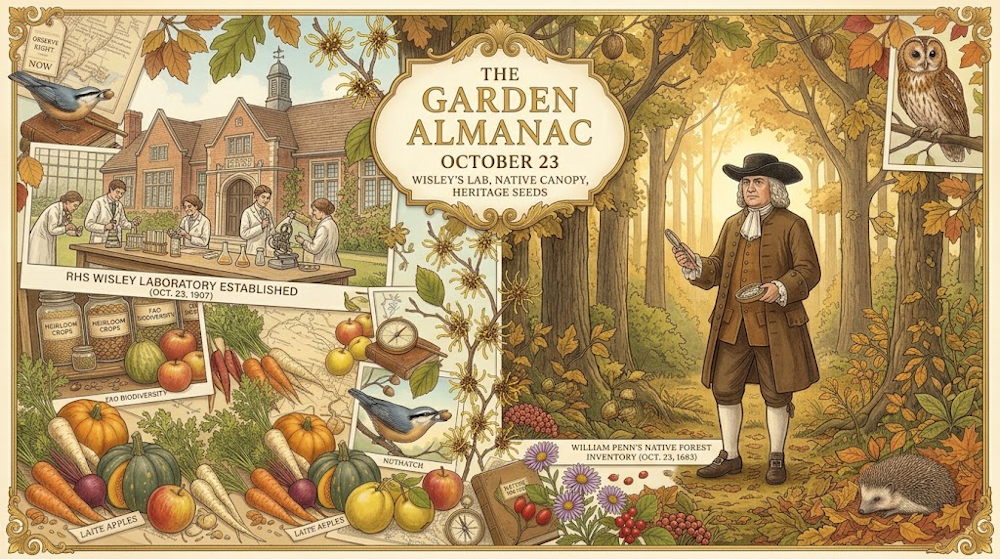

The crisp morning air of late October brings a distinct shift to the garden landscape. Leaves drop in quiet cascades, damp earth breathes out its rich, woody aroma, and the low sunlight casts long, golden shadows across dormant beds. October 23 stands as a pivotal threshold in the autumn calendar – a day where the physical decay of the season meets centuries of human curiosity about how plants grow, adapt, and sustain us through the cold months ahead.
Stepping into the garden on this day means observing a landscape in transition. It is an invitation to look beyond the surface of falling leaves and fading blooms, discovering how historical breakthroughs in botany, forest stewardship, and global seed preservation continue to shape the way we cultivate our home plots today.
Garden Reminder: Essential Late-October Tasks
- Mulch Exposed Soil: Apply a 2-inch layer of shredded leaves or bark to protect soil organisms and moderate subterranean temperatures.
- Clean Horticultural Tools: Disinfect pruners and shears with rubbing alcohol to prevent overwintering fungal spores from spreading next spring.
- Plant Spring Bulbs: Put down tulips, alliums, and daffodils before the ground freezes solid, ensuring roots establish in cold moisture.
- Harvest Root Crops: Lift carrots, beets, and parsnips after the first light frost to capture their peak sugar content.
October 23, 1907 – The Dawn of Scientific Gardening at Wisley
On October 23, 1907, the Royal Horticultural Society formally established its primary research laboratory at Wisley in Surrey, marking a profound turn in modern gardening history. Until that moment, horticultural advice relied heavily on unverified folklore, trial-and-error anecdotes, and erratic seasonal customs. By bringing rigorous microscopic investigation and soil chemistry directly into the garden setting, Wisley transformed the gardener from a passive practitioner into an informed observer of plant biology.
The true insight of this transformation was not simply the introduction of laboratory equipment into a countryside estate; it was the realization that plant diseases and pest infestations were natural ecological processes rather than arbitrary bad luck. Early researchers at Wisley turned their focus toward plant physiology, fungal life cycles, and organic soil composition long before the widespread adoption of modern synthetic chemicals. They proved that healthy, biologically active soil was the ultimate defense mechanism against crop failure.
This early scientific work laid the foundation for integrated pest management and sustainable cultivation practices used today. It demonstrated that understanding the life cycle of a pathogen – such as black spot or apple scab – allows growers to intervene through strategic pruning and microclimate management rather than relying on indiscriminate treatments.
For today’s backyard grower, the legacy of October 23, 1907, is a call to observe the garden through an investigative lens. When inspecting late-season foliage or preparing beds for winter, identifying the precise causes of plant stress – whether poor drainage, soil compaction, or nutrient lockup – allows us to address underlying environmental conditions rather than treating superficial symptoms.
Garden Science: What Happens to Soil Microbes in Late Autumn?
Question: Why is autumn soil biology crucial for spring fertility?
Answer: As topsoil temperatures cool down toward 50°F (10°C), earthworms and beneficial mycorrhizal fungi accelerate the breakdown of fallen organic matter. This subterranean activity converts leaf litter into stable humus, locking in slow-release nitrogen and phosphorus that remain stored underground until roots awaken in early spring.
October 23, 1945 – The Birth of FAO and the Preservation of Heritage Crops
On October 23, 1945, international delegates convened to establish the Food and Agriculture Organization (FAO), initiating a global effort to document, safeguard, and share agricultural resources. While originally envisioned as an emergency response to wartime food shortages, the organization quickly uncovered a troubling trend: the rapid loss of localized, open-pollinated crop varieties in favor of high-yield uniform monocultures.
The essential realization that emerged from this global survey was that food security relies on genetic diversity rather than sheer crop volume. Regional heirlooms – developed over generations by smallholder farmers to withstand drought, local pests, and unpredictable frosts – contained the resilient genetic traits needed to adapt to changing environmental conditions. Losing these traditional cultivars meant forfeiting centuries of natural adaptation.
This historical milestone shifted how agriculturalists viewed “primitive” or traditional crop varieties, transforming them from outdated relics into vital genetic reservoirs. It ignited the global seed-saving movement and catalyzed the creation of seed vaults designed to protect plant biodiversity against environmental degradation and climate shifts.
In the home garden, this legacy comes alive every time we choose open-pollinated seed varieties over uniform hybrids. Planting heirloom garlic, heritage apples, or landrace squashes in late autumn not only preserves rich culinary flavors, but actively safeguards genetic diversity within our local ecosystems, ensuring our gardens remain adaptable to erratic weather patterns.
Wildlife Note: Creating Overwintering Shelters for Beneficial Insects
- Leave Standing Stems: Keep hollow perennials intact; solitary bees and ladybugs overwinter inside hollow stems.
- Construct Leaf Stacks: Pile fallen oak and maple leaves in quiet corners to shelter ground beetles and amphibians.
- Preserve Deadwood: Small brush piles provide crucial hibernation sites for predatory insects that keep aphid populations in check next season.
October 23, 1683 – William Penn’s Forest Inventory and the Native Tree Paradigm
On October 23, 1683, founder William Penn penned a detailed inventory of the virgin forests and woodland soils of eastern North America. Unlike contemporary settlers who viewed dense forests primarily as timber to harvest or land to clear, Penn meticulously recorded the relationships between native oaks, walnuts, hickories, and the surrounding topsoil, arguing that native tree canopy was essential to protecting freshwater springs and maintaining regional climate stability.
Penn’s detailed observations revealed an ecological truth that was largely ignored during the era of rapid land clearing: native trees do not merely inhabit a landscape, they actively construct it. Their deep root networks draw minerals from subsoil layers, while their canopy reduces soil erosion during heavy rains and creates a specialized microclimate that supports hundreds of understory plants and microbial communities.
This early ecological accounting marked a turning point in forestry, showing that clearing mature forest canopy irrevocably alters local hydrology, temperature stability, and soil fertility. It challenged the prevailing idea that human management was inherently superior to wild, undisturbed forest ecosystems.
Today, Penn’s insights offer a powerful blueprint for backyard design and native plant choices. Incorporating native trees – such as white oak, serviceberry, or witch hazel – into home landscapes provides crucial ecological infrastructure, stabilizing garden microclimates, harboring native pollinators, and nourishing soil networks far more effectively than introduced ornamental species.
What to Observe Right Now: Late-October Indicators
Look closely at the forest floor and garden borders this week. Notice the sudden appearance of late-season saprophytic mushrooms breaking down wood chips, the subtle golden flowering of native witch hazel (Hamamelis virginiana), and the flurry of bird activity as jays and nuthatches cache acorns in loose garden soil.
Looking Ahead
The stories linked to October 23 remind us that gardening is a continuous conversation between human inquiry and natural cycles. From scientific soil diagnostics and heritage seed conservation to the enduring value of native forest canopy, history shows that working with natural processes always yields better results than fighting them. As late autumn settles over our plots, taking time to nourish the soil, protect biodiversity, and plant resilient species ensures our gardens remain vibrant for seasons to come.