
By mid-October, the garden has become a calendar you can touch. Fallen leaves mark the passing weeks, late flowers hold their colour against cooler mornings, and every ripe seed head seems to know exactly what time of year it is.
October 15 brings together three very different stories about time, land and care: a day that once vanished from the calendar, a modern observance rooted in rural labour, and the birthday of a poet who turned farming into literature. Together, they remind us that gardens are never outside history – they are one of the places where history becomes visible.
October 15, 1582 – The Day That Arrived Ten Days Early
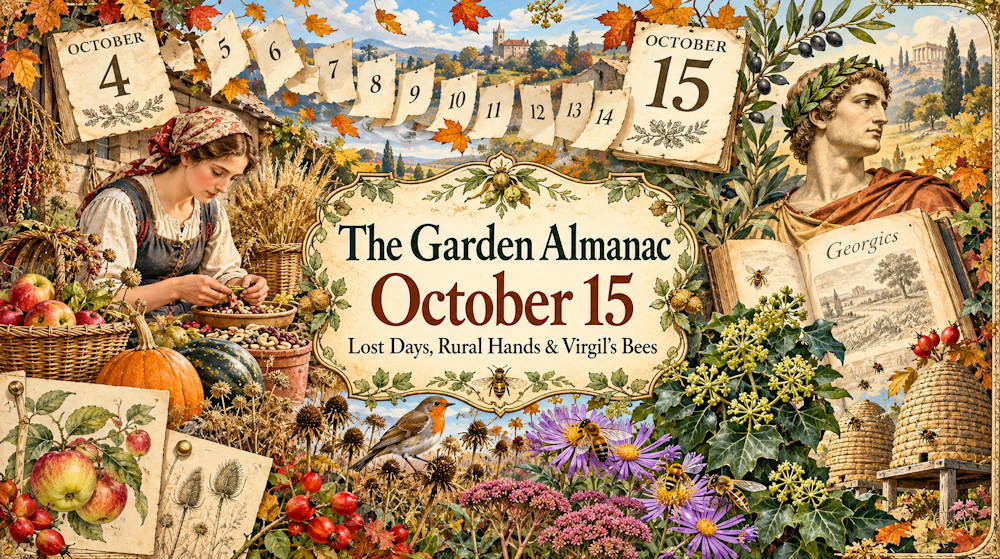
In 1582, in several parts of Catholic Europe, Thursday, October 4 was followed by Friday, October 15. Ten dates simply disappeared from the official calendar. The change was not a whim, but an attempt to correct a slow drift between human timekeeping and the solar year.
For gardeners, that drift is not an abstract problem. Calendars matter because sowing, pruning, grafting, flowering and harvest all depend on the relationship between counted days and seasonal reality. If a calendar gradually slips away from the equinoxes and solstices, the written year begins to lose touch with the living year.
The striking lesson of the Gregorian reform is that even something as fixed-looking as a date can be a gardening tool. A calendar is not nature itself; it is a measuring frame placed over nature. Good gardeners still use dates, but they also read buds, soil temperature, rainfall, daylight and the behaviour of plants. October 15 is a useful reminder to treat the calendar as a guide, not a command.
Garden Reminder – How to Garden by Date and by Season
Use calendar dates for planning long-term tasks such as ordering bulbs, preparing compost and scheduling pruning.
Use the garden itself for timing sensitive jobs: plant spring bulbs when the soil is cool but workable, not simply because a page says so.
Watch local signs: leaf fall, first light frosts, soil moisture and bird activity often tell you more than a fixed date.
Keep brief garden notes from year to year. After two or three seasons, your own records become more useful than any general calendar.
October 15 and the Rural Women Who Keep Food Growing
October 15 is also the International Day of Rural Women, a date that brings attention to women working in agriculture, food production and rural communities around the world. Its modern history is relatively recent, but the subject it marks is ancient: the often under-recognised labour behind seeds saved, food grown, animals tended, markets supplied and families fed.
The most interesting part of this observance is not only that it celebrates rural women, but that it changes where we look for agricultural knowledge. Farming history is too often told through landowners, inventions, machines and markets. Yet many of the decisions that shape resilient food systems happen at smaller scales: which seed is worth keeping, when water must be saved, how to stretch a harvest, how to recognise a failing crop before it is too late.
For today’s gardener, this widens the idea of expertise. Practical growing knowledge does not always arrive in formal language. It may live in repeated observation, local seed choices, food preservation, composting habits, shared cuttings and careful water use. A small home garden can honour that same intelligence by valuing resilience over display: useful plants, healthy soil, saved seed, diverse crops and techniques that work with local conditions.
This is especially relevant in October, when many gardens are being cleared. Instead of seeing the season only as an ending, it can be treated as a moment of household food wisdom: collect seed from reliable plants, store pumpkins and squash properly, dry herbs before damp weather spoils them, and note which crops were truly worth the space they used.
Garden Science – Why Diversity Makes a Garden More Resilient
A garden with several plant families, flowering times and root depths is usually better protected against stress than a garden built around one kind of crop. Diversity helps because different plants use nutrients differently, attract different insects and respond differently to drought, cold or disease.
In practical terms, this means mixing vegetables, herbs, fruiting shrubs, flowers and habitat plants where possible. Even in a small space, a few late-flowering plants, a patch of herbs, a compost system and some seed-saving can make the garden less fragile and more alive.
October 15, 70 BC – Virgil and the Farm as a Whole World
The Roman poet Virgil was born on October 15, 70 BC, near Mantua in northern Italy. He is best known for the Aeneid, but for gardeners his Georgics may be the more intimate work. It treats farming not as background scenery, but as a complex relationship between crops, trees, animals, bees, weather, labour and fate.
The Georgics is often described as agricultural poetry, but that phrase can make it sound gentler than it is. Its world is beautiful, but not easy. Fields must be worked at the right time; vines and trees require training; livestock need skill and attention; bees are admired for their order but remain vulnerable. The poem understands something every gardener eventually learns: cultivation is not control, but negotiation.
That makes Virgil surprisingly modern. A garden is not a collection of isolated tasks. Pruning affects flowers, flowers affect pollinators, soil affects water, and water affects everything. The older a gardener becomes, the more the garden looks less like a set of jobs and more like a living system of consequences.
Wildlife Note – Why Late Flowers Still Matter
In mid-October, pollinators may be less visible than in summer, but mild days can still bring bees, hoverflies and butterflies to nectar sources. Late flowers help them gather energy before cold weather reduces activity.
Good October plants for wildlife include asters, sedums, single-flowered dahlias, late salvias, ivy flowers and any herbs still in bloom. Leave some seed heads standing where you can; they feed birds, shelter insects and add winter structure to the garden.
What to Observe Right Now
- Look at which plants still attract insects on sunny afternoons.
- Notice where fallen leaves collect naturally; these places often reveal wind patterns and sheltered corners.
- Check which perennials collapse quickly after rain and which hold their shape.
- Watch the colour change in shrubs and trees: stressed plants often colour differently from well-rooted ones.
- Listen for birds returning to hedges and seed heads as the garden becomes more open.
Looking Ahead
October 15 shows that gardening depends on more than weather and tools. It also depends on how we measure time, whose knowledge we recognise, and whether we see the garden as a living system rather than a list of chores. The lost days of 1582 remind us to look beyond the printed calendar; the rural women honoured today remind us that practical knowledge often lives close to the ground; Virgil reminds us that farming has always been part labour, part attention and part wonder. For the modern gardener, that is a generous way to enter the second half of October: observe carefully, work seasonally, and let the garden teach you what the date alone cannot.