
By mid-October, a garden can feel unusually truthful. Weak stems show where the wind has been. Heavy soil reveals every place where water lingers. The first fallen leaves begin to mark the borders between order, shelter and decay.
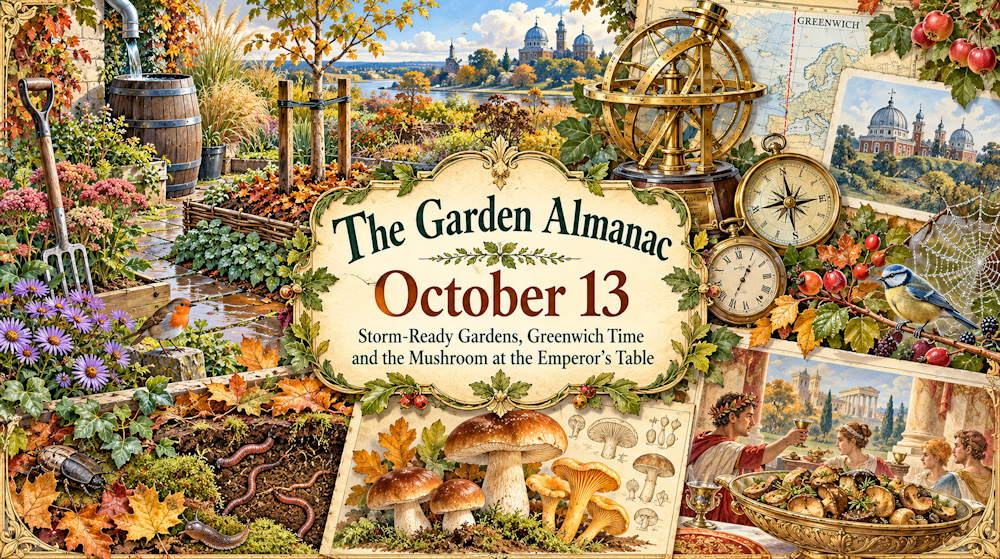
October 13 opens several doors into that autumn world: one leads to disaster awareness and the way communities learn to live with risk; another to the line at Greenwich that helped standardise global time; and a third to an imperial dinner in ancient Rome, where mushrooms became part of one of history’s most famous poisoning stories. Together, they make this a useful day for looking at gardens not as decorations, but as living systems that measure, absorb and warn.
October 13 – Disaster Risk Reduction Begins in the Garden
The International Day for Disaster Risk Reduction is observed on October 13, and its modern message is much wider than emergency response. It asks a quieter, more practical question: what can be done before damage happens? For gardeners, that question is not abstract. It lives in every slope, drain, hedge, tree root and patch of bare soil.
When the day was first established in the late twentieth century, the emphasis was on building a global culture of risk awareness. That idea has become more urgent as heatwaves, floods, wildfires and sudden storms affect not only distant landscapes, but ordinary gardens, allotments and food-growing spaces. A garden cannot stop extreme weather, but it can either soften its impact or make it worse.
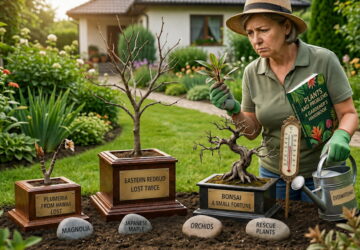
The useful shift is from “clean and controlled” to “resilient and absorbent”. Soil rich in organic matter holds more water during dry periods and takes in rain more gently during downpours. Planted ground heats less severely than bare surfaces. Trees and shrubs slow wind, intercept rainfall and provide shade. Even a modest garden can become a small piece of climate adaptation when it is designed to catch water, protect soil and support biodiversity.
This is why October is such a good month for a resilience check. The growing season has exposed what struggled, the autumn rains reveal where water collects, and the first cold nights show which plants are already stressed. Instead of treating every fallen leaf as a mess, gardeners can begin to see leaf litter, mulch, ground cover and deep-rooted planting as part of the garden’s protective infrastructure.
Garden Reminder: How to Make an Autumn Garden More Resilient
- Check where rainwater gathers after a storm, especially near paths, patios, sheds and house walls.
- Leave some fallen leaves under shrubs and hedges, where they protect soil and shelter small wildlife.
- Add compost or leaf mould to beds to improve soil structure before winter.
- Secure young trees and tall perennials before strong winds arrive.
- Avoid leaving soil bare: use mulch, winter cover crops or dense planting where possible.
- Clear blocked gutters, drains and water butts before the wettest part of the season.
October 13, 1884 – The Line That Taught the World to Measure Time
On October 13, 1884, delegates at the International Meridian Conference in Washington voted to make the Greenwich meridian the world’s prime meridian. It sounds like a technical decision, but it changed the way people mapped the Earth, navigated oceans and coordinated time. Before such standards became widely accepted, local time was exactly that: local, tied to the sun’s position over each town.
For gardeners, the hidden interest lies in the difference between clock time and natural time. Plants do not obey our calendars with mechanical precision. They respond to light, temperature, moisture and accumulated seasonal signals. A seed may be sown on the same date in two gardens, yet germinate differently because one bed is warmer, one is wetter, or one sits in a pocket of shade.
The Greenwich decision reminds us that standardisation is useful, but observation remains local. A frost date in a chart is a guide, not a guarantee. “Full sun” in a catalogue may mean something different beside a south-facing wall than it does in an open, windy plot. The best gardeners use dates as a framework, then adjust by watching buds, soil, insects, dew and the behaviour of their own plants.
Garden Science: Why Calendar Dates Are Only Half the Story
Plants often respond to a combination of day length, temperature and moisture rather than a date alone. Many spring bulbs need a period of cold before strong growth begins, while some trees prepare for dormancy as nights lengthen. In autumn, warm soil can keep roots active even after top growth slows, which is why planting shrubs and perennials now can be effective if the ground is moist but not waterlogged.
October 13, AD 54 – Claudius, Mushrooms and the Serious Art of Knowing What Grows
The Roman emperor Claudius died on October 13, AD 54, and ancient accounts later linked his death to poisoned mushrooms. Historians still debate details, but the story endured because it joins power, appetite and botanical danger in one unforgettable scene: a prized food at an imperial table becoming a possible weapon.
Mushrooms occupy a strange place in human culture. They are delicacies, medicines, decomposers, symbols and hazards. In the garden, they are usually not enemies at all. Most visible mushrooms are only the fruiting bodies of larger fungal networks living in soil, wood or mulch. Their appearance often signals moisture, decaying organic matter and active decomposition rather than a problem that needs to be removed.
The real lesson is not fear, but humility. Fungi are essential to healthy ecosystems, yet identification can be difficult and mistakes can be serious. A gardener who notices mushrooms in a lawn, compost heap or mulched border is seeing the soil food web at work. A forager, however, needs expert knowledge, not guesswork. Autumn is mushroom season in many regions, and the safest rule remains simple: admire freely, eat only with certainty.
Wildlife Note: Leave Some Decay Where It Belongs
A tidy garden can still be a living garden, but not every decaying stem or leaf needs to disappear. Fungi, beetles, worms and other decomposers help turn dead plant material into soil nutrients. Birds then benefit from the insects and seeds that remain in less disturbed corners. If disease is not present, leaving a few quiet zones under hedges or behind borders can support a surprising amount of autumn life.
What to Observe Right Now
- Look at where dew remains longest in the morning: these cooler, damper spots often reveal microclimates.
- Notice which trees colour first and which stay green longest; drought stress can bring early leaf fall.
- Check whether mushrooms appear after rain in lawns, mulch or around old roots.
- Watch seed heads for visiting finches and other small birds.
- Compare sheltered and exposed plants after a windy night; the difference can guide future planting and staking.
Looking Ahead
October 13 is a reminder that gardens are never separate from the wider world. They feel the same weather risks, time patterns, seasonal signals and ecological processes that shape forests, farms and cities. A more resilient garden begins with practical acts – better soil, slower water, more cover, wiser planting – but it also begins with sharper attention. When we learn to read what the garden is already telling us, the future becomes a little less sudden and a little more workable.