
By early October, the garden begins to speak in quieter details. Seedheads rattle where flowers once blazed, fallen leaves gather in corners, and the low sun reveals textures that summer light often flattens – bark, soil, dried stems, spider silk, the pale underside of a leaf turned by wind.
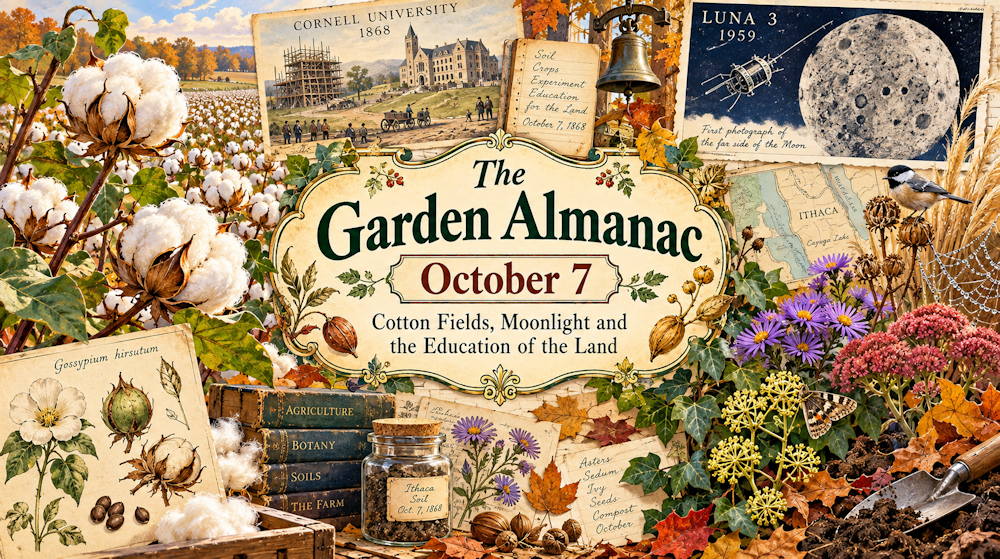
October 7 offers three very different ways of looking at cultivated land: through a global crop, a radical idea of agricultural education, and a spacecraft that taught humanity to see a familiar body from an unfamiliar side. Together, they remind us that gardens are never only about plants. They are also about trade, knowledge, observation and the courage to look again.
World Cotton Day – The Plant Behind the Fabric of Daily Life
Cotton is so ordinary that it almost disappears. It is in shirts, towels, seed oil, medical dressings and countless household objects, yet the plant itself is often absent from the imagination of people who use it every day. World Cotton Day, observed on October 7, brings that hidden crop back into view.
The story is not simply one of textiles. Cotton is a field crop with deep roots in warm climates, complex water needs, vulnerability to pests and a long history of human labour, innovation and controversy. Its fibres grow around the seeds in protective bolls, turning a biological strategy into one of the most important raw materials in global trade. What looks like softness in a finished cloth begins as a demanding agricultural system.
For gardeners, cotton offers a useful reminder: every material has a landscape behind it. Mulch, compost bags, twine, seed trays, fleece covers, plant labels, even the clothes worn while pruning all come from somewhere. Some are plant-based, some fossil-based, some reusable, some short-lived. A gardener who thinks about soil health in a bed can also think about the life of the materials brought into that garden.
Cotton also sharpens an old horticultural question: how do we grow useful plants without exhausting the land that supports them? In small gardens, the same principle appears in crop rotation, mixed planting, mulching and careful watering. A bed planted again and again with the same hungry crop will eventually show fatigue. A landscape treated as an endless resource will do the same.
Garden Reminder – What Cotton Can Teach an October Gardener
- Rotate annual crops where possible, especially vegetables from the same plant family.
- Add organic matter now so winter weather can help settle it into the soil.
- Keep bare soil covered with mulch, green manure or leaf litter to reduce erosion.
- Choose durable garden materials when you can, and reuse pots, ties and covers.
- Notice which beds looked tired this year – they may need compost, rest or a different crop next season.
October 7, 1868 – Cornell Opens on a Rough Field
On October 7, 1868, Cornell University held its first inauguration ceremony in Ithaca, New York. The grand idea was clear, but the setting was not polished. The young institution stood on a campus that was still raw, unfinished and visibly close to the farmland from which it had grown.
That roughness matters. Cornell belonged to the land-grant movement, which argued that higher education should not be reserved only for classical study or social elites. Agriculture, engineering and practical sciences deserved a place beside literature and philosophy. In the nineteenth century, this was a powerful shift: the farm, the workshop and the laboratory were being invited into the same conversation.
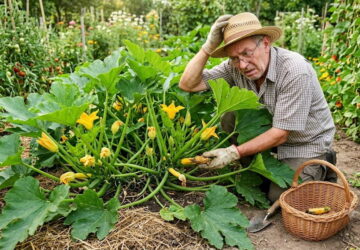
The gardening connection is more than symbolic. Modern horticulture depends on exactly this bridge between practice and research. Soil testing, plant breeding, pest monitoring, extension advice, compost science, disease-resistant varieties and orchard management all grew stronger because agriculture became a subject for systematic study. The gardener bending over a tomato leaf with a hand lens is part of that same tradition: curiosity made practical.
There is also a humbler lesson in Cornell’s beginning. Important green work rarely starts in perfect conditions. New gardens often begin as compacted ground, neglected corners, poor soil or vague ambition. The useful question is not whether the site is ready-made, but whether observation, patience and knowledge can make it better.
Garden Science – Why Soil Testing Is Not Just for Farmers
Soil can look healthy and still be short of key nutrients or have a pH that locks them away. A simple soil test helps explain why plants may be yellowing, growing weakly or refusing to flower.
In autumn, testing is especially useful because amendments such as lime, compost and mineral corrections have time to settle before spring planting. It also prevents guesswork. Adding fertiliser without knowing the soil’s condition can waste money, encourage soft pest-prone growth, or increase nutrient runoff into waterways.
October 7, 1959 – Luna 3 Photographs the Moon’s Far Side
On October 7, 1959, the Soviet spacecraft Luna 3 photographed the far side of the Moon for the first time. The images were imperfect, grainy and strange, but they changed the Moon from a familiar disc into a place with hidden geography. Humanity had looked at the same bright object for millennia and suddenly learned that half of it had remained unseen.
For gardeners, the Moon is already part of the seasonal imagination. It lifts tides, lights autumn paths and gives names to harvest moons and frost moons. Yet Luna 3’s achievement is a useful warning against overfamiliarity. The most common things in nature – a leaf, a bud, a patch of soil, a bird at the feeder – can still contain an unseen side if we change the angle of observation.
This is practical, not merely poetic. Many plant problems reveal themselves first on the underside of leaves: aphids, whitefly, spider mites, rust pustules, mildew, eggs, feeding marks. A shrub that looks healthy from the path may show dieback inside the canopy. A lawn that seems simply dry may reveal compaction, thatch or poor rooting when inspected closely.
The far side of the Moon did not become visible because people stared harder from the same place. It required a new position. Gardens often ask for the same thing: kneel down, turn the leaf over, visit at dusk, look after rain, check the same plant two weeks later. A different view can turn confusion into diagnosis.
Wildlife Note – What Changes in the Garden After Dusk?
October evenings are a good time to notice the garden’s second shift. As temperatures drop and human activity quiets, different lives become visible.
- Moths may still visit late flowers such as ivy, asters and sedum.
- Hedgehogs, where present, search for beetles, worms and fallen fruit.
- Spiders become easier to spot as dew catches their webs.
- Birds often make final feeding visits before roosting.
- Slugs and snails become active in damp weather, especially around tender autumn seedlings.
A wildlife-friendly garden is not spotless at night. Leaf piles, hollow stems, seedheads and quiet corners all provide shelter or food.
What to Observe Right Now – Early October Signals
This is a good week to walk through the garden slowly, without a tool in hand. The most useful observations are often made before the next job begins.
- Which plants are still feeding pollinators?
- Where does dew linger longest in the morning?
- Which beds stayed too wet or too dry this year?
- Are birds visiting seedheads, berries or fallen fruit?
- Which perennials are collapsing, and which still have strong winter structure?
- Where are leaves collecting naturally, and could they become mulch instead of waste?
These small notes can shape better decisions than memory alone. By spring, the garden will look like a different place; October is the time to read the season while its evidence is still visible.
Looking Ahead
October 7 does not offer one simple lesson, and that is part of its charm. Cotton asks us to see the fields behind everyday objects. Cornell’s opening reminds us that practical knowledge can transform rough ground into shared possibility. Luna 3 shows that even the most familiar landscape may change when viewed from another angle.
For today’s gardener, these stories point toward a more attentive way of working: know the source of materials, learn from the soil, and look closely before acting. The future garden will need beauty, but it will also need observation, restraint and better questions. Early October is an excellent time to begin asking them.