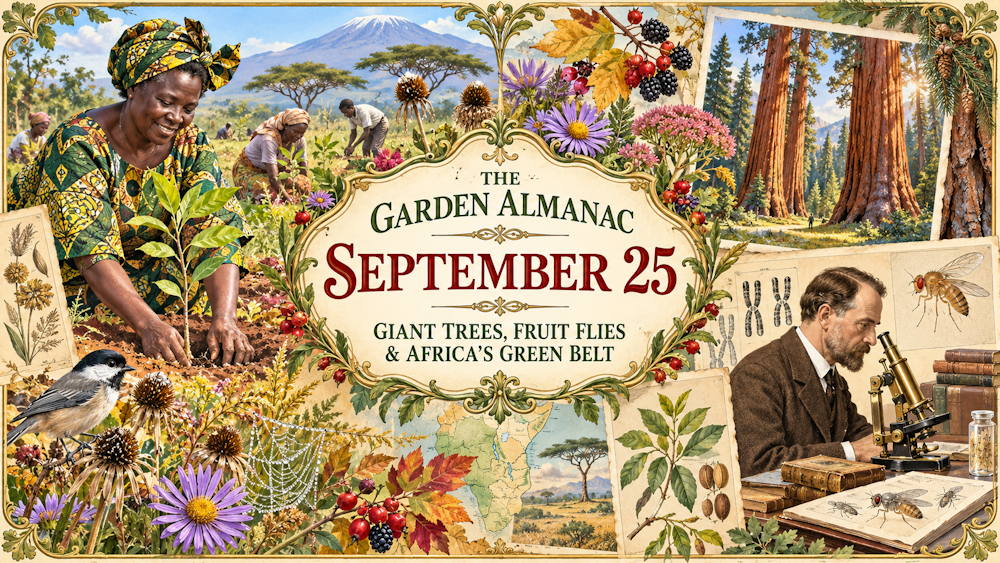

By September 25, the garden is learning to spend its resources carefully. In much of the Northern Hemisphere, daylight is shortening, late flowers are feeding the last busy insects, and trees are beginning to withdraw valuable nutrients from their leaves. It is a season of seeds, stored energy and decisions whose results may not be visible until spring.
The date also brings together three stories about how living things endure. One concerns a forest protected by law, another a scientist who showed where inherited traits are carried, and the third a Kenyan movement that turned tree planting into an instrument of environmental repair and social change. Each offers a useful way to look at a garden in early autumn: as habitat, inheritance and shared responsibility.
September 25, 2011 – Wangari Maathai and the Green Belt That Kept Growing
Wangari Maathai died in Nairobi on September 25, 2011, leaving behind one of the clearest examples of practical environmentalism in modern history. She founded Kenya’s Green Belt Movement in 1977 after listening to rural women describe disappearing firewood, less reliable water and declining food security. Tree planting became a direct response to problems that were ecological and domestic at the same time.
The movement trained communities, especially women, to raise seedlings and restore degraded ground. Its work eventually put tens of millions of trees into Kenyan soil, while Maathai’s public campaigns connected healthy forests with accountable government, livelihoods and peace. In 2004, she became the first African woman to receive the Nobel Peace Prize.
Her most useful lesson for gardeners is that planting is only the opening act. A tree succeeds when the species suits the place, its roots can establish, competing vegetation is managed and someone remains responsible for watering and protection. A locally native tree can support far more ecological relationships than an ornamental chosen only for quick growth, but even a native species must match the site’s soil, moisture and mature space.
September is an excellent planting month in many temperate regions because cooler soil loses water more slowly while roots may continue growing after shoot growth eases. Before buying a tree, look upward as well as downward: check its eventual crown spread, nearby buildings and cables, drainage, and the space available for roots. Maathai’s legacy asks a simple question that belongs in every garden – will this planting still be useful, healthy and cared for in twenty years?
Seasonal Tips – How to Give an Autumn Planted Tree a Strong Start
- Water the root ball thoroughly before planting and again after backfilling. Moist soil around the roots removes large air pockets and improves contact with the surrounding ground.
- Plant at the correct depth. The root flare should remain visible at soil level; burying the trunk encourages poor rooting and decay.
- Apply a 5–8 cm (2–3 inch) layer of organic mulch over the root zone, leaving a clear gap around the trunk so the mulch does not touch the bark. Piling mulch against the trunk traps moisture and may encourage decay.
- Check moisture during dry spells through autumn and during the first growing season. Newly planted trees need consistent water long before they need fertiliser.
September 25, 1890 – The Day Giant Sequoias Gained a Legal Shield
On September 25, 1890, Sequoia National Park was established in California’s southern Sierra Nevada. The new park protected mountain country containing groves of giant sequoias, trees found naturally only in a limited belt on the western slopes of the Sierra Nevada. Their immense size made them famous, but their survival could not be secured by admiration alone at a time when logging was transforming western forests.
Protection preserved trees and land, yet later ecology revealed that a forest cannot always be conserved by freezing it in place. Giant sequoias are adapted to periodic fire. Lower intensity burns reduce competing vegetation, expose mineral soil and help cones release seed, creating the open, sunlit conditions that young sequoias require. When fire is excluded for too long, fuels accumulate; under drought and extreme heat, later fires can become severe enough to kill even ancient trees.
The home garden carries a smaller version of the same lesson. Good stewardship is active, not merely protective. Thin congested growth where air movement is poor, remove diseased material, retain healthy habitat where it is safe, and avoid treating every fallen leaf or dead stem as waste. Above all, choose woody plants for their mature size. A sapling placed too close to a wall, path or power line becomes a future conflict that pruning cannot permanently solve.
Garden Science – Why Can Fire Help Some Trees but Harm Others?
Fire effects depend on intensity, frequency, season and the adaptations of the species present. Thick bark can insulate living tissue, while heat and drying may trigger seed release in some fire-adapted plants. At the same time, unusually hot fire can damage crowns, kill roots and sterilise the upper soil. In a garden, this is a reason to study natural processes rather than imitate them casually: prescribed burning requires expertise and is not a routine garden technique.
September 25, 1866 – Thomas Hunt Morgan and the Traits Hidden in a Seed
Thomas Hunt Morgan was born on September 25, 1866. Working with the tiny fruit fly Drosophila melanogaster in the early twentieth century, Morgan and his laboratory showed that genes are carried on chromosomes. A white-eyed male fly helped open the way: its unusual trait followed an inheritance pattern linked to sex, offering evidence that particular hereditary factors occupied particular chromosomes.
This work helped explain genetic linkage – the tendency of genes located near one another on the same chromosome to be inherited together – and earned Morgan the 1933 Nobel Prize in Physiology or Medicine. Modern plant breeding, crop improvement and conservation genetics all rely on the broader chromosome theory his experiments helped establish. The connection reaches from laboratory flies to tomatoes selected for flavour and wild plants managed for genetic diversity.
For gardeners, heredity explains why seed is both a promise and a surprise. Seedlings result from sexual reproduction, so they may combine traits differently from the parent plant, especially when the parent is a hybrid or has been cross-pollinated. If you need an exact copy of a favourite cultivar, use a reliable vegetative method such as division, cuttings or grafting where appropriate. If you save seed, label the parent, date and source, and expect variation – it is raw material for observation rather than evidence that anything went wrong.
Garden Reminder – What Is Worth Saving Seed From Now?
- Collect only mature, dry seed from healthy plants, and leave enough for birds and natural regeneration.
- Keep seed from several vigorous plants when possible. A broader sample preserves more genetic variation than seed from a single individual.
- Dry seed thoroughly before storing it in labelled paper packets. Cool, dark and dry conditions generally prolong viability, although some species need different treatment.
- Do not expect seed from an F1 hybrid to reproduce the parent variety uniformly. Save it for experimentation, not for a guaranteed copy.
Wildlife Note – Should Autumn Seed Heads Be Left Standing?
Yes, wherever disease control and safety allow. Hollow stems can shelter overwintering insects, while the seeds of coneflowers, sunflowers and many grasses feed birds. Late-flowering asters, sedums and ivy can also provide nectar when fewer flowers remain. Cut back diseased foliage and plants that seed invasively, but leave a varied patch of sound stems and seed heads until late winter or early spring.
What to Observe Right Now
- Which trees colour first, and whether the change begins on exposed, dry or shaded branches.
- Where dew lingers longest in the morning – it often reveals cooler pockets and differences in air movement.
- Which late flowers still attract bees, hoverflies or butterflies during the warmest part of the day.
- Which fruits and seed heads birds visit first, and which remain untouched until colder weather.
Looking Ahead
September 25 shows that the future of a living landscape depends on more than planting. Protection must allow ecological processes to function, genetics must be understood as variation rather than perfect repetition, and every young tree needs long-term care. A gardener can act on all three ideas now by choosing plants suited to place, preserving diversity and leaving useful habitat through winter. Those decisions may look modest this autumn, but they shape what will be able to grow, feed and shelter life in the seasons ahead.