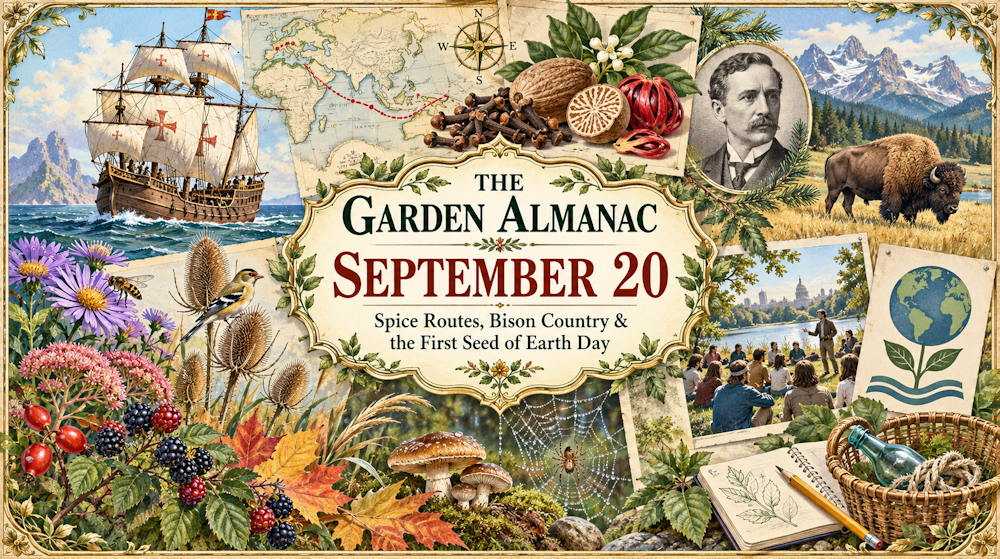

September 20 arrives at a threshold. In temperate gardens across the Northern Hemisphere, sunlight is thinning, seed heads are ripening and the first leaves may be loosening their grip. South of the equator, the same date carries the quickening energy of spring – fresh shoots, lengthening days and returning pollinators.
The stories attached to this day travel just as widely. They begin with spice plants valuable enough to send ships across unknown oceans, pass through a changing idea of what it means to protect a landscape and arrive at the quiet announcement that grew into Earth Day. Together, they ask a question every gardener eventually meets: how do we enjoy the living world without exhausting it?
September 20, 1519 – When Spice Plants Redrew the Map
On September 20, 1519, five ships sailed from Sanlúcar de Barrameda in southern Spain under the command of Ferdinand Magellan. Their objective was to reach the Moluccas, or Spice Islands, by sailing west. Magellan did not survive the expedition, and only the Victoria, commanded on its final stage by Juan Sebastián Elcano, completed the first circumnavigation. When it returned in 1522, just eighteen members of the original expedition sailed into Sanlúcar aboard the ship.
Behind this epic voyage were plants. Cloves were dried flower buds from trees native to a small group of Indonesian islands, while nutmeg and mace came from the fruit of another tropical tree with an equally restricted natural range. Their intense flavors, preservative qualities and rarity made them extraordinarily valuable. European demand turned particular plants and their habitats into the focus of global competition, bringing trade and botanical exchange, but also conquest, exploitation and profound disruption to local societies.
A modern garden offers a gentler lesson in plant geography. Every herb and fruit has climatic limits shaped by temperature, rainfall, soil and day length. Rosemary may thrive in dry, free-draining ground, while basil slows rapidly in cool weather and clove trees require tropical warmth and humidity. Learning what a plant genuinely needs is more useful than trying to force every desirable species into the same conditions.
Garden Inspiration – Grow Flavor Without Fighting the Climate
A small “spice route” collection can be both productive and educational:
- Plant hardy Mediterranean herbs such as thyme, sage and rosemary in the sunniest, best-drained position available.
- Grow tender basil, lemongrass or ginger in containers that can be moved under cover before cold nights.
- Harvest seeds from coriander, fennel or dill only after they have dried fully on the plant.
- Check the local status of unfamiliar plants before introducing them, especially in warm climates where some ornamental or culinary species may become invasive.
The history of spices reminds us that no plant exists in isolation. Its flavor comes with a climate, an ecosystem and a human story.
September 20, 1849 – George Bird Grinnell and the Landscapes Worth Defending
George Bird Grinnell, born in Brooklyn on September 20, 1849, became one of the most influential voices in early American conservation. Trained as a naturalist and later working as an editor and writer, he witnessed the rapid loss of wildlife across the American West. He campaigned for the protection of birds and bison, helped organize conservation groups and spent decades advocating for the mountain landscape that became Glacier National Park in 1910.
Grinnell’s career belongs to a period when conservation was changing from the protection of individual animals into the defense of habitats and entire landscapes. Yet early conservation also had serious limitations. It often centered the views of hunters, scientists and political leaders while overlooking Indigenous relationships with land and the ecological knowledge developed through generations of stewardship. Modern conservation is stronger when it protects species and habitats while also listening to the communities that know those landscapes intimately.
For gardeners, the enduring lesson is that wildlife cannot be preserved one species at a time without preserving the places where it feeds, shelters and reproduces. A garden need not be vast to contribute. Native flowers can supply season-long nectar, shrubs can provide nesting cover, fallen leaves can shelter invertebrates and a shallow water source can support birds and insects during dry periods. The most valuable garden is often not the tidiest one, but the one with several connected layers of life.
Wildlife Note – What Does a Garden Need to Become Habitat?
Look for four basic resources:
- Food: nectar, pollen, seeds, berries and the insects eaten by birds.
- Water: a shallow, regularly cleaned dish with stones or gently sloping edges.
- Shelter: dense shrubs, grasses, leaf litter, hollow stems and small piles of woody material.
- Safety: fewer pesticides, fewer unnecessary night lights and places protected from disturbance.
One spectacular flower may attract attention, but a sequence of plants flowering from spring into autumn supports wildlife for much longer.
September 20, 1969 – The Quiet Announcement That Grew into Earth Day
The strongest environmental echo of September 20 began in Seattle in 1969. During a public appearance, United States senator Gaylord Nelson announced plans for a national environmental teach-in. The proposal was initially modest, but it offered something new: a day when students, scientists, teachers and communities could examine pollution and ecological damage as connected public concerns rather than isolated local problems.
That idea became the first Earth Day on April 22, 1970. An estimated twenty million Americans took part in lectures, demonstrations, cleanups and community events. The scale of participation helped move environmental protection into everyday political discussion, at a time when polluted rivers, pesticide use, smog and habitat destruction were becoming impossible to ignore.
Gardens are unusually sensitive places from which to notice environmental change. Gardeners observe when blossoms open, when migratory birds arrive, which insects become scarce and how quickly soil dries after rain. A dated notebook containing flowering times, rainfall, frost, pest outbreaks and wildlife sightings can turn casual impressions into a useful record. Over several years, it may reveal changes that memory alone would miss.
The practical legacy of the original teach-in is therefore not simply to “care about nature”, but to observe, share and act. Choose one measurable improvement this season – reduce pesticide use, replace part of a lawn with diverse planting, capture rainwater or add native plants that flower when food is scarce. Then record what changes. A garden can be both a refuge and a small field station.
Garden Science – Why Do Leaves Change Color Before Frost?
Frost does not switch on autumn color. In many deciduous plants, shortening days initiate changes that reduce chlorophyll production. As the green pigment breaks down, yellow and orange carotenoids already present in the leaves become visible. Some trees also produce red or purple anthocyanins, especially when bright days are followed by cool nights.
Weather influences the intensity and timing of the display, but day length provides the dependable seasonal signal. A branch turning brown much earlier than the rest of the tree may therefore indicate drought, root damage or disease rather than normal autumn change.
Garden Reminder – Let World Cleanup Day Begin at the Garden Gate
September 20 is also World Cleanup Day, an international observance focused on the global waste problem. In a garden, responsible cleanup means removing harmful litter without stripping away useful habitat.
- Collect plastic twine, plant labels, broken pots and fragments of netting before they disappear beneath mulch or enter compost.
- Reuse sound containers and trays, and recycle materials only through schemes that accept that particular type of plastic.
- Keep batteries, old chemicals, oils and pesticide containers separate from household or garden waste.
- Remove diseased leaves and fallen infected fruit, but leave healthy seed heads, stems and some leaf litter for birds and overwintering insects.
- Check hedges and dense vegetation carefully before moving or cutting them, as wildlife may still be using the cover.
A biologically healthy garden is not an immaculate one. The aim is to remove pollution, not every trace of natural decay.
What to Observe Right Now
Around September 20 in northern temperate gardens, watch for:
- the first trees changing color on exposed, cool or dry sites;
- spiders’ webs revealed by dew on autumn mornings;
- birds feeding on sunflower, teasel and grass seeds;
- late bees and hoverflies visiting ivy, asters, sedums and other final nectar sources;
- mushrooms and other fungal fruiting bodies appearing after rain;
- shadows lengthening noticeably as the equinox approaches.
In the Southern Hemisphere, turn your attention instead to swelling buds, fresh leaf growth, early nesting activity and the first strong flush of spring pollinators. In either season, repeated observation is more revealing than a single glance.
Seasonal Tips – Useful Jobs for the September Garden
- Plant spring-flowering bulbs while the soil is workable, following locally appropriate planting times for each species.
- Divide crowded hardy perennials once flowering has finished and the weather is no longer hot and dry.
- Continue watering newly planted trees and shrubs during dry spells – cooler air does not mean their roots can manage without moisture.
- Stop feeding tender growth with high-nitrogen fertilizer as cold weather approaches.
- Leave healthy ornamental grasses and perennial stems standing where they can provide winter structure, seeds and shelter.
- Gather ripe seed only on a dry day, label it immediately and allow it to dry thoroughly before storage.
Looking Ahead
September 20 shows how large changes can begin with plants, observations and ideas that initially seem small. The search for spices reshaped the world, conservationists learned that wildlife depends on whole landscapes and one proposal for a teach-in grew into a global environmental tradition. Today’s gardener can carry those lessons forward by choosing plants suited to place, protecting connected habitats and recording what the seasons reveal. A better relationship with nature is cultivated in exactly this way – attentively, practically and one living patch of ground at a time.