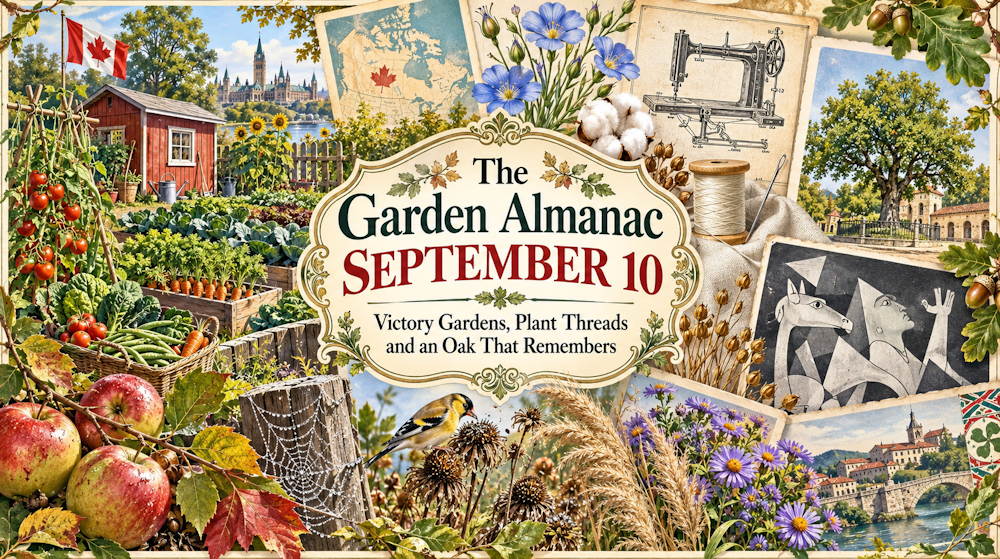

September 10 arrives at a revealing point in the northern garden year. Tomatoes are still ripening in sheltered corners, apples are beginning to fall, seed heads are replacing flowers, and cooler nights are quietly changing the rhythm of growth.
The date also draws together three unexpectedly connected stories – a wartime decision that transformed ordinary plots into food gardens, an invention that changed humanity’s relationship with plant fibres, and the homecoming of a famous painting linked to one of Europe’s most meaningful trees. Each reminds us that gardens are never isolated from history. They feed people, clothe them, preserve memory and offer living evidence of what a community chooses to carry forward.
September 10, 1939 – When Canadian Gardens Joined the Home Front
On September 10, 1939, Canada declared war on Germany and entered the Second World War. The decision changed daily life far beyond military bases and government offices. Farms faced labour shortages and increasing production demands, imported goods became less predictable, and households were encouraged to waste less, preserve more and reconsider every usable piece of ground.
As the war continued, Victory Gardens appeared across Canada in backyards, school grounds, vacant lots and shared urban spaces. Similar movements developed in the United States, Britain, Australia and elsewhere. These plots supplied fresh vegetables while commercial agriculture and transport systems carried the heavier burden of feeding armed forces and civilian populations. They also gave people at home a practical task at a time when many larger events felt frighteningly beyond their control.
The most useful legacy of the Victory Garden is not the romantic image of a perfectly productive household plot. First-time growers still had to contend with poor soil, pests, unsuitable varieties and unrealistic plans. Successful gardens depended on the same principles that matter today – growing crops suited to the local climate, concentrating effort on foods the household would actually eat, sowing successively rather than all at once, and learning how to store the harvest.
A modern resilience garden need not resemble a wartime allotment. A few containers of herbs, a bed of reliable vegetables and one productive fruit bush can make a household less dependent on long supply chains while increasing seasonal awareness. In early September, gardeners can assess which crops genuinely earned their space, save seeds from suitable open-pollinated varieties and plan autumn improvements to soil structure. The practical lesson is simple: a useful food garden begins with observation and continuity, not emergency planting.
Garden Reminder – What can you sow or plant in September?
Exact timing depends on climate, but early September can still begin another productive season.
- Sow spinach, rocket, radishes and fast-growing Asian greens where autumn remains mild.
- Plant overwintering onions or garlic only at the locally recommended time, as planting too early can cause excessive soft growth.
- Fill empty beds with a suitable green manure if they will not be used for vegetables.
- Harvest damaged or split produce promptly so that decay does not spread.
- Record the varieties that performed well before labels, packets and memories disappear.
September 10, 1846 – The Sewing Machine and the Garden Inside Our Clothes
On September 10, 1846, Elias Howe received a United States patent for a lockstitch sewing machine. He was not the first person to experiment with mechanical sewing, but his design brought together several important features, including a needle with its eye near the point, a shuttle carrying a second thread and an automatic feed. The machines that followed helped accelerate garment production and reshaped the textile industry.
Behind that mechanical revolution stood a much older botanical story. For most of history, cloth began not in a factory but in a field, pasture or forest. Cotton is formed from the soft seed hairs of plants in the genus Gossypium, while linen comes from fibres inside the stems of flax, Linum usitatissimum. Hemp, nettles and many regional plants have also supplied spinnable fibres. A shirt may appear to belong to the world of manufacturing, yet its story can begin with flowers, soil, water, pollination and harvest.
For gardeners, fibre plants reveal how much plant usefulness lies beyond food and ornament. Flax produces delicate blue flowers and is usually grown densely when long, straight stems are wanted for fibre. Cotton requires a long, warm growing season and is more realistic as a curiosity or glasshouse plant in cool regions. Gardeners interested in practical plants can start modestly – grow a small patch, study how the stems or seed hairs develop, and investigate traditional processing before deciding whether a larger crop is worthwhile.
Garden Science – Where do plant fibres come from?
Plant fibres are strong, elongated cells, but they do not all develop in the same place.
- Cotton fibres grow from the surface of the seed and help surround it in a soft mass.
- Flax and hemp provide bast fibres from tissues within their stems.
- Coir comes from the fibrous husk surrounding a coconut.
- Leaf fibres, including sisal, are extracted from the structural tissues of leaves.
The qualities that make these fibres useful to people – strength, flexibility and resistance to tearing – first evolved to serve the plant itself. Growing even one fibre species can turn an everyday piece of cloth into a lesson in plant anatomy.
September 10, 1981 – Guernica Came Home to a Town Remembered by a Tree
On September 10, 1981, Pablo Picasso’s Guernica arrived in Spain after decades in New York. Painted in response to the 1937 bombing of the Basque town of Gernika during the Spanish Civil War, the work had remained abroad while Spain was governed by Francisco Franco. Its return following the restoration of democracy gave the date significance far beyond the movement of a painting.
Gernika possesses another cultural emblem – the Tree of Gernika, an oak associated with Basque assemblies, laws and civic freedoms. Records of meetings beneath the famous tree reach back to the Middle Ages. Individual oaks eventually age and die, but successors have been planted to continue the living line of the symbol. The present tree was planted in 2015, carrying forward an idea rooted in both nature and public memory.
That succession offers a valuable lesson for anyone caring for an old garden. A veteran tree may appear permanent, but responsible stewardship includes preparing for what follows it. Protect mature trees from soil compaction and unnecessary disturbance, monitor them with qualified help when defects appear, and plant younger trees early enough to develop before the oldest canopy is lost. Where a particular tree has family or local meaning, record its story and consider raising seedlings or arranging appropriate vegetative propagation – remembering that a seed-grown tree continues a lineage but is not a genetic copy of its parent.
Wildlife Note – Why leave some seed heads standing?
By September, faded stems can be more useful than they look. Hollow stalks and dense vegetation provide shelter for small invertebrates, while seed heads may feed finches and other birds. Late flowers such as asters, sedums and ivy can also supply nectar when fewer sources remain available.
Instead of cutting every border to ground level, leave healthy stems in selected areas until late winter or spring. Remove diseased material where necessary, but allow part of the garden to retain its structure. A slightly untidy corner can function as a miniature winter habitat.
What to Observe Right Now – The Garden’s First Autumn Signals
September does not change the garden in a single dramatic moment. Look for the smaller signs that reveal the season turning.
- Notice whether morning dew is lasting longer in shaded places.
- Watch for spiders rebuilding webs between stems after rain or wind.
- Compare fruit ripening on sunny and shaded sides of the same plant.
- Look for the first autumn colour on drought-stressed trees, which may change before healthy specimens.
- Observe which late flowers attract insects during the warmest part of the day.
- Check where fallen leaves begin collecting naturally – these sheltered pockets often become valuable habitat.
These observations can improve practical decisions. They show where frost may settle first, which beds retain moisture, where pollinators still find food and which plants have struggled during the growing season.
Seasonal Tips – Turning the September Harvest into Future Resilience
The old Victory Gardens were concerned not only with growing food but also with using and preserving it wisely. That principle remains relevant wherever late-summer abundance risks becoming waste.
Harvest beans, courgettes and cucumbers regularly so plants do not devote unnecessary energy to oversized fruits. Store only sound produce, because bruised apples, damaged onions and split roots deteriorate quickly. Freeze, dry, ferment or preserve manageable quantities rather than allowing an ambitious kitchen project to consume more time and energy than the harvest is worth.
September is also an excellent month for improving the next growing season. Compost healthy crop residues, cover bare soil and note recurring pest or disease problems before clearing beds. Rotate plant families where space permits, but remember that good airflow, healthy soil, resistant varieties and prompt removal of infected material can be just as important as a rigid rotation plan in a small garden.
Looking Ahead
The stories attached to September 10 show three forms of cultivation – growing food during uncertainty, turning plants into useful materials and keeping cultural memory alive through a succession of trees. None belongs only to the past. Gardeners can strengthen local resilience by growing something edible, understanding the origins of the materials they use and planting for a landscape they may never see at full maturity. The most forward-looking garden is not necessarily the newest or neatest one – it is the garden that leaves healthier soil, richer habitat and a living inheritance for whoever tends it next.