
Early September is a hinge in the gardening year. Summer still occupies the afternoon, yet cooler mornings, longer shadows and loosening seedheads suggest that the season is turning.
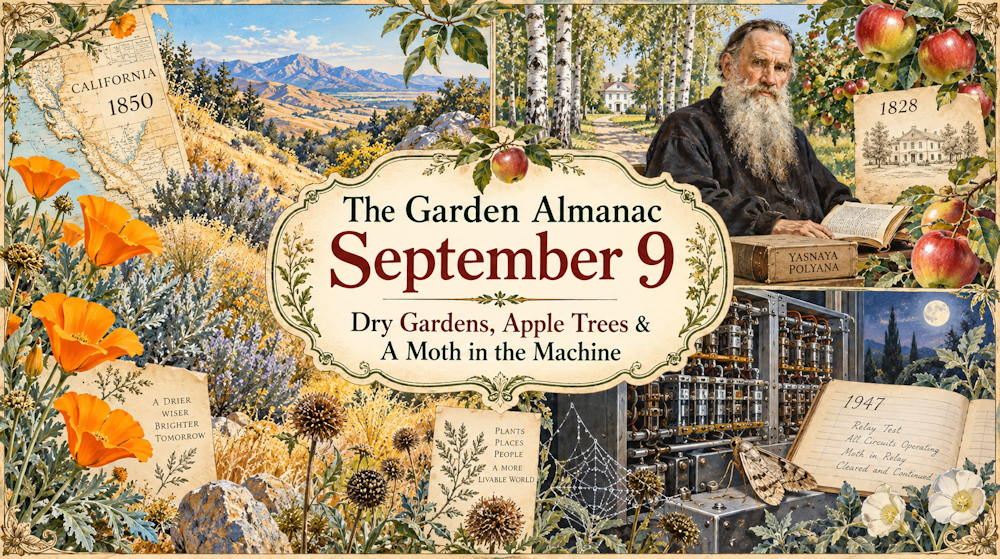
September 9 offers three unusually different ways to read that change. A new American state invites us to think about gardening with climate rather than against it, a Russian writer’s birthday leads into an orchard rich in living history, and a moth trapped in an early computer reminds us that the garden’s night shift is both essential and easily overlooked.
September 9, 1850 – California and the Art of Gardening with a Dry Summer
On September 9, 1850, California became the 31st state of the United States. The decision came amid the Compromise of 1850 and soon after the Gold Rush had accelerated migration, settlement and pressure on land. Long before statehood, Indigenous peoples had shaped Californian landscapes through practices including selective harvesting and carefully managed fire. The date marks not the beginning of the region’s environmental history, but a dramatic new chapter.
California contains deserts, foggy coasts, mountain forests, fertile valleys and exceptional plant diversity. Across much of the state, the climate follows a Mediterranean pattern – rainy winters and warm, dry summers. Many native plants respond with small, leathery or aromatic leaves, deep roots, summer dormancy or growth timed to the wetter months. These are elegant solutions to predictable drought.
That makes California a gardening lesson far beyond its borders. A garden becomes more resilient when plant choice begins with local rainfall, soil, winter temperatures and exposure, rather than with an image borrowed from another climate. Constant irrigation may keep unsuitable planting alive, but disguises a mismatch. Plants adapted to the site generally need less intervention once established and are more likely to support local wildlife.
Early autumn is often the best planting window in summer-dry climates, although gardeners should wait until heat has eased and reliable seasonal rain is approaching. Warm soil encourages root growth, while cooler air reduces water loss from leaves. The principle travels well: plant during the season that gives roots the longest mild, moist interval before the next period of stress. September 9 can therefore serve as a yearly reminder to stop asking how much water a garden can be given and start asking what kind of garden its climate is ready to sustain.
Garden Science – Why do silvery and leathery leaves cope with drought?
Drought-adapted leaves often reduce water loss in several ways. A waxy or leathery surface slows evaporation, a small leaf exposes less area to sun and wind, and fine pale hairs can reflect light while trapping a thin layer of still air. These features do not make a plant drought-proof, especially before its roots are established, but they are useful clues when choosing plants for a hot, exposed bed.
September 9, 1828 – Tolstoy’s Birthday and an Orchard That Became an Archive
Leo Tolstoy was born on September 9, 1828, at Yasnaya Polyana, his family estate south of Moscow. He later wrote much of War and Peace and Anna Karenina there, surrounded not only by rooms and books but by ponds, woods, avenues, fields and orchards. The landscape was part of daily life rather than literary scenery added at a distance, and his simple grave lies in an old wooded part of the estate.
The orchards have a history extending beyond the writer himself. An early 19th-century inventory recorded 849 apple trees representing 34 kinds, while a nursery on the estate raised young fruit and forest trees. Such collections matter because an old orchard is also a genetic library. Varieties once valued for flavour, storage, cooking, hardiness or local disease tolerance can disappear when a narrow range of commercial cultivars replaces them.
A home gardener does not need hundreds of trees to help keep fruit diversity alive. Before buying an apple, pear or plum, look beyond the familiar supermarket names and ask a reputable local nursery about regional cultivars suited to the area’s chill, rainfall and common diseases. Check pollination compatibility and mature size before planting, keep the graft union above soil level, and record the variety and rootstock. One well-labelled tree can preserve both a story and a useful set of traits.
Seasonal Tips – How can you prepare for autumn fruit-tree planting?
- Choose an open position with good light and soil that does not remain waterlogged.
- Match the rootstock to the available space – it largely determines the tree’s eventual vigour and size.
- Check whether the variety needs a compatible pollination partner flowering at the same time.
- Prepare the ground broadly rather than digging a deep pocket of rich compost, which can discourage roots from spreading.
- Order while specialist nurseries still have a good choice, but plant only when conditions are suitable.
September 9, 1947 – The Moth in the Machine and the Garden’s Night Shift
On September 9, 1947, engineers working with the Harvard Mark II computer recorded a wonderfully literal technical fault: a moth had become trapped in a relay. They taped it into the logbook beside the words “first actual case of bug being found”. The word bug had already been used for engineering faults, and the discovery was not the origin of the term, but the preserved moth turned an old expression into one of computing history’s most memorable images.
In a garden, a moth should not automatically be treated as a fault. Moths are food for bats, birds and other animals, and many species carry pollen while visiting flowers after dusk. Their caterpillars may eat leaves, but they are also part of the food web. The sensible response to damage is identification, not reflex spraying: inspect the plant, judge whether harm is serious, and remember that an insect feeding on a leaf may later feed a nest of young birds.
Garden lighting can be the less visible problem. Bright or poorly directed lamps may disturb nocturnal insects’ feeding, navigation and mating. Use outdoor light only where and when it is needed, keep it low, shield it so the beam points downward and choose the least intense suitable setting. Pair darker nights with nectar-rich flowers that remain accessible into evening, and the garden becomes a safer refuelling station for its overlooked night workers.
Wildlife Note – How can you make a garden friendlier to moths?
- Switch off decorative lighting when no one is using the garden.
- Leave some dense vegetation, leaf litter and hollow stems as shelter for different life stages.
- Grow a varied sequence of flowering plants and avoid spraying open blooms.
- Tolerate modest leaf damage until the insect has been identified.
- Look at pale, scented flowers after dusk – their visitors may surprise you.
Garden Reminder – What should you do in the garden in early September?
Early September is a useful moment for selective work, not a wholesale clear-out. Conditions vary widely by climate, so let soil moisture, plant condition and the local forecast decide the exact timing.
- Collect ripe seed on a dry day and store it in clearly labelled paper packets once fully dry.
- Divide congested hardy perennials when the soil is workable and not waterlogged, then water the divisions thoroughly.
- Remove collapsed, slimy or diseased growth, but leave sound stems and seedheads for structure, shelter and bird food.
- Keep newly planted trees, shrubs and perennials watered during dry spells – autumn planting still requires establishment care.
- Pick fallen or damaged fruit promptly if it is diseased, while leaving a little sound windfall in a quiet area for wildlife where appropriate.
What to Observe Right Now – Is the Garden Already Turning Towards Autumn?
Do not look only for changing leaf colour. Notice whether morning dew lingers longer, where low sunlight now reaches beneath shrubs, which fruits are attracting wasps or birds, and which flowers remain busy late in the day. After dusk, spend five quiet minutes near ivy, tobacco plant, honeysuckle or another scented flower and watch for moths. These small observations reveal the garden’s seasonal transition sooner and more accurately than the calendar alone.
Looking Ahead
The stories of September 9 all reward closer attention to place: to the climate beneath a garden plan, the inherited diversity inside an old fruit tree and the nocturnal life beyond a pool of artificial light. The practical future of gardening lies in making such details part of ordinary decisions. Choose plants that fit local conditions, keep useful varieties growing and allow darkness and habitat to remain. A more resilient garden begins not with controlling every element, but with noticing what already works there.