
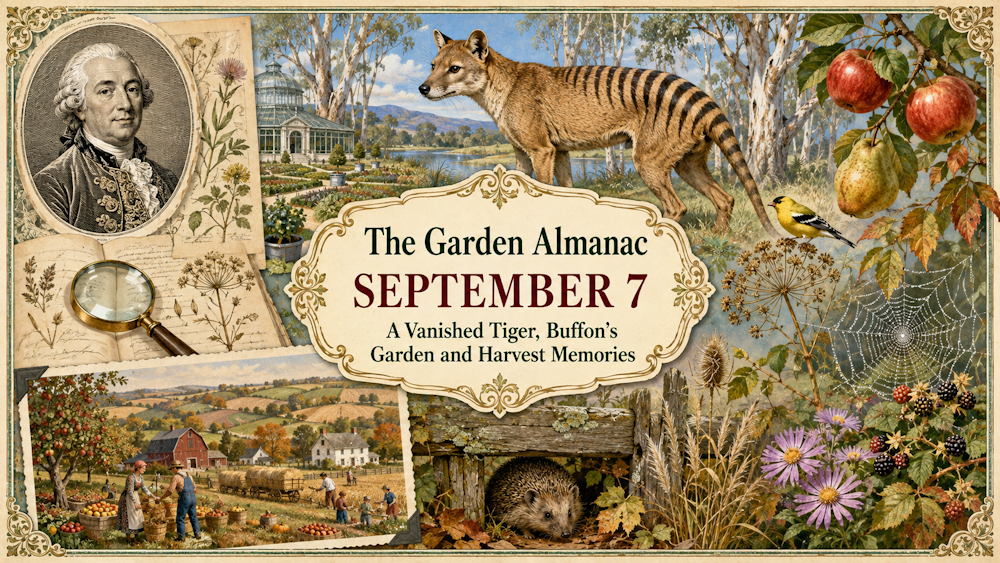

September 7 stands on a seasonal threshold. Across much of the Northern Hemisphere, gardens are beginning to loosen their grip on summer: apples colour, seed heads dry, spiders stretch new webs between stems and the first cool nights slow the growth of tender plants. South of the equator, however, spring is gathering momentum.
The stories attached to this date cross those seasonal boundaries. They take us from the extinction of an extraordinary Australian animal to an eighteenth-century garden transformed into a centre of natural history, and finally into the remembered farm landscapes of one of America’s best-known folk artists. Together, they ask a surprisingly practical question: how closely are we paying attention to the living world around us?
September 7, 1936 – The Day the Last Known Thylacine Died
On September 7, 1936, the last known thylacine died in captivity at Hobart’s Beaumaris Zoo. Also called the Tasmanian tiger because of the dark stripes across its back, this large carnivorous marsupial had once occupied forests, wetlands and open grasslands across Tasmania. European settlement brought livestock, habitat disturbance and a government bounty that encouraged thousands of animals to be killed. Protection finally arrived in 1936, only weeks before the last captive individual died.
The tragedy was not caused by one simple mistake. Hunting played a central role, but habitat loss, fragmentation, introduced dogs and possibly disease also weakened the remaining population. The thylacine depended on a varied landscape rather than a single type of habitat – a mosaic in which shelter, hunting ground and movement routes remained connected. Once that mosaic was broken into smaller and more dangerous pieces, survival became increasingly difficult.
September 7 is now observed in Australia as National Threatened Species Day. Its lesson extends far beyond rare animals and distant wildernesses. Many familiar garden visitors also need connected habitat: hedgehogs travel between feeding areas, amphibians move between water and cover, while insects require different plants or nesting places at different stages of their lives. A garden rich in flowers but isolated by sealed fences and bare paving may be less useful than a slightly untidy garden linked to neighbouring green spaces.
For today’s gardener, the thylacine’s story is a reminder to protect relationships, not merely individual species. A small pond, a gap beneath a fence, a native shrub, an undisturbed leaf pile and a succession of flowering plants can work together as a miniature habitat network. No single feature creates biodiversity by itself, but several connected features can turn an ordinary plot into part of a much larger refuge.
Wildlife Note – How can a garden become easier for animals to cross?
- Leave a ground-level opening of about 13 × 13 centimetres in suitable fences for hedgehogs where they are native.
- Avoid enclosing ponds with steep, smooth sides – provide a shallow margin or escape ramp.
- Connect shrubs, climbers and herbaceous borders instead of leaving isolated “islands” of planting.
- Reduce unnecessary outdoor lighting, especially beside hedges, ponds and flowering plants.
- Keep pesticides away from areas intended to support insects, amphibians and birds.
September 7, 1707 – Buffon and the Garden That Became a Museum
Georges-Louis Leclerc, later known as the Comte de Buffon, was born in Burgundy on September 7, 1707. In 1739 he became intendant of the Jardin du Roi in Paris, a royal garden originally associated with medicinal plants. During the following 49 years, he enlarged the institution, strengthened its teaching and collections, and helped turn it into one of Europe’s leading centres for the study of the natural world.
Buffon’s importance lies partly in the scale of his curiosity. He treated nature as something shaped by climate, geography, time and physical conditions, rather than as a collection of unrelated curiosities. The garden and its collections allowed plants, animals, minerals and specimens from different regions to be studied together. Although many of his ideas were later revised, his reliance on observation and comparison helped widen natural history into an investigation of how living things relate to their environments.
That same approach remains valuable in a private garden. A plant label tells us its name, but regular observation reveals where it truly thrives. Two specimens of the same species may behave differently because one receives morning sun, sits in heavier soil or is exposed to drying wind. Recording flowering dates, frost damage, pest activity and soil moisture turns the garden into a modest but meaningful field station – one capable of showing how local conditions are changing from year to year.
Garden Science – Why do plants behave differently in the same garden?
Gardens contain numerous microclimates. A south-facing wall stores heat, a hollow collects cold air, paving raises nearby temperatures and a hedge slows moisture-stealing wind. Even a difference of a few metres can alter flowering time, frost exposure and water demand. Before moving or replacing an unhappy plant, compare its light, soil moisture and wind exposure with those of healthier specimens elsewhere in the garden.
September 7, 1860 – Grandma Moses and the Memory of the Farming Year
Anna Mary Robertson Moses was born on a farm in New York State on September 7, 1860. She spent much of her life working in rural households and on farms, but did not begin painting seriously until her late seventies. Her first solo exhibition opened in 1940, when she was 80, and her scenes of maple sugaring, haymaking, harvests, winter travel and community gatherings eventually made Grandma Moses an internationally recognised figure in twentieth-century American art.
Her paintings were not technical records of agriculture, yet they preserved something easily lost when farming changes: the rhythm of work imposed by weather and season. Fields, orchards, barns, woodland edges and kitchen gardens were shown as parts of one lived landscape. Harvest was not an isolated event but the visible result of earlier sowing, tending, cutting, preserving and cooperation. Nature provided the calendar, and people organised their labour around it.
Modern gardeners can recover some of that attentiveness without romanticising the hardship of earlier rural life. Photographing the same view each month, noting the first ripe apple or recording when swallows depart can reveal patterns that memory alone tends to blur. Such observations help with practical decisions too: when to sow, which varieties cope best with local conditions and whether flowering or harvest dates are gradually shifting.
What to Observe Right Now – Signs of the September transition
- Seeds darkening and loosening in poppy, fennel and ornamental grass heads
- Morning dew lingering longer on lawns and spider webs
- Later flowers attracting bees during the warmest part of the day
- Apples and pears releasing more easily when gently lifted and twisted
- The first colour changes appearing on stressed, exposed or early-turning trees
- Birds feeding more frequently on berries, insects and ripening seed
Garden Reminder – What Should Be Done in the Early September Garden?
Early September is a useful time to work with the changing season rather than attempting to preserve the garden exactly as it looked in midsummer. Soil often remains warm enough for roots to establish, while cooler air reduces stress on newly planted hardy perennials, shrubs and spring-flowering bulbs. Water new plantings deeply and check the soil below the surface – brief showers may wet the leaves without reaching the root zone.
Collect ripe seed only on a dry day and allow it to finish drying indoors before storing it in labelled paper envelopes. Leave some seed heads standing for wildlife, particularly those of sunflowers, teasels, thistles and ornamental grasses. Remove diseased leaves from beneath susceptible plants, but place clean fallen foliage under hedges or in a leaf-mould container instead of treating every autumn leaf as waste.
Harvest onions and potatoes for storage only when they are dry, and reject damaged specimens because rot can spread during storage. Continue picking beans, courgettes and tomatoes to encourage the remaining crop, while beginning to protect tender plants from unexpectedly cool nights. Where summers are becoming hotter and drier, note which plants recovered after heat stress – those observations may guide more resilient planting choices next year.
A Garden Is Also an Archive
The thylacine, Buffon’s expanding garden and Grandma Moses’ painted farms appear to tell very different stories. Yet each concerns the fate of knowledge held in landscapes. Species preserve evolutionary history, botanical collections preserve evidence and cultivated ground preserves the accumulated experience of people learning to work with seasons.
Gardens can hold such knowledge on a smaller scale. An old fruit variety, a hedge used by generations of nesting birds or a notebook filled with flowering dates may seem ordinary, but each records a relationship between place and time. Protecting these living archives does not mean freezing a garden in the past. It means understanding what is valuable before change makes it impossible to recover.
Looking Ahead
September 7 reminds us that observation becomes most useful when it leads to action. We can connect habitats before wildlife disappears, study our growing conditions before replacing plants, and record seasonal changes before familiar patterns become uncertain. A more resilient garden begins with small, informed choices – one permeable boundary, one well-placed plant and one carefully noted change at a time. The future of the living landscape may depend less on grand gestures than on how faithfully we notice, remember and respond.