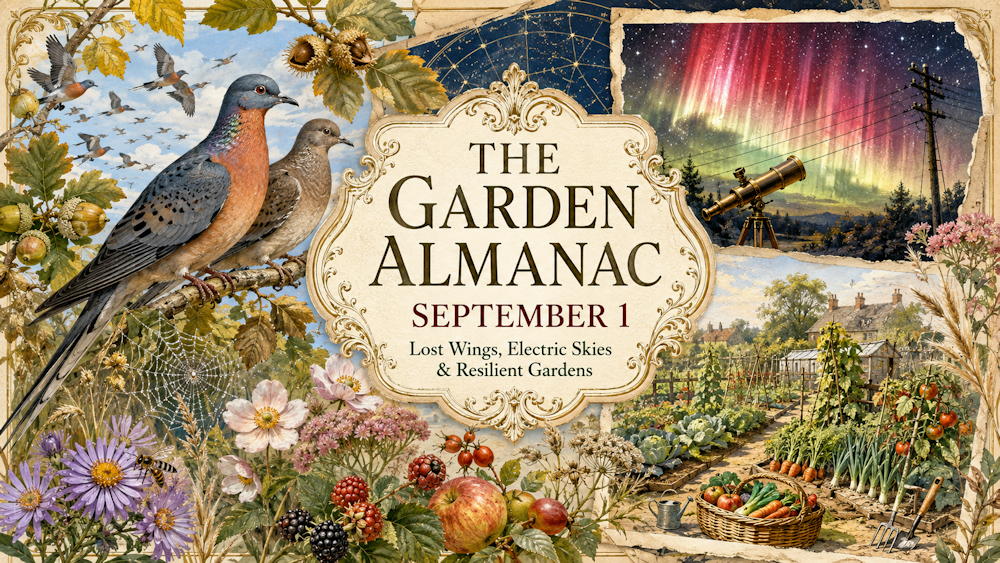

September begins with a curious balance. In much of the Northern Hemisphere, summer is still plainly present in warm soil, ripe fruit and busy insects, yet the light has softened and the evenings are drawing in. Meteorological autumn starts today, but gardens rarely obey a date as neatly as a calendar does.
September 1 also carries three unusually powerful stories about abundance, disturbance and resilience. One recalls a bird once counted in billions, another a night when the sky appeared to catch fire, and the third the moment ordinary plots of soil began to assume new importance in a continent at war. Together, they ask a practical question: how can gardens remain lively, productive and adaptable when the wider world changes?
September 1, 1914 – When the Last Passenger Pigeon Fell Silent
On September 1, 1914, Martha, the last known passenger pigeon, died at Cincinnati Zoo. Only decades earlier, the species had been among the most numerous birds on Earth. Immense flocks moved across eastern North America, sometimes darkening the sky, following the seasonal abundance of acorns, beechnuts, chestnuts, seeds and berries in vast deciduous forests.
That spectacular abundance proved dangerously misleading. Commercial hunting removed birds on an industrial scale, while forest clearance reduced the connected feeding, nesting and roosting areas on which the species depended. Passenger pigeons were intensely social and bred in colonies, so a scattered remnant was not simply a smaller version of a healthy population. At low numbers, the birds could no longer reproduce successfully enough to recover.
Martha’s death became one of conservation history’s clearest warnings: common is not the same as secure. Familiar butterflies, beetles and birds may appear dependable, but populations can decline rapidly when food sources disappear, nesting places become isolated or pesticides remove whole layers of the food web. A garden cannot replace a forest, yet it can form one useful link in a chain of habitats.
For today’s gardener, the practical response is to provide continuity rather than a single token feature. Grow several plants that flower in succession, retain some seed heads through winter, include berrying shrubs, and allow leaf litter to remain beneath hedges where it can shelter invertebrates. If space permits, choose a native tree or shrub suited to the local soil – long-lived woody plants offer food, cover and nesting structure that seasonal flowers alone cannot provide.
Wildlife Note – How can a garden support birds in early autumn?
- Leave sunflower, teasel and other safe seed heads standing where possible.
- Let windfall fruit remain briefly in a quiet area for insects and fruit-eating wildlife, removing anything diseased.
- Keep water clean, shallow and easy to escape from, with a stone or sloping edge.
- Delay major hedge cutting until active nests are no longer present, checking carefully before any work.
- Avoid insecticides – many birds need insects even when feeders are available.
September 1, 1859 – The Day the Sun Touched the Telegraph
On September 1, 1859, British astronomer Richard Carrington was observing a large group of sunspots when he saw an intense burst of white light. The associated solar eruption reached Earth with extraordinary speed, helping to produce the geomagnetic disturbance now known as the Carrington Event. Auroras appeared far beyond their usual polar range, while telegraph systems sparked, failed and, in some cases, reportedly continued operating after their batteries had been disconnected.
This was not weather in the garden-variety sense, but it revealed that Earth’s environment extends far beyond clouds and soil. The Sun drives photosynthesis, evaporation and seasonal rhythms, while its magnetic activity can disturb modern technology. A comparable storm today could affect satellites, communications and power networks – all relevant to irrigation control, transport, forecasting and precision agriculture.
The gardener’s lesson is not to fear the Sun, but to observe it intelligently. Never look directly at it without certified solar-viewing equipment. Use forecasts and digital tools, but keep simple resilience in the garden too: a rain gauge, hand watering option, water butt and written planting notes still work when an app or sensor does not.
Garden Science – Why does September sunlight feel different?
As the Northern Hemisphere tilts progressively away from the Sun, the midday Sun sits lower and daylight shortens. Light travels through more atmosphere and reaches leaves at a shallower angle, while cooler nights slow many growth processes. Plants respond not only to temperature but also to day length: some initiate dormancy, form buds or change flowering behaviour as nights lengthen. This is why late feeding with high-nitrogen fertiliser can be unhelpful for many hardy woody plants – it may encourage soft growth just as tissues should be maturing for colder weather.
September 1, 1939 – When Food Gardens Became Part of Europe’s Defences
Germany invaded Poland on September 1, 1939, beginning the European conflict that became the Second World War. One quieter consequence was a rapid reassessment of cultivated land. Countries dependent on imported food faced disrupted shipping, labour shortages and rationing, and gardens, allotments and parks were increasingly treated as productive ground.
Britain’s Dig for Victory campaign followed in October 1939, encouraging households to grow vegetables on almost any workable patch. Similar efforts developed elsewhere, building on the longer history of allotments and wartime gardens. Their value lies not in romanticising crisis, but in showing how horticultural knowledge, shared land and locally adapted crops can strengthen food resilience.
A modern garden need not imitate a wartime plot, and biodiversity should not be sacrificed to rows of a single crop. The useful principle is planned productivity: grow foods that suit the site and that the household will actually eat, keep soil covered, make compost, save suitable seed, and stagger sowings so that everything does not mature at once. In small spaces, herbs, cut-and-come-again leaves, climbing beans and compact tomatoes can give worthwhile harvests without turning the entire garden into a vegetable field.
Garden Reminder – What should you do in the garden at the start of September?
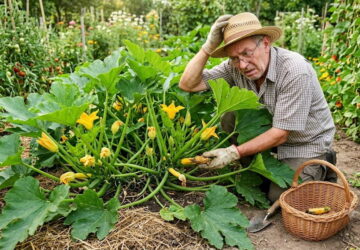
- Harvest courgettes, beans, tomatoes and soft fruit regularly so plants do not waste energy on overripe produce.
- Sow fast or cold-tolerant crops appropriate to your climate, such as radish, rocket, spinach, lamb’s lettuce or winter salads.
- Plant spring-flowering bulbs at the correct depth for the species, generally with the pointed end upward in free-draining soil.
- Divide congested herbaceous perennials once flowering has finished and the soil is moist enough for re-establishment.
- Collect healthy seed only when it is fully mature and dry; label it immediately with the plant name and year.
- Check regional frost dates before pruning, feeding or making late sowings – September conditions vary greatly with latitude and altitude.
What to Observe Right Now – The Garden at the Seasonal Threshold
Early September is an excellent time to notice transitions rather than dramatic endings. Watch which flowers still attract bees during warm midday hours, where dew remains longest in the morning and which parts of the garden cool first after sunset. These small differences reveal valuable microclimates for future planting.
Look also for the beginning of bird movement, spiders becoming more conspicuous in dew-marked webs, ripening hedgerow fruit and the first subtle changes in leaf colour. A yellowing leaf is not automatically a deficiency – on deciduous plants it may be the controlled withdrawal of useful nutrients before leaf fall. Note patterns across the whole plant before reaching for fertiliser.
Seasonal Tips – Build Continuity into Next Year’s Garden
Photograph borders before plants collapse, mark gaps that need spring bulbs, and note which crops struggled with heat, shade or irregular watering. These observations are more valuable than memory alone when seed catalogues arrive in winter.
Think in overlapping seasons. An early spring bulb beneath a summer-flowering perennial, followed by autumn seed heads, can serve the garden for much more of the year than an isolated burst of colour. The same principle applies to food growing: combining quick crops, main crops and overwintering plants spreads harvests and reduces the risk that one spell of bad weather ruins everything.
Looking Ahead
September 1 reminds us that neither abundance nor stability should be taken for granted. Martha’s story argues for connected habitat, the electric sky of 1859 for alertness and practical resilience, and the food gardens of wartime Europe for skills that can be shared before they are urgently needed. A gardener cannot control every change beyond the gate, but can keep soil healthy, make room for wildlife, conserve water and grow at least a little useful food. Those modest choices help create gardens that are not only beautiful today, but better prepared for tomorrow.