

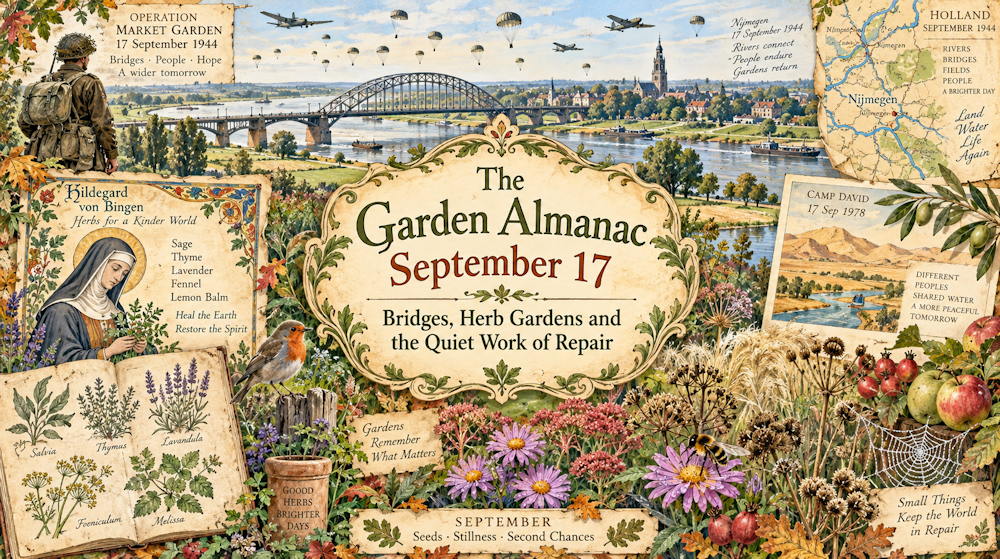

By September 17, the garden has begun to speak in a lower voice. The mornings are cooler, seedheads are drying, late fruit is softening on the branch, and the year’s growth is slowly turning into memory, mulch and next season’s promise.
It is a fitting date for stories about connection: bridges across rivers, remedies gathered from plants, and landscapes where peace depends not only on human agreements, but on water, soil and careful stewardship. September 17 opens a surprisingly rich door into the ways people have tried to cross, heal and repair the living world around them.
September 17, 1944 – Operation Market Garden and the Lessons of a Living Landscape
On September 17, 1944, Allied airborne forces began Operation Market Garden in the Netherlands, one of the largest airborne operations of the Second World War. Its aim was bold: capture a chain of bridges over rivers and canals, open a route into Germany, and perhaps shorten the war. The plan depended not only on military timing, but on landscape – roads, waterways, floodplains, towns, woods and open fields.
For gardeners and nature lovers, this date is a reminder that landscapes are never just scenery. The Dutch countryside was shaped by water management, ditches, raised roads, low fields and river crossings. What looked like a line on a map was, on the ground, a complex living system where movement depended on bridges, soil conditions, visibility, weather and the human-made patterns of drainage and settlement.
The operation’s name has always carried an accidental poetry: “Market Garden”. Yet the real lesson is not romantic. It shows how deeply human plans depend on the land beneath them. A narrow road, a wet meadow, a riverbank or a line of trees can change what is possible. Gardeners know this in quieter ways: a path placed badly stays muddy, a bed in the wrong exposure struggles, and water always reveals whether our design understands the site.
Today, former battle landscapes across Europe also raise questions of repair. Hedgerows, orchards, riversides and village greens are places where memory and ecology meet. Replanting trees, restoring meadows, protecting old field boundaries and caring for pollinator-rich verges are not decorative gestures. They help return structure, life and continuity to places marked by disturbance.
Garden Reminder – What September Paths and Beds Can Teach You
- Walk your garden after rain and note where water collects, runs or compacts the soil.
- Keep autumn paths clear of slippery fruit, leaves and moss, especially near steps and gates.
- Use September observations to plan winter drainage improvements, new stepping stones or better bed edges.
- Avoid heavy digging in waterlogged soil, as it damages soil structure and reduces air spaces around roots.
- Where possible, leave some plant stems and seedheads standing for insects and birds.
September 17 and Hildegard of Bingen – The Garden as a Place of Healing
September 17 is also associated with Hildegard of Bingen, the medieval abbess, writer, composer and herbal thinker who died on this date in 1179. Her world was very different from ours, but her attention to plants, health and the vitality of nature still feels surprisingly close to the gardener’s daily experience.
In monastic gardens, plants were not divided neatly into beauty, food and medicine. Herbs, fruit trees, vegetables and flowers often grew within the same practical and spiritual world. A plant might season food, soothe a wound, scent a room, attract bees and carry symbolic meaning all at once. This layered way of seeing plants is useful even now, when many modern gardens separate the ornamental from the useful too sharply.
Hildegard’s legacy invites today’s gardener to build a garden that supports wellbeing without becoming a pharmacy. A small herb bed of thyme, sage, lavender, lemon balm, fennel or mint can feed pollinators, enrich cooking and encourage closer observation of scent, texture and seasonal growth. The practical lesson is simple: grow herbs in sunny, well-drained soil, harvest lightly and regularly, and let at least some plants flower so bees and hoverflies can use them.
Garden Science – Why Do Herbs Often Taste Stronger in Sunny, Lean Soil?
Many Mediterranean herbs produce aromatic oils partly as protection against heat, drought and grazing. In rich, wet soil, plants may grow lush leaves but develop a milder flavour. In a sunny position with free-draining soil, herbs such as thyme, rosemary, sage and oregano often grow more compactly and produce stronger scent and taste.
This does not mean herbs should be neglected. Water new plants until established, avoid prolonged drought in pots, and trim after flowering to keep growth bushy. The aim is balance: enough care for healthy roots, but not so much feeding and watering that the plant loses its natural character.
September 17, 1978 – Camp David and the Ecology of Peace
On September 17, 1978, the Camp David Accords were concluded, creating a framework that led to peace between Egypt and Israel. At first glance, diplomacy may seem far from the garden. Yet in dry regions, peace and land stewardship are closely linked, because water, agriculture, grazing, settlement and conservation all depend on long-term cooperation.
The landscapes connected with this history include deserts, coasts, irrigated fields and fragile border regions. In such places, soil fertility is never guaranteed and water is never an abstract resource. A canal, well, aquifer, orchard or grazing area can shape livelihoods for generations. The gardener’s version of this lesson is smaller but real: every garden has a water budget, and autumn is an excellent time to think about how wisely it is being used.
For today’s gardeners, the practical message is to design for resilience before stress arrives. Mulch bare soil, collect rainwater where local rules allow, group plants by water needs, and choose species suited to the site rather than forcing thirsty plants into dry ground. Peace with a garden often begins when we stop treating water as an emergency response and start treating it as part of the design.
Seasonal Tips – How to Make an Autumn Garden More Water-Wise
- Add compost or leaf mould to improve soil structure before winter rains arrive.
- Mulch around shrubs and young trees, keeping mulch away from direct contact with stems.
- Move drought-stressed container plants into positions with gentler sun and wind.
- Divide overcrowded perennials so roots have better access to moisture and nutrients.
- Plant autumn bulbs and hardy perennials into well-prepared soil while it is still workable.
September 17 in the Seasonal Garden – The Art of Crossing Over
The middle of September is a crossing point of its own. Summer crops may still be ripening, but the garden is already preparing for dormancy. Tomatoes, peppers, beans, apples, pears, late plums, dahlias, asters and ornamental grasses all show different versions of the same transition: finish, store, seed, colour, release.
This is a good week to become more selective. Remove diseased leaves from vegetables, but do not over-tidy healthy borders. Cut back only what is collapsing, shading new growth or spreading disease. Seedheads of echinacea, teasel, fennel, grasses and many late perennials can remain valuable for wildlife and winter structure.
It is also a useful moment to assess what the year has taught you. Which plants coped with heat? Which needed too much watering? Where did pollinators gather most often? Which corner stayed bare, dry, crowded or damp? September is not only harvest time. It is evidence-gathering time.
Wildlife Note – Why Leave Some Seedheads Standing?
Seedheads feed birds, shelter insects and keep the winter garden structurally alive. Hollow stems may provide overwintering places for small beneficial insects, while late flowers such as asters, sedums and single dahlias can offer nectar when many summer blooms have faded.
If you prefer a tidy garden, compromise by cutting back the front of borders and leaving selected clumps at the back. This keeps the garden cared for while preserving food and shelter. In wildlife-friendly gardening, a little roughness in autumn is not neglect – it is habitat.
What to Observe Right Now – Signs of the Garden Turning
September 17 is an excellent day for looking closely rather than rushing to clear everything away. The garden is full of small signals that reveal how plants and animals respond to shortening days.
Watch for:
- bees visiting late flowers more urgently in mild afternoon sun;
- birds testing seedheads and berrying shrubs;
- spiders building larger webs across paths and stems;
- leaves beginning to colour first on stressed or exposed branches;
- fungi appearing in lawns, mulch or old wood after damp weather;
- ripening fruit attracting wasps, flies and butterflies;
- perennial crowns forming new buds close to the soil for next spring.
These observations are more than seasonal charm. They help you understand where the garden is healthy, where it is under pressure, and where a small change in planting, pruning or soil care could make next year easier.
Looking Ahead
The stories of September 17 remind us that gardens, like landscapes, are built on connections: water to soil, plants to insects, paths to use, memory to repair. A good garden is not made by controlling every detail, but by learning how each part supports the next.
As autumn deepens, the most useful work is often quiet: observing drainage, protecting soil, saving seed, planting thoughtfully and leaving enough habitat for other lives to continue. These small choices prepare the ground for resilience. And in that sense, every September garden becomes a hopeful bridge between what has happened and what can still grow.