


Late August is a season of contrasts. Summer still holds the garden in warm hands, yet mornings arrive with cooler air, ripening fruit and the first unmistakable signs that growth is beginning to slow.
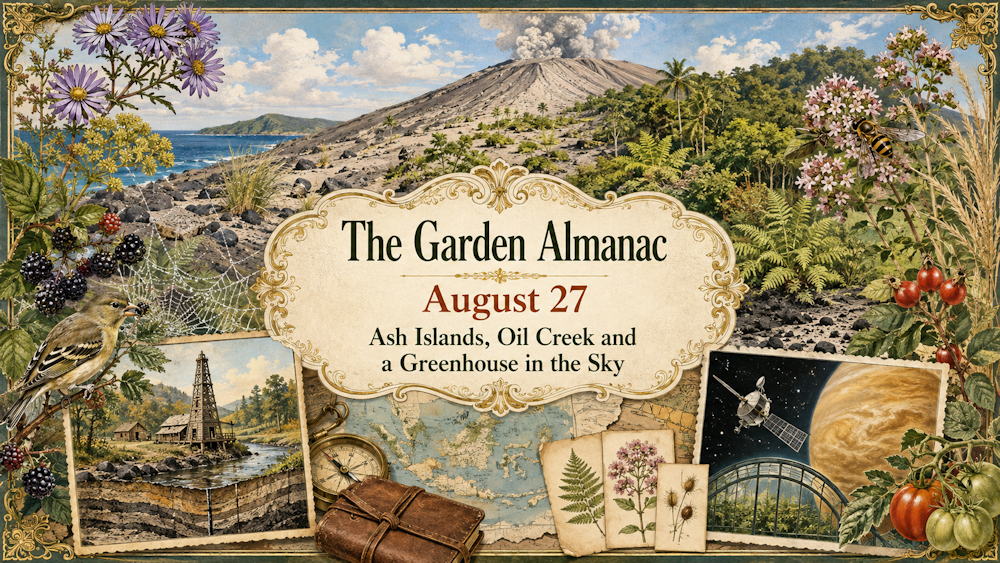
August 27 also holds three remarkable stories about change. One began with a volcanic island stripped almost bare, another with oil rising from a narrow well in Pennsylvania, and the third with a spacecraft setting off towards a planet hidden beneath clouds. Together, they invite us to look more closely at resilience, soil, energy and the delicate balance of heat that shapes every garden.
August 27, 1883 – Krakatau and the Garden That Grew Back
On the morning of August 27, 1883, Krakatau reached the catastrophic climax of an eruption that had been building for months in the Sunda Strait, between Java and Sumatra. Four enormous explosions shattered much of the volcanic island, generated devastating tsunamis and sent ash high into the atmosphere. More than 36,000 people died, most of them in the waves that struck nearby coasts. The effects travelled far beyond Indonesia – pressure waves circled the globe, while volcanic particles contributed to unusually vivid sunsets in distant countries.
For naturalists, the islands left behind also became an extraordinary place to observe ecological recovery. Much of the vegetation appeared to have been destroyed or buried beneath ash and pumice. Yet life gradually returned. Spores and lightweight seeds arrived on the wind, floating fruits and seeds were carried by seawater, and birds brought plant material in mud, droppings and digestive tracts. Ferns, grasses and coastal plants established first, followed over time by scrub and woodland.
Krakatau demonstrated that recovery does not begin with a finished ecosystem. Pioneer plants first stabilise loose material, trap organic debris and soften harsh conditions. Their dead leaves and roots contribute to the beginnings of soil, while shade and moisture create opportunities for less rugged species. Insects, spiders, reptiles, birds and other animals follow as food and shelter become available. The landscape develops through many overlapping arrivals rather than through a tidy, predictable sequence.
A garden is not a volcanic island, but the same principles can guide the repair of disturbed ground. On bare, compacted or recently cleared soil, the first priority is protection rather than perfection. Keep the surface covered with mulch, living ground cover or a temporary green manure; avoid repeated digging; and allow roots, fungi and soil animals to rebuild structure. A resilient garden is rarely created by planting everything at once – it grows through layers, succession and time.
Garden Science – How Does Bare Ground Become Living Soil?
Soil formation begins when weather breaks mineral material into smaller particles, but fertile soil requires biology as well as geology. Roots release carbon compounds that feed microorganisms, fungi connect plants with nutrients, and decomposing leaves add organic matter that improves water retention.
In a garden, this recovery can be encouraged by:
- leaving healthy roots in the ground after cutting plants back;
- applying compost to the surface instead of burying it deeply;
- keeping soil covered against heavy rain, heat and erosion;
- growing several plant families rather than one repeated crop;
- avoiding unnecessary traffic over wet beds.
August 27, 1859 – When Oil Rose beside a Pennsylvania Creek
On August 27, 1859, a drilling operation near Titusville, Pennsylvania, reached an oil-bearing formation at a depth of about 69.5 feet, or 21 metres. The well was associated with Edwin Drake, although the drilling work was carried out with the help of William “Billy” Smith. Oil was noticed rising in the borehole the following day. The well was not the world’s first use or discovery of petroleum, but it proved that oil could be deliberately drilled for and produced commercially in the United States.
The success beside Oil Creek helped trigger an oil boom and marked a turning point in humanity’s relationship with the ground beneath its feet. Petroleum transformed lighting, transport, manufacturing and agriculture. It also brought leaking wells, spills, industrial disturbance and, on a much larger scale, carbon emissions that now affect growing seasons, rainfall patterns and the frequency of extreme heat.
For gardeners, the anniversary offers a practical reminder that apparently healthy ground can carry an invisible history. Soil near old workshops, fuel tanks, busy roads or industrial land should not automatically be treated as suitable for food crops. If contamination is possible, obtain a professional soil test appropriate to the site. Raised beds with a barrier and verified clean soil may reduce contact with the original ground, but they do not remove the source of contamination. Never compost soil or plants suspected of being polluted with petroleum products.
Garden Reminder – Late-August Soil Care
As summer beds begin to empty, protect the soil that supported them:
- Sow a suitable green manure where a bed will remain unused for several weeks.
- Mulch bare ground with compost, leaf mould, straw or other clean organic material.
- Water deeply but less often, directing water towards roots rather than foliage.
- Do not cultivate wet soil – working it when saturated can destroy its crumb structure.
- Record where crops grew so that next season’s rotation is easier to plan.
August 27, 1962 – Mariner 2 and the Planetary Heat Trap
On August 27, 1962, Mariner 2 launched from Cape Canaveral on its journey to Venus. When it flew past the planet that December, it became the first successful spacecraft mission to another planet. Venus had often been imagined as a humid, perhaps even luxuriant world beneath its permanent cloud cover. The measurements returned by Mariner 2 helped replace that enticing picture with evidence of extreme heat.
Later missions revealed the full severity of Venusian conditions, but Mariner 2 provided crucial early support for the idea that the planet’s surface was intensely hot. Its atmosphere, dominated by carbon dioxide, traps heat through an extreme greenhouse effect. Venus is not a simple model of Earth’s future, yet its study has greatly improved scientific understanding of how atmospheric gases influence planetary temperature.
The same physical principle operates on a gentler scale in greenhouses, cold frames and glazed conservatories. Short-wave sunlight enters and warms surfaces, which then release energy as heat. Enclosed structures also prevent warm air from mixing freely with cooler outdoor air. In late August, a closed greenhouse can therefore overheat even when the day feels moderate. Open vents early, maintain airflow, check containers daily and use shade where necessary. Tomatoes and peppers need warmth, but excessive heat can impair pollination, scorch leaves and cause pots to dry with surprising speed.
Garden Science – Why Is a Greenhouse Hotter Than the Garden?
A greenhouse warms partly because sunlight heats soil, staging, pots and plants, but restricted air movement is equally important. The warmed air cannot escape as readily as it would outdoors.
Automatic vent openers are useful, but they should not be the only protection during hot weather. Cross-ventilation works best when fresh air can enter low down and warmer air can leave through higher vents. A maximum–minimum thermometer reveals temperature spikes that may occur while nobody is in the greenhouse.
Wildlife Note – Who Needs the Late-Summer Garden?
By late August, many flowers are fading, but insects still require nectar and pollen. Ivy may not yet be in full bloom, so late-flowering plants can bridge an important seasonal gap. Sedum, asters, oregano, single-flowered dahlias and other regionally suitable species can keep food available for bees, hoverflies and butterflies.
Leave some seed heads standing where they do not interfere with diseased-plant removal. They provide food for birds and shelter for small invertebrates, while hollow or pithy stems may later become overwintering sites. Avoid cutting the entire garden back at once – a mixture of tidy working areas and undisturbed patches supports more wildlife.
What to Observe Right Now – The Garden at Summer’s Turning Point
August 27 falls close to a subtle seasonal threshold. Look beyond the most obvious flowers and notice how the whole garden is adjusting:
- Which fruits change colour before they soften or develop their full aroma?
- Where does dew remain longest in the morning?
- Are spiders rebuilding webs in the same sheltered positions?
- Which plants continue flowering after neighbouring species have set seed?
- Do tree leaves show drought stress, natural ageing or signs of disease?
- Which bare patches are being colonised first, and by what plants?
These observations can improve future decisions. Persistent dry zones may need more organic matter, early leaf fall may reveal water stress, and concentrated insect activity can identify the flowers most valuable during the late-summer food gap.
Looking Ahead
The stories of August 27 show that gardens are shaped by forces operating at very different scales – from microorganisms rebuilding soil to industries altering the atmosphere. Krakatau teaches patience with ecological recovery, Oil Creek reminds us to protect the ground from hidden pollution, and Mariner 2 reveals how powerfully heat can be trapped.
The practical response begins close to home: cover bare soil, investigate uncertain land, ventilate growing spaces and keep late flowers available for wildlife. None of these actions is dramatic on its own, but together they help create gardens that are safer, more observant and better prepared for change.