


Late August often feels settled. Gardens are heavy with ripening fruit, seed heads and tired foliage, while the first cooler mornings hint that the season is beginning to turn. Yet August 26 carries stories of profound change – landscapes remade, invisible plant processes revealed and old barriers finally challenged.
Today’s almanac travels from a volcanic island in Indonesia to an eighteenth-century laboratory in Paris and the long campaign for women’s political equality in the United States. Each story offers the gardener something practical: how nature rebuilds, why roots need air and why preserving knowledge can be as important as preserving seed.
August 26, 1883 – When Krakatau Became a Garden from Nothing
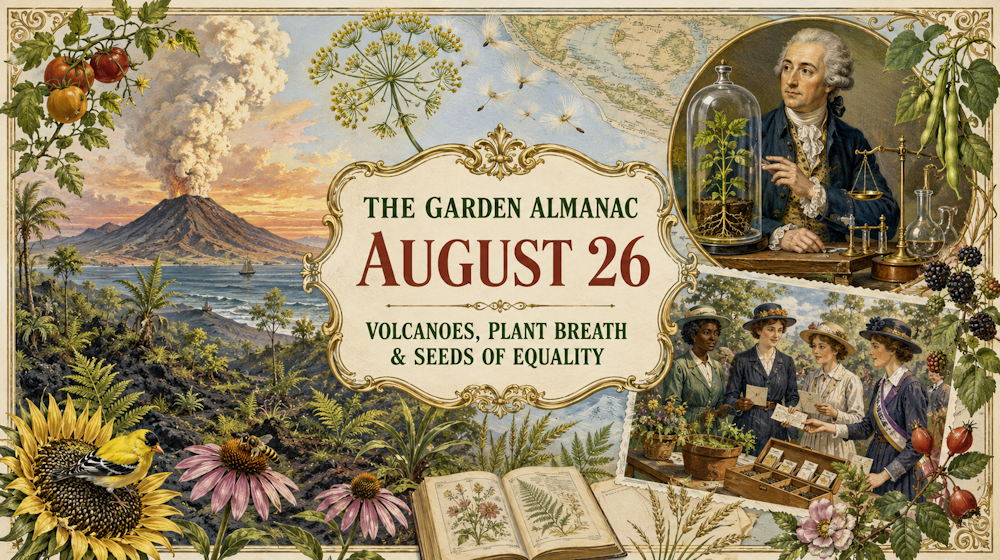
On the afternoon of August 26, 1883, the eruption of Krakatau entered its catastrophic final phase. The volcano lay in the Sunda Strait between Java and Sumatra, in what was then the Dutch East Indies and is now Indonesia. Ash rose high above the island, explosions followed one another at short intervals and waves began striking neighbouring coasts. The following morning brought the most destructive blasts and tsunamis, killing tens of thousands of people and stripping vegetation from the islands.
The disaster also created one of the world’s most remarkable natural experiments. Thick ash and volcanic debris covered the surviving pieces of Krakatau, leaving researchers to ask how life could return to a devastated landscape. Spores and lightweight seeds arrived on the wind, while currents, floating vegetation, birds and other animals carried further colonists from nearby islands. Ferns, grasses and other pioneers established first, followed over time by shrubs, trees and increasingly complex plant communities.
Krakatau showed that ecological succession is neither a tidy march nor a fixed recipe. Which species arrive first depends on distance, wind, water, chance and the conditions they encounter. A plant able to tolerate fierce sunlight and poor, unstable ground may prepare the way for another by trapping organic matter, shading the surface or providing food and shelter for animals. As vegetation develops, plants alter the very habitat in which they grow.
A garden is not a volcanic island, but the same principle works at a smaller scale. Bare soil rarely remains bare, and the first plants to appear are not necessarily signs of failure. On disturbed ground, deep-rooted or fast-growing pioneer plants can protect the surface, support insects and begin rebuilding soil structure. Where safe and practical, cover an empty bed with green manure, mulch or a planned ground cover instead of repeatedly clearing it back to exposed earth.
Garden Science – How does vegetation return to bare ground?
Primary succession begins where little or no developed soil remains. Early colonisers tolerate harsh conditions and gradually add organic matter as roots, leaves and stems die. Fungi, microbes and small animals join the developing community, nutrients begin to cycle more effectively and later plants gain somewhere to establish. Gardeners can speed up a similar recovery by protecting the soil surface, adding mature compost and avoiding unnecessary disturbance.
August 26, 1743 – Lavoisier and the Hidden Chemistry of a Living Garden
Antoine Lavoisier was born in Paris on August 26, 1743. His careful measurements helped transform chemistry, particularly through his work on oxygen, combustion and the conservation of mass. Working with Marie-Anne Paulze Lavoisier, whose translations, illustrations and scientific collaboration were essential to their laboratory, he helped replace vague theories with experiments that could be measured and repeated.
The consequences reached far beyond chemistry. Lavoisier’s investigations connected respiration with the use of oxygen and the release of carbon dioxide and energy. Later plant science revealed the complementary processes at work in a garden: photosynthesis uses light energy to build sugars from carbon dioxide and water, while respiration releases usable energy from those sugars. Plants photosynthesise in sufficient light, but living cells in leaves, stems and roots respire continuously.
That distinction explains a common gardening puzzle. A plant may wilt in saturated soil even though water is abundant because water has displaced much of the air around its roots. Without enough oxygen for normal root respiration, roots lose their ability to function properly, and prolonged waterlogging can cause damage or death. If a container stays wet for days, check its drainage holes, empty any water-filled saucer and use a growing medium suited to the plant rather than responding automatically with more water.
Garden Reminder – What should you do in the late-August garden?
- Water deeply when the soil below the surface is dry, preferably in the morning.
- Check containers after heavy rain and make sure excess water can escape freely.
- Harvest courgettes, beans, cucumbers and tomatoes regularly to keep productive plants going.
- Remove diseased leaves, but leave healthy seed heads where they can feed birds.
- Stop giving tender perennials high-nitrogen feed if they need time to produce firmer growth before cooler weather.
August 26, 1920 – Votes, Gardens and Knowledge That Deserved a Voice
On August 26, 1920, US Secretary of State Bainbridge Colby certified the Nineteenth Amendment, which prohibited denying citizens the vote on the basis of sex. It was a decisive constitutional change, although discriminatory laws and practices continued to prevent many women, particularly women of colour, from voting freely. Fifty years later, campaigners chose the same date for the nationwide Women’s Strike for Equality, and August 26 subsequently became Women’s Equality Day in the United States.
Gardens offer their own revealing view of that history. Women had long grown food, selected seed, exchanged plants, taught children and organised community improvement, yet their expertise was often treated as domestic habit rather than professional knowledge. Greater access to education, public life and horticultural careers allowed more women to shape botanical research, landscape design, conservation, garden writing and agricultural policy. The plants in our gardens therefore carry not only genetic histories but also histories of whose observations were recorded and whose were overlooked.
A useful response is to treat gardening knowledge as something to document and share. When saving seed from open-pollinated beans, peas, tomatoes or flowers, record the variety, harvest date and qualities that made the plant worth keeping. Note whether it coped well with drought, flowered for an unusually long period or attracted particular pollinators. Exchanging both seeds and observations helps preserve crop diversity while ensuring that practical knowledge does not disappear when one gardener leaves a plot.
Wildlife Note – Why leave some late-summer seed heads standing?
Seed heads provide natural food for finches and other seed-eating birds, while hollow or pithy stems may later shelter overwintering insects. Leave healthy stems of plants such as sunflowers, teasels and coneflowers where they will not spread invasively. Delay cutting them until late winter or early spring, and remove any material showing serious disease.
What to Observe Right Now – Signs That Summer Is Turning
Late August is a season of overlap rather than a sudden ending. Look beyond fading flowers and the garden reveals active seed dispersal, fruit ripening, renewed growth after rain and wildlife adjusting its behaviour.
- Notice which plants still attract bees and hoverflies when earlier flowers have finished.
- Watch for seeds travelling by wind, clinging to fur or dropping close to the parent plant.
- Compare dry, compacted soil with ground protected by leaves or mulch after rainfall.
- Look for cooler corners where dew lingers longer in the morning.
- Listen for changes in birdsong and watch birds feeding more frequently on berries and seeds.
These observations can guide future planting. A late-flowering perennial crowded with insects deserves space next year, while a bed that repeatedly dries or floods may need better soil cover, a change of planting or improved drainage.
Looking Ahead
August 26 reminds us that gardens are shaped by disturbance, discovery and participation. Krakatau demonstrates that recovery begins with arrival and opportunity; plant respiration shows that healthy growth depends on conditions we cannot always see; and the history of equality asks whose knowledge is allowed to take root. By protecting soil, understanding plant needs and sharing seeds and observations generously, gardeners can create spaces that are both more resilient and more diverse. The future garden begins with what we notice – and what we choose to preserve – today.