


By late August, a garden often seems to contain two seasons at once. Tomatoes and beans are still arriving in generous handfuls, yet seed heads are forming, shadows are lengthening and the first tired leaves are beginning to show.
August 23 opens an unusually wide window onto this moment. It takes us from a spacecraft looking homeward across the Moon to the sugar plantations of the Caribbean and the vegetable fields of California. Together, these stories ask a deceptively simple question: what does it mean to care for the ground that sustains us?
August 23, 1966 – The First Earthrise Seen from Lunar Orbit
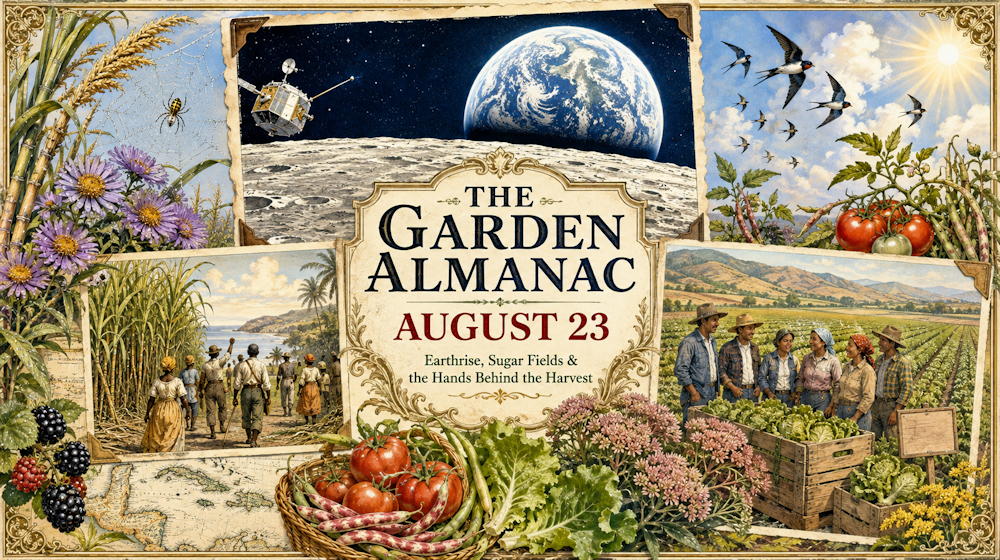
On August 23, 1966, NASA’s Lunar Orbiter 1 turned its camera away from the lunar surface and captured the first photograph of Earth taken from the vicinity of the Moon. The image was not part of the spacecraft’s primary assignment, which was to photograph potential landing sites for future Apollo missions. Yet the unexpected picture became one of the mission’s most enduring achievements.
The photograph was grainy and monochrome, unlike the celebrated colour Earthrise image made by Apollo 8 two years later. Even so, it revealed something profound: beyond the barren lunar horizon hung a single distant world containing every forest, farm, wetland and garden known to humanity. No borders were visible, and neither were the divisions between cultivated and wild land.
For gardeners, this view is more than an inspiring historical image. It is a reminder that soil, water and atmosphere form connected systems. Fertiliser washed from one plot can reach a stream; peat extracted for compost can affect distant wetlands; a flowering garden can become one small link in a much larger network of habitats. What happens within a fence rarely remains entirely inside it.
The photograph also offers a useful principle for garden planning: think beyond individual plants. A healthy garden depends on relationships among soil organisms, roots, insects, birds, water and weather. Choosing plants suited to local conditions, protecting soil from erosion and reducing unnecessary chemical use help the whole system function rather than treating each problem in isolation.
Garden Science – Why does bare soil dry out so quickly?
Uncovered soil receives direct solar radiation, allowing water to evaporate rapidly from its surface. Heat can also reduce biological activity in the uppermost layer. A covering of compost, leaf mould or other organic mulch shades the ground, slows evaporation and softens the impact of heavy rain.
Keep mulch a few centimetres away from the stems and crowns of plants. A layer around 5–8 cm deep is usually sufficient for established beds, provided the soil is already moist before it is applied.
What to Observe Right Now – Late Summer’s Quiet Turning Point
August 23 falls near the threshold between high summer and the first clear signs of seasonal change across much of the Northern Hemisphere. The calendar may still say summer, but plants and animals are already responding to shortening daylight, maturing fruits and cooler nights.
Look for:
- seed heads developing on grasses, perennials and wildflowers
- earlier dew lingering on lawns and leaves
- spiders becoming more conspicuous in morning light
- swallows and other migratory birds gathering or feeding intensely
- late pollinators visiting asters, sedums, heleniums and other nectar-rich flowers
- deciduous trees shedding a few stressed leaves after hot or dry weather
Not every yellow leaf signals disease. In late summer, older leaves may be discarded because of drought, natural ageing or shade within dense growth. Check the pattern before acting: widespread spotting, distortion or rapid decline deserves investigation, while a handful of ageing lower leaves is often normal.
August 23, 1791 – When a Plantation Colony Rose Against Slavery
The night of August 22–23, 1791 marked the beginning of a major uprising among enslaved people in Saint-Domingue, the French colony that later became Haiti. The revolt developed into the Haitian Revolution and ultimately contributed to the creation of an independent state. August 23 is now observed internationally as a day of remembrance for the slave trade and its abolition.
Saint-Domingue’s immense colonial wealth had been built largely on plantation crops, particularly sugar and coffee. Their apparent abundance concealed a brutal system in which land and human lives were exploited together for distant markets. The history of these familiar plants therefore reaches far beyond botany or taste: it is also a history of forced labour, transformed landscapes and economies organised around monoculture.
For today’s gardener, the practical lesson begins with curiosity about origins. Sugar, coffee, cocoa, cotton, spices and many ornamental plants travelled through trade systems that profoundly changed both societies and ecosystems. Learning where a plant comes from, how it is grown and who produces it turns an ordinary purchase into a more informed decision. Fairly traded goods, responsibly produced materials and peat-free or locally sourced garden products can reduce hidden social and environmental costs.
Garden Inspiration – Grow plants with their stories attached
When growing a crop with a long global history, add its origin and traditional uses to the plant label or garden journal. Beans, chillies, tomatoes, maize and many herbs carry histories of cultivation, migration and cultural exchange. Knowing those stories makes a kitchen garden richer without requiring it to become larger.
Wildlife Note – Should Late-Summer Seed Heads Be Cut Down?
Not all fading flowers need immediate removal. Seed heads can provide food for finches and other birds, while hollow or pithy stems may later shelter insects. Their structure also gives beds winter interest and protects some plant crowns from severe weather.
Leave healthy stems standing where they are not smothering nearby plants or spreading unwanted seed. Particularly useful choices include coneflowers, teasels, sunflowers and many ornamental grasses. Diseased material, however, should be removed rather than left in place.
A mixed approach works best: deadhead selected plants to prolong flowering, collect seed from favourites and leave part of the border undisturbed for wildlife. Tidiness and biodiversity do not have to be opposing choices.
August 23, 1970 – The Strike That Stopped the Salad Fields
On August 23, 1970, thousands of agricultural labourers walked out of California’s vegetable fields in what became known as the Salad Bowl strike. Centred on the Salinas Valley and led by the farmworker movement associated with César Chávez, it grew into one of the largest farmworker strikes in United States history.
The name referred to a landscape famous for lettuces and other vegetables rather than to a single crop. These highly productive fields supplied vast quantities of fresh food, but the strike drew attention to the workers whose labour made that abundance possible. It challenged consumers to see a head of lettuce not simply as a plant or commodity, but as the end of a chain involving soil, irrigation, skill, transport and human effort.
Home-grown produce provides only a glimpse of that labour. Sowing a row of lettuce, protecting it from heat, watering it consistently and harvesting it before it bolts makes clear why fresh vegetables cannot be separated from the people who tend them. Gardeners can carry this awareness into the marketplace by wasting less food, buying seasonal produce and supporting growers and supply chains that treat workers fairly.
Garden Reminder – What should be done in the late-August vegetable garden?
- Harvest courgettes, beans and cucumbers frequently so plants continue producing.
- Pick tomatoes as they colour, especially if heavy rain is forecast, to reduce the risk of splitting.
- Water leafy crops deeply and consistently, as alternating drought and heavy watering can cause stress.
- Sow fast-growing radishes, rocket and suitable salad leaves for an autumn crop.
- In hot regions, give new seedlings temporary afternoon shade and keep the seedbed evenly moist.
- Remove badly diseased leaves, but avoid heavy pruning that suddenly exposes fruits to strong sun.
Lettuce and many other salad crops germinate poorly in very warm soil. If late-summer sowings repeatedly fail, move the container or seed tray to a cooler position, sow in the evening and keep the growing medium moist without waterlogging it. Choosing heat-tolerant or autumn varieties can also make a considerable difference.
A Garden Seen as a Whole
The three stories attached to August 23 operate on very different scales. One looks back at Earth from 380,000 kilometres away. Another confronts the plantation system that reshaped Caribbean land and lives. The third enters the vegetable fields behind an everyday meal.
Yet all three discourage us from seeing plants in isolation. Every crop is connected to a landscape, every harvest to labour and every garden decision to a wider living system. Even a small plot participates in cycles of water, carbon, nutrients, migration and trade.
This perspective need not make gardening feel burdensome. It makes ordinary actions more meaningful. Saving water, feeding the soil, leaving habitat for wildlife, choosing responsibly produced materials and valuing the people who grow our food are modest acts, but they move in the same direction.
Looking Ahead
The first lunar view of Earth showed a finite garden suspended in darkness, while the histories of Haiti and California reveal how closely cultivation is tied to human dignity. The future of gardening will depend not only on what we grow, but on how carefully we use land, water and labour. A thoughtful garden can conserve resources, welcome other species and deepen respect for the people behind every harvest. On August 23, the most useful place to begin is close at hand: with the soil beneath our feet and the connections we choose to notice.