

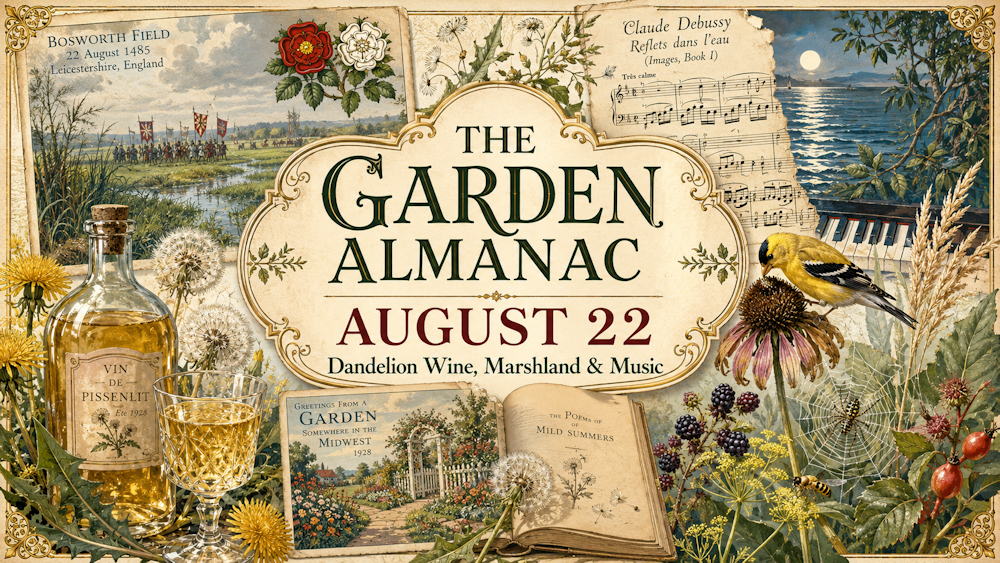

By August 22, the garden has begun to speak in two seasons at once. Dahlias and late summer perennials may still be full of colour, yet seed heads are forming, berries are ripening and cooler mornings occasionally carry the first suggestion of autumn.
This date also connects three very different landscapes: an English field whose soil helped reveal the site of a decisive battle, the imagined Midwestern gardens of a celebrated American storyteller, and the coasts, rain and moonlit water that inspired one of France’s most influential composers. Together they remind us that landscapes are not passive backgrounds. They preserve evidence, awaken memory and teach us how closely human culture is rooted in the natural world.
August 22, 1920 – Ray Bradbury and the Summer Preserved in Dandelion Wine
Ray Bradbury was born in Waukegan, Illinois, on August 22, 1920. The town later became the model for Green Town, the fictional setting of several of his works, including Dandelion Wine. In that novel, the making of dandelion wine becomes a way of bottling the days of summer – each bottle holding something of warm pavements, cut grass, family gardens and childhood discovery.
The title works because the dandelion is such an ordinary yet astonishing plant. Its familiar yellow flower is actually a composite head made up of many small florets. After flowering, these produce a globe of parachute-like fruits that can be carried away by air currents. A deep taproot helps the plant survive mowing and dry periods, while new leaves grow from a low rosette close to the soil.
For gardeners, Bradbury’s dandelion is a useful lesson in attention. A plant labelled as a weed may also be an edible species, an early source of pollen and nectar, a soil indicator and a small piece of cultural history. That does not mean dandelions must be allowed to take over vegetable beds or newly sown lawns. It does suggest that control can be selective: remove plants before seed dispersal where they are troublesome, but consider tolerating a few in less formal areas.
Late August offers its own opportunities to preserve the season. Herbs can be dried, ripe tomatoes turned into sauce, berries frozen and flower seeds gathered for next year. The practical principle is simple: harvest only healthy material, label everything clearly and never eat a wild or garden plant unless its identity and safety are certain. A jar of seeds, dried leaves or preserved fruit can become the gardener’s own version of Bradbury’s bottled summer.
Garden Science – Why are dandelions so difficult to remove?
Dandelions store energy in a substantial taproot. If only the leaves are removed, surviving root tissue can produce new growth. Digging is most effective when the soil is moist and as much of the root as possible can be lifted intact. Repeatedly removing regrowth will gradually weaken an established plant, while maintaining dense, healthy ground cover reduces the open soil in which new seedlings can establish.
August 22, 1485 – What the Ground Revealed at Bosworth
On August 22, 1485, the forces of Richard III and Henry Tudor met near Market Bosworth in central England. Richard was killed, Henry won the crown, and the Tudor dynasty began. The battle became known as the decisive encounter of the Wars of the Roses, although the familiar red and white roses were later simplified into a much tidier symbol than the conflict itself.
For centuries, the precise location of the fighting remained uncertain. Historical accounts mentioned marshy ground, but the modern landscape had been altered by drainage, agriculture, woodland planting, a canal and a railway. Detailed investigation eventually placed the core battlefield farther from the traditionally accepted site. Soil evidence, historical field names, topography and the distribution of metal objects all helped reconstruct how the land may have shaped the battle.
Bosworth demonstrates why old landscapes deserve to be read before they are redesigned. A hollow may mark a former pond, a line of mature shrubs may preserve an ancient boundary, and moisture-loving plants may reveal where water still gathers below the surface. Gardeners can use the same habit of observation on a smaller scale. Before improving a persistently damp or dry patch, watch it through rain and drought, examine the soil and choose plants suited to the conditions rather than forcing the entire garden into uniformity.
Garden Inspiration – Read the history beneath your garden
- Compare old photographs or maps with present boundaries and mature trees.
- Observe where water remains after heavy rain and where soil dries first.
- Look for changes in vegetation that may indicate buried rubble, compacted ground or former paths.
- ished hedges, veteran trees and undisturbed corners before beginning major work.
- Adapt planting to the site’s existing character whenever possible.
A wet hollow need not automatically be filled or drained. Where conditions allow, it can become a rain garden planted with species that tolerate periodic saturation. Such areas slow runoff, allow water to soak into the ground and create more varied habitat than a uniformly dry lawn. The first rule of good garden design is often the same as the first rule of landscape archaeology: understand the ground before changing it.
August 22, 1862 – Claude Debussy and the Garden of Sound
French composer Claude Debussy was born on August 22, 1862, in Saint-Germain-en-Laye. His music departed from many established European conventions and often drew its energy from atmosphere, light and movement. Titles and musical images associated with clouds, rain, moonlight, wind, gardens and the sea reveal a composer deeply attentive to natural rhythms.
Debussy did not reproduce nature as a simple sound effect. Instead, shifting harmonies and changes in tone created impressions of water, weather and light that never remain completely still. Gardeners know a similar experience. A garden is not a fixed composition: grasses bend, leaves expose their pale undersides before rain, shadows move across a border and the character of a planting changes with every hour.
This is a reminder that a successful garden can be designed for the ear as well as the eye. Leaves of different sizes produce different sounds, seed heads rustle, gravel marks approaching footsteps and water introduces a cooler acoustic note. When choosing where to place a seat, spend a few quiet minutes listening first. Moving noisy equipment, choosing gentler water circulation and planting a wind-filtering hedge can make a resting place feel more secluded without adding a wall.
Wildlife Note – What should you hear in a late summer garden?
Listen for the hum of insects around nectar-rich flowers, the dry whisper of grasses and the calls of birds moving through hedges. A garden that is completely silent during suitable weather may lack food, water or shelter. Avoid broad insecticide use, retain dense shrubs for cover and provide a shallow water source with safe, gently sloping edges.
Garden Reminder – What should gardeners do in late August?
Late summer is not the moment to clear everything that has begun to fade. Some plants benefit from deadheading, while others are more valuable if allowed to form seed.
- Deadhead dahlias, roses and other repeat-flowering plants to encourage further blooms.
- Leave selected coneflowers, sunflowers and ornamental grasses standing for birds, insects and winter structure.
- Check soil below the surface before watering. If it is dry about 5 cm down, water deeply around the root zone rather than sprinkling the foliage.
- Water containers separately, as they can dry out much faster than garden soil.
- Collect ripe seed heads on a dry day and store fully dried seeds in labelled paper envelopes.
- Remove diseased leaves and fallen fruit, but place healthy plant material in the compost.
- Sow suitable fast-growing autumn crops, such as radishes or leafy greens, where the local growing season is long enough.
Plants producing fruit or preparing perennial buds for the following year can still be stressed by irregular moisture. Mulch helps slow evaporation, but it should not be piled against stems or tree trunks. A small gap around the base reduces the risk of persistent dampness and decay.
What to Observe Right Now – The first quiet turn towards autumn
Look closely at late summer borders and you will see that the seasonal handover has already begun. Spiders stretch webs between stems, berries gain colour, grasses release pollen or develop seed, and some migrating birds begin to appear in new places.
Notice which flowers attract insects when little else is blooming. These plants reveal the garden’s late-season nectar gaps and can guide future planting. Also watch where birds feed: they may lead you to fruiting shrubs, seed-rich perennials or insect-filled corners worth protecting.
Do not be alarmed if some birds look untidy at this time of year. Many species replace worn feathers during late summer or early autumn, and moulting individuals may appear patchy or unusually quiet. Fresh water and nearby cover are particularly useful while they are less agile.
Looking Ahead
August 22 shows how much can be stored in a landscape: a remembered summer in a dandelion, centuries of evidence in damp ground and an entire world of weather in a sequence of sound. The forward-looking garden begins with this kind of close observation. By working with existing soil, preserving useful seed heads and making room for water and wildlife, we create spaces that are both resilient and rich in meaning. The season may be turning, but the garden is already composing next year.