
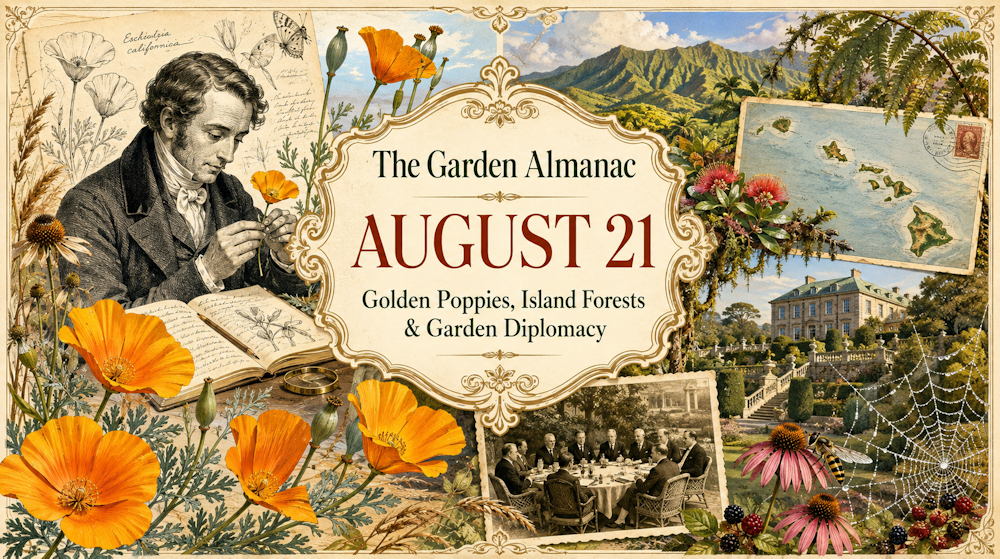

By August 21, the garden has begun to speak in two seasons at once. Summer is still busy in the flowers, but seed heads are forming, shadows are lengthening and the first signs of change are appearing at the edges of the day.
This date also opens three unusually far-reaching windows onto the living world: a poet-botanist who gave California’s golden poppy its scientific name, an island chain whose political anniversary carries an urgent lesson in ecological isolation, and a Washington garden where plans for a new international order took shape. Together, they ask a very practical question – how carefully do we notice, name and care for the places entrusted to us?
August 21, 1838 – The Poet-Botanist Behind the Golden Poppy
Adelbert von Chamisso died in Berlin on August 21, 1838, leaving a career divided, unusually fruitfully, between literature and botany. Born in France and established in Prussia, he sailed as naturalist on the Russian expedition ship Rurik from 1815 to 1818. In San Francisco Bay, his records of plants and animals became an early ecological snapshot of a changing landscape.
Among the plants he studied was the luminous orange flower now known as Eschscholzia californica. Chamisso formally described it and named the genus for his shipmate Johann Friedrich Eschscholtz, a physician and naturalist. The California poppy had, of course, been known to Indigenous peoples long before European taxonomists encountered it. What Chamisso added was a name within the international botanical system – a reminder that scientific naming can help knowledge travel, but does not mark the beginning of a plant’s human history.
The poppy itself offers a better gardening lesson than any heroic tale of discovery. It is adapted to open, sunny ground and relatively lean, sharply drained soil. Its taproot makes established plants resent transplantation, so seed is best sown where the flowers are to grow. In climates resembling its native western North American range, autumn sowing lets winter moisture prepare plants for spring; in cold-winter regions, sowing in early spring is usually safer. Rich feeding and frequent watering tend to produce soft growth rather than the compact, floriferous display gardeners want.
Chamisso’s inventories also show why ordinary observations matter. A dated note about flowering, seed ripening, insect visitors or drought damage may appear modest, yet repeated over years it can reveal shifts in season and habitat. Keep a simple garden log and photograph the same patch from the same position each month.
Garden Science – Why Do Some Poppy Seeds Wait Before Germinating?
Seeds do not interpret the first drop of water as an automatic command to grow. Dormancy and environmental cues help many species avoid emerging during a brief spell of unsuitable weather. California poppy seed generally germinates best near the soil surface in cool, moist conditions, while excessive warmth or deep burial can reduce success.
- Sow thinly and cover with only a very fine layer of soil.
- Keep the seedbed evenly moist during germination, but never waterlogged.
- Thin seedlings rather than moving them, protecting the developing taproot.
- Leave a few mature seed capsules if self-sowing is welcome, but check local guidance before growing the species beyond its native range.
August 21, 1959 – Hawaiʻi and the Fragility of an Island Garden
On August 21, 1959, Hawaiʻi became the fiftieth state of the United States. The anniversary is complex, because statehood followed the overthrow of the Hawaiian Kingdom, annexation and decades of territorial rule. It also brings into view an archipelago whose isolation produced extraordinary life – and extraordinary vulnerability.
Species that reached the islands naturally arrived rarely, then evolved in isolation. The result is exceptional endemism: many Hawaiian organisms occur nowhere else. Native communities also evolved without many aggressive plants, grazing mammals, predators and pathogens later brought by people. An introduced ornamental can therefore escape into a climate where it has few natural checks, transforming forests and displacing plants that support specialised wildlife.
The lesson travels far beyond the Pacific. Before choosing a vigorous exotic, check whether it is invasive in your region, not merely whether a nursery sells it. Favour locally native plants where they meet the garden’s conditions, and inspect gifts, mail-order plants, pots, soil and compost for hitchhiking seeds, insects or egg masses. Never dump aquarium plants or garden waste in the countryside – responsible gardening begins at the boundary between a cultivated plot and the wider landscape.
Wildlife Note – Which Late-Summer Seed Heads Should Stay?
Not every faded flower is untidy. Seed heads can feed birds, shelter small invertebrates and give spiders secure points for their webs, while hollow or pithy stems may later provide overwintering sites. Leave sound stems standing where possible, especially in a quieter corner.
- Keep selected heads of sunflowers, coneflowers and teasels for seed-eating birds.
- Remove diseased foliage and seed heads from serious weeds rather than leaving them in place.
- utting the entire border at once – a varied structure supports more species.
August 21, 1944 – When Global Plans Began in a Garden
On August 21, 1944, representatives of the United States, the United Kingdom and the Soviet Union began formal talks at Dumbarton Oaks in Washington, D.C.; Chinese representatives joined the second phase. The proposals developed there became an important foundation for the United Nations. The setting was no neutral conference hall, but an estate whose celebrated landscape had been shaped over decades by owner Mildred Bliss and landscape designer Beatrix Farrand.
Farrand transformed former farmland into a sequence of terraces and garden rooms that gradually opened toward less formal ground. Paths, walls, changes of level and carefully composed planting created both enclosure and connection. That progression offers an apt image for cooperation: distinct spaces can retain their character while belonging to a larger whole. The later history of international environmental action also makes the setting feel quietly prophetic, since climate, migratory wildlife, oceans and invasive species all ignore political boundaries.
A home garden can apply the same principle at a smaller scale. Treat beds not as isolated displays but as a connected habitat: repeat key plants so pollinators can move between feeding areas, link cover with hedges or climbers, and keep gaps beneath fences where safe for ground-dwelling wildlife. Structure matters as much as the plant list. A beautiful garden becomes more ecologically useful when food, water and shelter form a navigable network.
Garden Reminder – What Should You Do in the Garden in Late August?
- Water deeply but less often, directing water to the root zone in the morning. Newly planted trees, shrubs and perennials need priority over established lawns.
- Collect ripe seed only on a dry day. Label the envelope immediately with the plant name, colour, location and date, then let the seed dry before sealed storage.
- Deadhead repeat-flowering plants if you want more bloom, but leave selected healthy heads for seed and wildlife.
- Check stressed plants before feeding them. Wilt caused by dry soil needs water; wilt in wet soil may indicate damaged or oxygen-starved roots.
- In the Northern Hemisphere, plan autumn planting now, but wait for cooler soil and reliable moisture before moving or planting woody plants.
What to Observe Right Now – Is the Garden Already Turning Towards Autumn?
Look for change rather than assuming that the whole garden follows the calendar at the same pace. Fruits are colouring, grasses are taking on straw tones and some perennials are moving energy below ground even while others remain in full flower. Notice where dew lingers longest in the morning – those cooler pockets may also hold moisture better during dry weather.
Watch insects, too. Late-season bees, hoverflies and butterflies often concentrate on a smaller number of nectar-rich flowers as earlier blooms fade. Record which plants receive visits at several times of day. That simple observation can guide next year’s planting more reliably than a generic list of “pollinator-friendly” varieties.
Looking Ahead
August 21 reminds us that stewardship begins with close attention: a botanist’s field note, an island gardener’s careful choice or a path that connects one patch of habitat to another. The future of gardening will depend less on collecting ever more plants and more on understanding how each plant belongs to its place. Observe before intervening, prevent problems from crossing the garden gate and design for connection. Small plots cannot solve every environmental challenge, but they can become informed, resilient parts of a much larger living landscape.