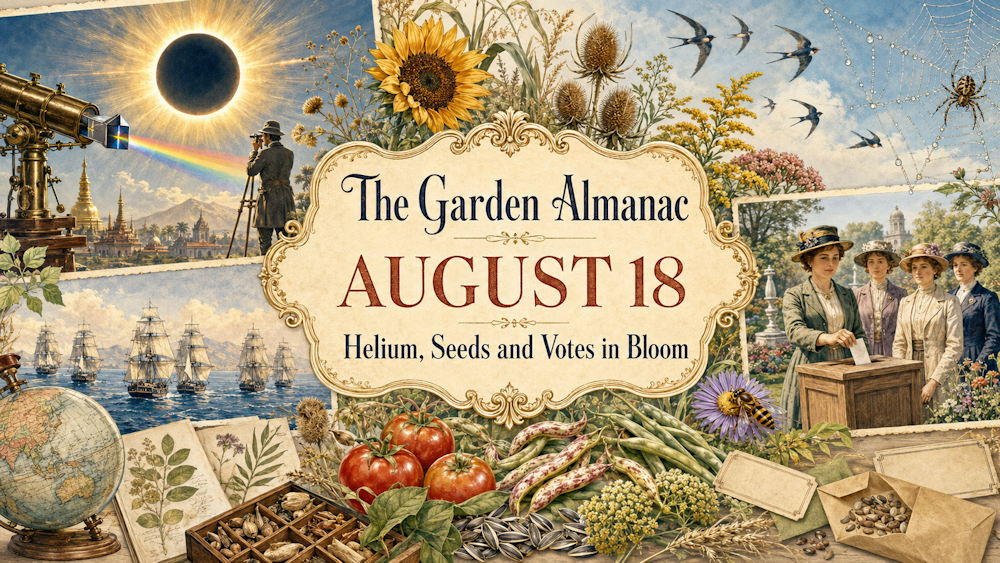

By August 18, the garden has begun to speak in two seasons at once. Tomatoes and beans still carry the full flavour of summer, yet seed heads are forming, shadows lengthen earlier and the first coolness may collect in low ground before dawn.
This date has also opened several remarkable windows onto the living world. An eclipse over Asia revealed an element in the Sun, a fleet sailed with botanists towards the Pacific, and a close political vote widened women’s public voice in the United States. Each story asks a question gardeners know well – what becomes visible when we observe carefully, collect responsibly and allow more people to shape the ground we share?
August 18, 1868 – The Eclipse That Found an Element Before Earth Did
On August 18, 1868, a total solar eclipse crossed a long path from East Africa through southern Asia and into the Pacific. King Mongkut of Siam had calculated its timing and location with extraordinary accuracy, while scientific parties travelled to sites along the route. At Guntur in India, French astronomer Pierre Janssen examined the Sun’s prominences with a spectroscope and saw a bright yellow line that did not match the expected signature of sodium.
That line became the clue to helium, an element recognised in the solar spectrum before it was isolated on Earth. The episode transformed sunlight from mere illumination into information: split into a spectrum, it could reveal the chemical composition of a star. For gardeners, the connection is wonderfully direct. The same sunlight that carries spectral fingerprints also drives photosynthesis, governs leaf temperature and helps set the seasonal timing of flowering, dormancy and growth.
A plant does not use all sunlight equally. Chlorophyll absorbs strongly in the blue and red parts of the spectrum, while leaves reflect much of the green light we see. Gardeners cannot change the Sun, but they can manage how its energy reaches plants – by spacing crops well, pruning only where airflow and light genuinely need improvement, and using temporary shade cloth when intense heat threatens peppers, young transplants or soft-leaved ornamentals.
An eclipse is dramatic because light disappears; a garden is instructive because light is redistributed every day. On August afternoons, notice which beds receive fierce reflected heat from walls, which remain damp under dense foliage and which flowers turn towards the open sky. Mapping those small light climates now will make autumn planting far more accurate than relying on a label that simply says ‘sun’ or ‘shade’.
Garden Science – Why Can Strong Summer Sun Reduce Growth?
Photosynthesis rises with light only up to a point. When leaves become too hot or water is scarce, stomata – the tiny pores that exchange gases – partly close to slow water loss. Carbon dioxide uptake then falls, so growth can stall even in brilliant sunshine. Water deeply in the morning, mulch bare soil and give vulnerable plants temporary afternoon shade rather than assuming that more light always means more growth.
August 18, 1838 – Six Ships, 648 Kinds of Seed and a Living Legacy
Thirty years before the eclipse, six ships left Hampton Roads, Virginia, on August 18, 1838. The United States Exploring Expedition would spend nearly four years surveying parts of South America, Antarctica, the Pacific islands, Australia and the north-western coast of North America. Its company included naturalists and botanists, and its immense collections later helped establish major national scientific holdings.
Among the expedition’s botanical cargo were tens of thousands of preserved plant specimens, seeds representing 648 species and more than 250 living plants. Such collections allowed researchers to compare plant forms and distributions across distant climates, and they fed the nineteenth-century growth of herbaria and botanic gardens. They also belong to a more complicated history: specimens and cultural objects were gathered amid imperial ambition, unequal power and too little regard for the knowledge or consent of local and Indigenous communities.
Modern gardeners can take a better lesson from the urge to preserve diversity. Save seed from healthy, open-pollinated beans, peas, lettuce or tomatoes, but collect from several typical plants rather than one unusually early specimen, label the variety and harvest date, and let seed mature fully before drying it. Never remove plants or seed from protected habitats, and treat local knowledge and legal access as part of good horticulture – biodiversity is not a souvenir but a relationship maintained over time.
Garden Reminder – What Should Gardeners Do in Mid-August?
- Water deeply at soil level in the morning; frequent shallow sprinkling encourages shallow roots.
- Harvest courgettes, cucumbers, beans and tomatoes regularly so plants continue producing.
- Collect ripe seed only on a dry day, then label it immediately with the plant name, variety and year.
- Leave some sound seed heads on coneflowers, teasels and sunflowers for birds and winter structure.
- Sow quick autumn crops suited to your climate, such as radish, rocket, spinach or winter salads.
August 18, 1920 – When Public Ground Gained More Gardeners
On August 18, 1920, Tennessee became the decisive thirty-sixth state to ratify the Nineteenth Amendment to the United States Constitution. The amendment prohibited denying the vote on account of sex, although discriminatory laws and practices continued to exclude many Black, Native American, Asian American and Latina women. It was a major threshold, not the completion of equal political participation.
Why does that belong in a garden almanac? Because gardens are shaped by public decisions as surely as by rain: voting influences parks, street trees, allotments, water protection, pesticide rules and the survival of urban habitat. Women were already prominent in garden clubs, civic improvement campaigns, horticultural education and conservation work. A wider formal voice gave more of that practical environmental knowledge a route into public policy, even while access remained unequal.
The useful lesson is to look beyond the fence. A gardener can report a threatened mature tree, support pollinator-friendly mowing, contribute locally adapted seed to a community exchange or ask how new development will handle stormwater and habitat. Private plots may be small, but connected gardens, verges and public green spaces form the corridors through which insects, birds, seeds and cooling shade move.
Wildlife Note – Which Late-Summer Flowers Still Feed Pollinators?
- Prioritise open, nectar-rich flowers such as asters, goldenrods, sedums and single-flowered dahlias where they are suitable and non-invasive.
- Keep several kinds blooming together – different flower shapes serve bees, hoverflies, butterflies and other insects with different mouthparts.
- Avoid spraying open flowers, and leave a shallow dish of clean water with stones as safe landing places during hot, dry weather.
What to Observe Right Now – Signs That Summer Is Turning
- Seeds darkening and loosening inside dry pods or flower heads.
- Earlier dew in sheltered areas and cooler air settling into hollows.
- Swallows or other aerial insect-feeders gathering more conspicuously where migration occurs.
- rebuilding webs across paths overnight as late-summer insect activity changes.
- Fruit colour deepening while leaves on drought-stressed plants lose their gloss or curl.
Looking Ahead
August 18 reminds us that discovery begins with attention, preservation requires responsibility and greener places depend on participation. Read the light in your own garden, save seed with care and notice how your plot connects to the larger living landscape. Those habits may seem modest, but they build gardens that are more resilient, more diverse and more generous to the people and wildlife that come next.