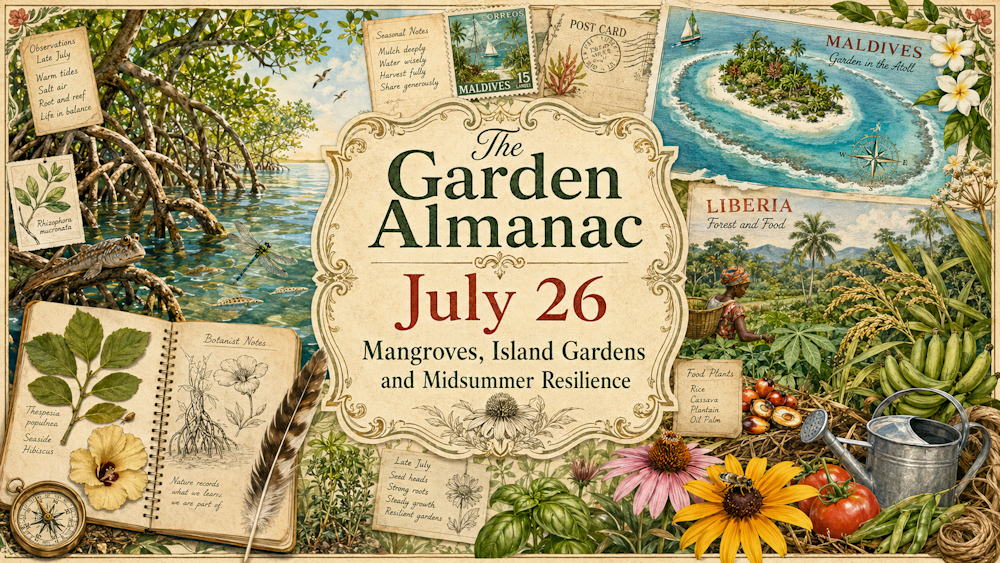

By July 26, summer has stopped arriving and has begun to rule. In many gardens, the generous green of June has changed into something more demanding: soil dries faster, leaves lose water by midday, and even strong plants begin to reveal where their roots are shallow or their shelter is poor.
But this date opens more than one garden gate. July 26 belongs to mangrove forests that hold coastlines together, to island nations where gardening means learning from salt, wind and limited soil, and to tropical landscapes where forests, food plants and human history are tightly interwoven.
It is a good day to think about resilience. Not the vague kind, but the practical kind a gardener can see: roots that grip, leaves that conserve water, soils that stay covered, and living systems that protect one another.
July 26 – The Day of the Mangrove Forest
July 26 is observed internationally as a day for the conservation of mangrove ecosystems. At first glance, mangroves may seem far from an ordinary garden. They grow where land and sea keep interrupting each other: in tidal mud, brackish water and shifting coastal edges.
Yet few plant communities offer a clearer lesson in survival. Mangroves tolerate salt, low oxygen, unstable ground and regular flooding. Their roots do not simply anchor the trees; they slow water, trap sediment, shelter young fish and create a living barrier against erosion and storm surges.
For gardeners, mangroves are a reminder that roots are architecture. A plant’s beauty above ground depends on its ability to manage stress below ground. In a summer garden, this means paying attention to soil structure, mulch, drainage and the quiet life around roots. Plants under heat stress are rarely helped by quick surface watering alone; they need soil that can hold moisture without becoming airless.
Garden Science – Why Do Some Plants Survive Salt and Heat Better Than Others?
Salt-tolerant plants survive because they manage water differently. Some exclude salt at the root, some store it safely in older leaves, and some excrete excess salt through leaf surfaces. In gardens, true salt tolerance matters most near coasts, roads treated with de-icing salt, or patios where mineral buildup occurs in containers.
Useful lessons for summer gardens:
- Deep watering encourages deeper roots than frequent shallow watering.
- Mulch reduces evaporation and keeps soil temperatures steadier.
- Compost improves water retention in sandy soil and drainage in heavy soil.
- Heat-stressed plants should be watered at soil level, not sprayed in full sun.
- Container plants may need occasional thorough flushing if salts from fertilizer build up.
Mangroves may live in a world of tides, but their message travels inland: protect the root zone, and the whole plant becomes stronger.
Liberia, July 26, 1847 – Forests, Food and a Young Republic
On July 26, 1847, Liberia declared its independence. Its political history is complex, but for a Garden Almanac, the landscape itself is also part of the story. Liberia lies within the Upper Guinean forest region of West Africa, one of the world’s important biodiversity areas, with rainforests, river systems, coastal wetlands and a long relationship between people and useful plants.
This is a country where forest and agriculture have always met. Rice, cassava, plantains, oil palm, vegetables and tree crops all belong to the wider food landscape. Later, rubber plantations became one of Liberia’s best-known agricultural features, showing both the economic power and ecological risks of large-scale monoculture.
For gardeners, Liberia’s July 26 story carries a useful caution: productive land is not the same as simplified land. A garden, farm or orchard becomes more resilient when it includes layers – trees, shrubs, groundcovers, seasonal crops, leaf litter, insects, fungi and birds all doing different work.
A small garden can borrow this forest logic. Fruit trees can be underplanted with herbs or pollinator plants. Bare soil can be covered. Compost heaps can turn waste back into fertility. Even a narrow border can become more useful when it includes flowers for insects, seed heads for birds and plants with different root depths.
Garden Reminder – What Should Gardeners Do in Late July Heat?
Late July is often when summer care decides whether the garden coasts into August or collapses into exhaustion.
- Water less often but more deeply, especially around trees, shrubs and newly planted perennials.
- Refresh mulch where soil is exposed, keeping it a few centimetres away from stems.
- Remove diseased leaves, but leave healthy foliage to shade the soil.
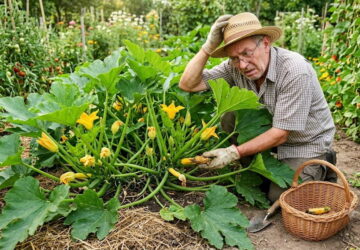
- Harvest beans, cucumbers and courgettes regularly so plants keep producing.
- Avoid heavy pruning during extreme heat, as sudden leaf loss can expose stems and fruit to sunscald.
- Watch young trees carefully: drought stress in the first years can affect growth for seasons to come.
The practical rule is simple: in late July, the best gardener is not the busiest one, but the one who notices stress early.
Maldives, July 26, 1965 – Gardening on Coral Islands
The Maldives gained independence on July 26, 1965. Its islands offer a very different kind of nature lesson: low-lying coral land, thin soils, salt-laden winds, intense sun and a close dependence on the surrounding sea.
Gardening in such places is never only decorative. It is about food, shade, protection and soil-making. Coconut palms, breadfruit, banana, papaya, pandanus and home garden plants have long been part of island life in tropical regions. Where soil is shallow or sandy, every bit of organic matter matters. Fallen leaves, coconut husk, compost and plant residues become tools for holding moisture and feeding roots.
This speaks directly to gardeners far from the Indian Ocean. Poor soil can be improved, but not by wishful planting. Sandy soil needs organic matter and surface cover. Windy gardens need shelter belts or permeable screens. Containers in hot places need larger soil volume, careful feeding and protection from afternoon scorch.
The Maldives also reminds us that gardens are part of climate adaptation. On islands, vegetation helps cool settlements, reduce wind exposure and stabilize fragile ground. In towns and inland gardens, the same principle applies at a smaller scale: shade trees, planted courtyards, hedges and green roofs can all reduce heat and soften hard surfaces.
What to Observe Right Now – Signs of Heat Stress in the Garden
Late July is an excellent time to look closely rather than rush to intervene. Many plants show heat stress before they are truly failing.
Look for:
- Leaves that wilt in afternoon but recover by morning – often a normal heat response.
- Leaves that remain limp at dawn – a sign that watering or root health needs attention.
- Brown leaf edges on container plants – often linked to uneven watering, salt buildup or hot pots.
- Blossom drop on tomatoes or peppers – common during high heat.
- Bees visiting water sources – a reminder to keep shallow, safe water available.
Observation prevents overcorrection. A plant resting through a hot afternoon may not need rescue; a plant still struggling in the morning probably does.
A Botanist’s Birthday – Plants, Exploration and the Work of Seeing Clearly
July 26 also marks the birth anniversary of Ernesta Di Capua, an Italian botanist and explorer born in 1875. Her name is not widely known outside specialist circles, but that is part of the charm of an almanac day: it lets quieter scientific lives step briefly into the light.
Botany has always depended on patient noticing. Before a plant can be protected, cultivated, named or understood, someone has to observe it carefully: its leaves, flowers, habitat, season, variation and relationship with place. That kind of attention is not reserved for laboratories or expeditions. It is also the gardener’s everyday skill.
In July, careful observation becomes especially valuable. Plants are not only growing; they are responding. Some are setting seed, some are slowing down, some are attracting pollinators, and some are revealing whether they were planted in the right position. A border in late July is almost a living report card.
A gardener who keeps notes now will make better decisions in autumn. Which perennials collapsed in heat? Which herbs flowered too early? Where did the soil crack? Which plants drew bees even in dry weather? These observations are more useful than any perfect planting plan made in winter.
Wildlife Note – Why Leave Some Flowers to Go to Seed?
Not every faded flower should be removed immediately. Deadheading can extend bloom, but seed heads also feed birds, shelter insects and add structure to the garden.
Good candidates to leave, at least in part, include echinacea, rudbeckia, teasel, ornamental grasses, fennel, dill and many native wildflowers. In a wildlife-friendly garden, the aim is balance: deadhead some plants for continued flowering, but allow others to complete their cycle.
Seed is not mess. It is stored energy, future plants and late-season food.
Looking Ahead
July 26 brings together coastlines, forests, islands and the quiet discipline of botanical observation. Its strongest lesson is that living systems endure by working in layers: roots with soil, plants with water, gardens with insects, people with place.
For today’s gardeners, that means designing for stress as much as for beauty. A resilient garden is not made by one spectacular plant, but by shade, mulch, diversity, healthy soil and close attention.
As summer deepens, the best question may be simple: what is my garden trying to tell me now? Listen well, and it will show where to water, where to cover, where to plant more wisely – and where life is already finding its own clever way forward.