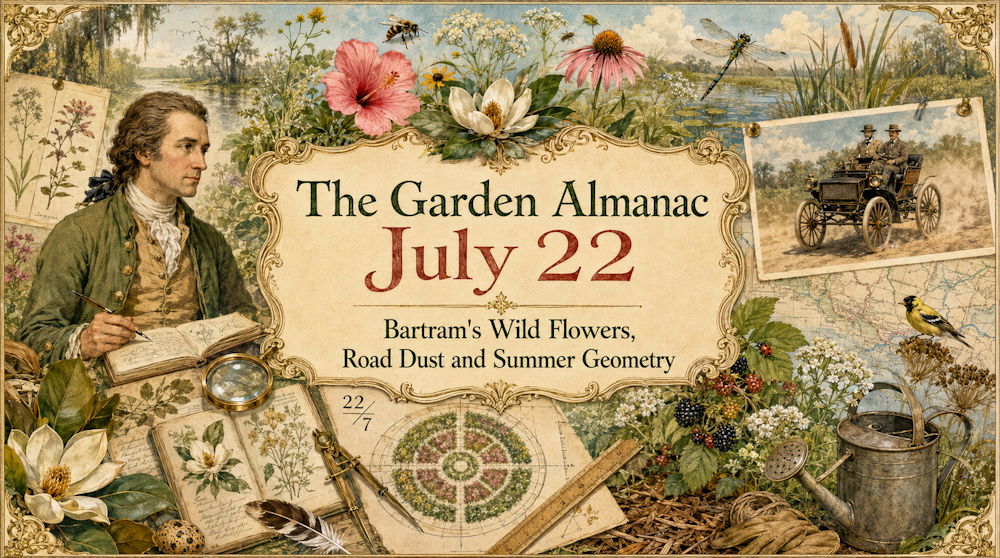

Late July is never a quiet page in the garden calendar. By July 22, summer has settled into its fullest voice: seedheads are forming, fruit is swelling, lawns are slowing, and every border seems to be negotiating with heat, water and insects.
It is also a day with an unexpectedly wide natural reach. July 22 takes us from the death of the American naturalist William Bartram to the first automobile trial between Paris and Rouen, from the mathematics of circles to the weather-wise art of reading the summer garden. The date is a reminder that gardens are never isolated places. They belong to travel, science, technology, climate, culture and the patient work of observation.
July 22, 1823 – William Bartram and the Art of Seeing Plants Properly
William Bartram, the American naturalist, writer and explorer, died on July 22, 1823. His book, usually known as Bartram’s Travels, recorded his journeys through the American Southeast in the 1770s and became one of the most important early accounts of the region’s plants, animals and landscapes. He observed forests, rivers, wetlands, flowering plants, birds and Indigenous agricultural landscapes with a rare combination of scientific attention and literary feeling.
For gardeners, Bartram matters because he reminds us that plant knowledge begins with looking carefully. He did not see plants as decorations placed against a human background. He saw them in relation to soil, water, season, wildlife and place. A shrub was not only a shrub; it was part of a woodland edge, a riverbank, a fire-shaped landscape or a living system of pollinators and seed dispersers.
That way of seeing is still one of the best gardening skills. A plant that struggles in one corner may flourish a few metres away because the soil holds moisture differently. A border that looks tired in July may not need more fertiliser, but deeper mulching, better plant spacing or more drought-tolerant companions. Observation turns gardening from guessing into understanding.
Garden Inspiration – What Bartram Can Teach a Modern Gardener
- Notice where plants thrive without help. These are clues about soil, drainage and microclimate.
- Watch the whole habitat, not just the flower. Bees, seedheads, leaf damage and bird visits all tell a story.
- Keep a seasonal notebook. Even a few lines each week can reveal patterns you would otherwise miss.
- plants for place, not only for beauty. The right plant in the right site needs less rescue work.
Late July in the Garden – When Heat Becomes a Design Question
By July 22, many gardens in the Northern Hemisphere are entering the part of summer when good design shows itself. Spring enthusiasm can carry a garden through May and June, but late July reveals whether the planting has resilience. Shallow-rooted annuals may wilt quickly, while deeper-rooted perennials, Mediterranean herbs, ornamental grasses and well-established shrubs often hold their shape with far less fuss.
This is the season when watering should become more thoughtful. Frequent light watering encourages roots to remain near the surface, where soil dries fastest. Deeper, less frequent watering helps many plants build stronger root systems, especially in beds and borders. Containers are the exception: they may need daily attention in hot weather because their root zones heat and dry much faster than open soil.
Mulch is another quiet hero of late July. A 5–7 cm layer of organic mulch can reduce evaporation, buffer soil temperature and support soil life as it gradually breaks down. Keep it slightly away from stems and trunks, though, because wet mulch pressed against plant tissue can encourage rot.
Garden Reminder – What Should You Do in the Garden Around July 22?
- Water early in the morning, when less moisture is lost to evaporation.
- Soak the root zone rather than sprinkling the leaves.
- Deadhead repeat-flowering plants to encourage new blooms, but leave some seedheads for wildlife where possible.
- Check containers daily, especially small pots, hanging baskets and plants against warm walls.
- Top up mulch where soil is exposed, but avoid piling it against stems.
July 22, 1894 – The Road to Rouen and the Garden Beside the Road
On July 22, 1894, the Paris–Rouen motoring event took place in France. Often described as one of the world’s first automobile competitions, it was less a modern race than a reliability trial for “horseless carriages,” covering about 126 kilometres between the two cities.
At first glance, this may seem far from gardening. But the rise of road transport changed landscapes profoundly. Roads altered how plants moved, how towns expanded, how rural edges were managed, and how dust, pollution and heat affected roadside vegetation. Today, road verges can be ecological corridors or sterile strips, depending on how they are managed.
For gardeners, the lesson is local and practical. Front gardens, driveways, paths and boundary strips are miniature versions of this same question: do we harden every edge, or do we leave room for life? Permeable surfaces, planted verges, hedges, rain gardens and gravel areas with drought-tolerant plants can soften heat, slow runoff and support insects.
A narrow strip beside a path may not look important, but it can feed pollinators, cool paving and catch rainwater before it rushes away. The garden of the future may depend as much on these small edges as on grand flower borders.
Garden Science – Why Do Paved Areas Make Gardens Hotter?
Hard surfaces such as asphalt, concrete and stone absorb solar energy during the day and release it slowly as heat. This can create a warmer microclimate around paths, terraces and driveways. Plants near these surfaces often dry out faster, especially if reflected heat reaches their leaves.
To reduce heat stress, use ground-cover plants, gravel with planting pockets, climbing plants on walls, shade trees where space allows, and permeable paving. Even partial planting can make a noticeable difference because leaves cool the air through transpiration.
Pi Approximation Day – The Useful Geometry of Circles
July 22 is also known informally as Pi Approximation Day, because 22/7 is a traditional fractional approximation of pi. Pi is the ratio between a circle’s circumference and its diameter, and it appears wherever circles, curves and spheres need to be measured.
In the garden, circles are more than decorative shapes. They help us think about tree canopies, root zones, compost heaps, irrigation patterns, ponds, planters and planting distances. A circular tree canopy, for example, often hints at the area of soil where roots are actively gathering water and nutrients, even though real root systems are usually wider and more irregular than the canopy above.
Pi is also useful when estimating materials. If you are planning a circular bed, pond edge or mulch ring around a tree, knowing the approximate area helps you avoid buying far too much or too little compost, gravel or bark mulch.
The practical lesson is simple: good gardening often combines feeling with measurement. A border can be romantic and still benefit from a tape measure. A fruit tree can be beautiful and still need a correctly sized mulch ring.
Wildlife Note – What Is Moving Through the Garden Now?
Late July is a busy time for garden wildlife. Many birds are quieter than they were in spring, but they are still active, especially around water, berrying shrubs and insect-rich planting. Bees, hoverflies, butterflies and moths are drawn to open, nectar-rich flowers, while seedheads begin to attract finches and other seed-eating birds.
This is also a good time to notice which plants are genuinely useful to wildlife in your own garden. Some flowers look spectacular but attract very few visitors. Others, especially single-flowered herbs and perennials, may be alive with insects from morning to evening.
Good late-summer wildlife plants include oregano, thyme, lavender, echinacea, rudbeckia, verbena, fennel, borage, catmint and many native wildflowers. Leaving a few untidy corners can be just as valuable as planting something new.
What to Observe Right Now
- Which plants recover quickly after a hot afternoon, and which remain limp into the evening?
- Are bees visiting open flowers more often than double flowers?
- Where does the soil stay damp longest after watering?
- Are birds using shrubs for shelter as well as feeding?
- Which parts of the garden feel hottest underfoot, and could planting reduce that heat?
These observations are small, but they build a more intelligent garden. They show where shade is needed, where soil improvement would help, and which plants are earning their place through resilience and ecological value.
Looking Ahead
July 22 brings together a naturalist’s field notes, the first dusty steps of the motor age, the geometry of circles and the practical realities of a hot summer garden. Their shared message is surprisingly clear: the future of gardening depends on attention.
We need to notice plants as Bartram did, not as isolated ornaments but as members of living communities. We need to rethink hard surfaces, edges and roadsides as places where heat, water and biodiversity are shaped. We need to measure when measurement helps, and observe when observation teaches more than any rule.
A good garden in late July is not perfect. It is responsive. It holds shade, saves water, feeds insects, protects soil and gives the gardener useful information every day. That may be the most hopeful lesson of the date: even in the heat of summer, careful seeing can become practical care.