
May 25 is a wonderfully layered day in the Garden Almanac: Saint Urban’s Day, vineyard weather lore, bees, winegrowers, late spring anxiety, Africa Day, and even Towel Day for anyone who likes their calendar with a little cosmic absurdity.
In many European wine regions, late May was a dangerous time. The vines were growing, the promise of grapes was visible, and the weather could still turn suddenly cold. A saint connected with vineyards and winegrowers was therefore not a decorative figure. He was someone people watched, praised, blamed and occasionally punished.
Saint Urban and the Weather of the Vineyard
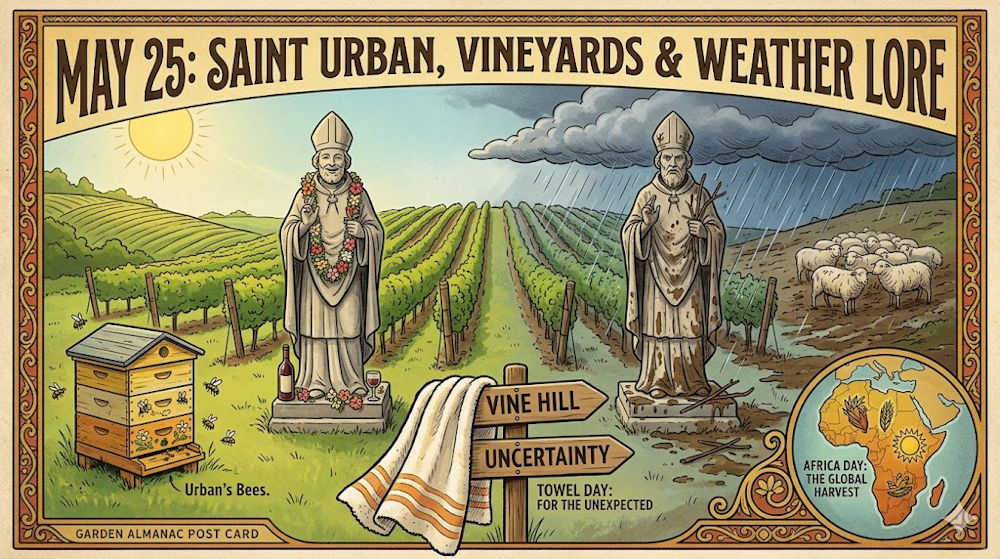
Saint Urban’s Day was especially important in vineyard folk tradition. Urban was associated with winegrowers, coopers, innkeepers and those whose work depended on grapes becoming wine. In vineyards and wine hills, statues of Saint Urban were sometimes placed as guardians of the crop.
The logic was simple and deeply human: if the weather was good, Urban had done his job. If the weather turned cold, wet or damaging, someone had to answer for it.
Late spring weather mattered enormously. Frost, cold rain or harsh wind could damage young vine growth and threaten the harvest months before the grapes were ripe. Saint Urban’s Day therefore became a moment of watching, judging and interpreting the sky.
Flowers for Good Weather, Mud for Bad
One of the most vivid customs connected with Saint Urban was the treatment of his statue. If the day brought fine weather, the statue could be decorated with flowers, honored with wine, praised and celebrated. People might eat nearby, drink old wine, and even pour some wine over the saint in gratitude.
If the weather was bad, the mood changed. In some traditions, the statue might be splashed with water, scolded, spat at, beaten with sticks or smeared with mud.
This was folk religion with muddy boots. It was not abstract theology. It was a relationship built from dependence, fear, humor and bargaining. The winegrower needed the weather to cooperate, and Saint Urban became the face of that uncertain negotiation.
What the Sky Promised
Weather sayings around Saint Urban’s Day varied from region to region. In some places, rain on Urban’s Day could be seen as a promise of good yield. Elsewhere, clear sunshine suggested sweet wine, while rain warned of sour drink in the barrel.
Such contradictions are part of folk weather lore. These sayings were not universal scientific rules. They were local memories: shaped by hillsides, soils, grape varieties, winds, years of loss and years of abundance.
What they shared was attention. People watched the sky because the sky had consequences.
Urban’s Bees
In some traditions, bees were called Urban’s little creatures or Urban’s bugs. Around this time of year, swarming could begin, and the movement of bees became another sign in the late spring calendar.
Bees, vines and weather belong together in the old agricultural imagination. They all speak of fertility, timing and risk. A vineyard is not only rows of vines. It is weather, insects, soil, hands, tools, barrels, memory and hope.
When bees moved and vines grew, the whole season seemed to be making up its mind.
Shepherds, Sheep, and the Cold Trick of May
Saint Urban could trouble more than winegrowers. In some folk traditions, shepherds also watched the day carefully, because a sudden cold spell after sheep had been shorn could be miserable for both animals and herders.
This makes Urban’s Day a broader late-May threshold. It was not only about grapes. It was about the risk of trusting spring too early.
The calendar said summer was close. The weather sometimes disagreed.
Always Know Where Your Towel Is
May 25 is also Towel Day, celebrated by fans of Douglas Adams and The Hitchhiker’s Guide to the Galaxy. It is a modern, playful observance built around the idea that a towel is the most useful thing a traveler can carry.
In the Garden Almanac, this strange little calendar layer fits better than expected. The gardener, too, needs a towel now and then: for sweat, rain, muddy hands, spilled water, sudden weather and the general absurdity of trying to make plans with the sky.
The old winegrower did not hitchhike through the galaxy, but he certainly travelled through uncertainty.
Africa Day and the Wider Question of Harvest
May 25 is also Africa Day, a reminder that questions of land, harvest, water and weather are global. The vineyard lore of Saint Urban belongs to Europe, but the deeper concern is shared everywhere: will the rains come, will the crops hold, will the season feed the people?
Gardening and farming have always been local acts tied to global forces. Climate, water, soil and human resilience connect fields and gardens across continents.
What May 25 Teaches
Saint Urban’s Day is funny because the image is funny: a saint rewarded with flowers or punished with mud because of the weather. But the humor rests on something serious. People feared losing the crop. They needed the vine to survive. They needed the barrel to fill.
The lesson of May 25 is that gardening has always involved work, hope and a little bargaining with forces beyond control.
In the Garden Almanac on this day, the vineyard becomes a stage where sky, soil, bees, sheep, wine and human nerves all meet. If the weather is kind, bring flowers. If it is not, keep your towel handy.