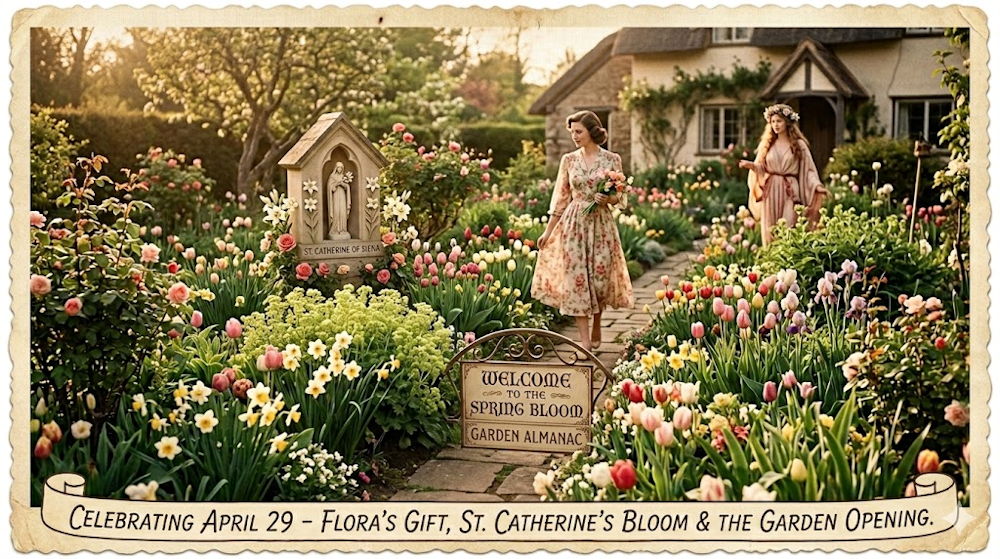

April 29 belongs to that part of spring when the season no longer feels restrained. The garden is beginning to open fully now – not only in leaf, but in flower, scent, movement, and confidence. What had been tentative earlier in the month is becoming expressive. Late April shifts the garden from suggestion into declaration.
This makes April 29 especially well suited to a floral almanac mood. It falls within the days of the Floralia, the Roman festival of Flora, goddess of flowers, fertility, and abundance. That old celebration gives the date a vivid seasonal brightness. It reminds us that bloom is not merely decorative. It is one of spring’s clearest announcements that the year has truly advanced.
Flora and the Season of Display
The Floralia belongs to the exuberant side of spring. It celebrates flowering not as a minor detail, but as a force in its own right: color, fertility, growth, and the joyful visibility of life returning.
Gardeners understand this instinctively. By late April, flowers begin to do more than ornament the garden. They reveal momentum. They show which parts of the season are thriving, which shrubs and borders are at their height, and how the garden’s structure is beginning to carry beauty as well as growth.
Saint Catherine of Siena and the Lily-Rose Imagery
April 29 is also the feast day of Saint Catherine of Siena, whose imagery is often linked with the lily and the rose. In an almanac, this offers a graceful second layer to the day. The lily suggests clarity and uprightness; the rose suggests beauty, devotion, and fullness. Together they deepen the floral character of the date.
What matters here is not devotion alone, but symbolism. Late April often feels like the season of flowers with personalities: blossoms that do not merely appear, but shape the emotional tone of the garden.
Reading Bloom as a Sign
Flowering at this point in the year is not only about enjoyment. It is also a form of information. A garden in bloom reveals timing, balance, vigor, and stress with remarkable honesty. Too much speed, too little water, sudden abundance, sheltered success, awkward crowding – all of these begin to show themselves more clearly once the garden enters a more expressive phase.
This is why April 29 is such a useful observational date. Beauty and diagnosis meet here.
What This Day Suggests in Practice
April 29 is a good day to walk through flowering parts of the garden with unusual care. Notice which plants are carrying the season well, which may soon need support or thinning, where color is gathering beautifully, and where the structure of the garden is becoming visible through bloom.
It is also a fine moment simply to enjoy spring without apology. The almanac is not only about labor and caution. Some dates exist to remind us that flourishing deserves attention too.