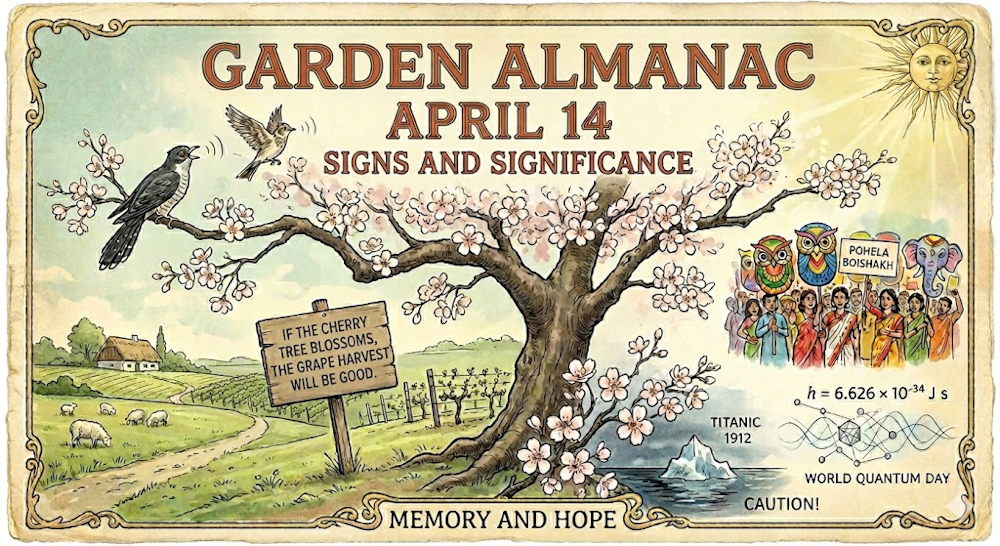

A Day Read Through Signs. April 14 is an excellent almanac date because it is rich in signs. In Hungarian folk tradition, it is read through cherry blossom, birch leaf, green fields, meadow growth, and the first voices of the cuckoo and skylark. Elsewhere in the world, the same date can carry themes of renewal, disaster, scientific celebration, and seasonal thresholds. It is a day that asks to be interpreted rather than merely observed.
Spring often works this way. It does not arrive in one announcement. It appears through converging signals. A blossom opens, a bird calls, a ritual begins, a warning is remembered. April 14 belongs to that layered language.
Cherry Blossom and the Hope of Grape Flowering
The Hungarian saying that if the cherry tree is in bloom on Tibor’s Day, the vine will flower well too, captures a deeply agricultural way of thinking. It links one plant to another, not by theory alone but by lived comparison. The orchard becomes a predictor for the vineyard.
This pattern is central to traditional cultivation. Nature is not seen as a collection of isolated facts, but as a network of responses. One species gives a clue about another. One phase of bloom suggests a likely rhythm elsewhere in the landscape.
That makes April 14 a day of relational knowledge — the kind of knowledge built by watching many springs in the same place.
Pohela Boishakh and the Renewal of the Year
April 14 is also celebrated as Pohela Boishakh, the Bengali New Year, especially in Bangladesh. It is a day of colour, community, processions, music, cleansing, and fresh beginnings. Beneath the festivity lies a seasonal logic familiar to almanacs everywhere: a year turns not only in the calendar, but in the shared imagination of a people.
This gives April 14 a striking international echo. In one tradition, people listen for the cuckoo and read the orchard. In another, they welcome a new year with ritual and public joy. In both cases, the date becomes a threshold between what has passed and what is about to unfold.
World Quantum Day and the Modern Celebration of the Invisible
April 14 is also observed as World Quantum Day, a very modern kind of commemoration built around the numerical value of Planck’s constant. At first glance, this seems far removed from birdsong and blossom. Yet the connection is not as strange as it appears.
Both folk signs and scientific thought ask the same basic question: what hidden order lies beneath what we see? Traditional observers answered by watching trees, wind, and animal behaviour. Modern physics answers through theory and measurement. An almanac can hold both, because both are ways of reading a world larger than immediate appearances.
Titanic and the Warning Still Inside Spring
April 14 is also the date associated with the Titanic’s collision with an iceberg in 1912, a reminder that confidence and catastrophe can travel close together. In a seasonal sense, this too belongs to spring. April is beautiful, but it is not always gentle. Warm afternoons can mislead. Tender growth can still be struck back. Sudden reversal remains part of the season’s character.
This is one reason why traditional sign-reading matters. It teaches caution alongside hope.
What to Notice in the Garden Today
April 14 is a particularly good day for noticing how many kinds of evidence a garden offers.
- Which blossom is acting as a signal for something else still to come?
- What is the birch, or its local equivalent, saying about the progress of spring?
- How evenly green is the field, the meadow, or the lawn?
- What has changed in the soundscape since last week?
- Where should confidence be balanced by restraint?
A true almanac date teaches not only what to do, but how to read.
The Meaning of April 14
April 14 gathers together blossom, birdsong, seasonal thresholds, ritual renewal, scientific curiosity, and caution. It is a date about interpretation — about the human effort to notice patterns and make meaning from them.
That is one of spring’s oldest lessons. The season rarely speaks once. It repeats itself through signs, and wisdom lies in learning which ones to trust.