
March 31 often feels like a day balanced on an edge. Spring is visible now, perhaps even persuasive, yet it is not fully proven. Light lasts longer, buds seem fuller, soil begins to soften, and the garden gives off that unmistakable sense of movement that arrives after a long winter pause.
And yet this is still a day that deserves caution. What appears settled may still reverse. What looks ready may still need time. What tempts the gardener most strongly is often exactly what requires the greatest patience.
Across many gardening traditions, the final days of March have been treated as uncertain days, almost borrowed from one season by another. The image is a memorable one: a handful of days in which winter has not quite withdrawn, even as spring has clearly entered the scene. Whether or not one takes the folklore literally, the gardening truth inside it remains remarkably sound. The end of March is often when confidence arrives slightly earlier than stability.
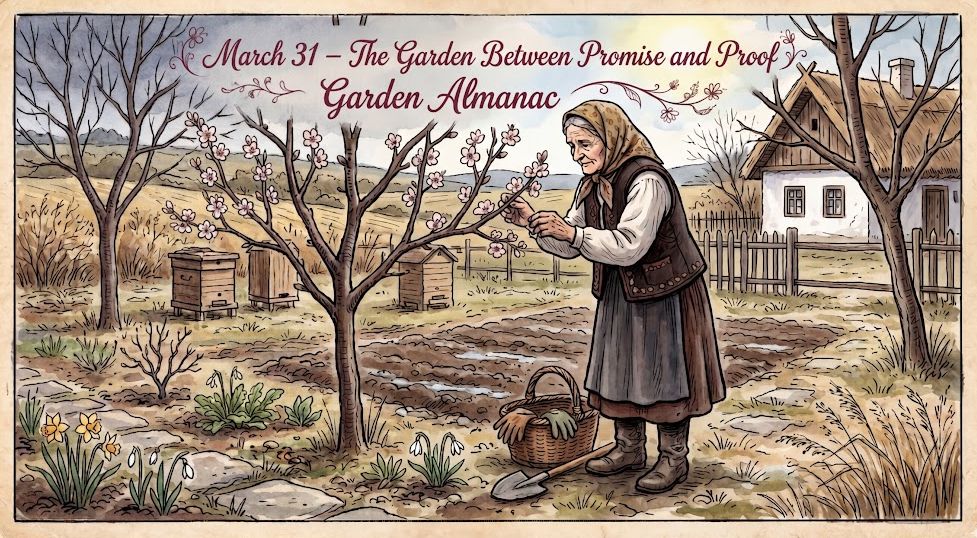
That is why March 31 is best understood not as a day of completion, but as a day of interpretation. The garden is already speaking, but not yet plainly. It offers clues rather than conclusions. A border may look awake, but not evenly. A fruit tree may swell with promise, while a single cold dawn still threatens its most eager buds. Containers near walls or on steps may warm quickly and encourage early growth, while open ground remains cooler and slower. In one area, the season seems to have advanced; in another, it still hesitates.
Reading the Signs Before the Season Speaks Clearly
For gardeners, March 31 is an invitation to observe more deeply than usual. It is a day for walking through growing spaces and noticing not just what is happening, but how confidently it is happening.
- Which parts of the soil have genuinely become workable, and which still hold too much cold or moisture?
- Which shrubs and perennials are waking with strength, and which remain hesitant or uneven?
- Which corners of the garden collect warmth, and which continue to trap chill after sunset?
- Where do slugs, aphids, or signs of fungal trouble appear first?
- Which supports, ties, labels, frames, and coverings will soon become urgent if ignored now?
These are not dramatic questions, but they are foundational ones. Much of spring success comes not from doing everything early, but from understanding what is truly ready and what only appears ready from a distance.
The Wisdom of the Last Day of March
The end of March teaches a kind of practical humility. A gardener may feel eager to sow more, move more, uncover more, prune more, or trust more. The season, however, still holds back a little. This hesitation is not frustrating once it is accepted for what it is. It is useful. It slows us down just enough to pay attention.
Older garden wisdom often understood this instinctively. The final days of the month were not always treated as a clean doorway into settled spring, but as a testing period. Weather could turn quickly. A mild day could be followed by a hard morning. Growth could surge and then pause. Moisture could disappear from the soil surface while colder layers beneath remained untouched. The lesson was clear: the calendar might suggest progress, but the garden itself had the final word.
That remains true in every kind of growing space. In a country plot, it may mean watching orchards and exposed beds with care. In a town garden, it may mean comparing sunny walls with shaded borders. On a balcony, it may mean resisting the temptation to leave tender pots out overnight too soon. Indoors, it may mean adjusting watering, ventilation, and light as houseplants begin to respond more actively to lengthening days.
Work That Belongs to This Day
March 31 is not usually the day for the boldest seasonal gestures. It is a better day for preparation, correction, and readiness.
- Tidy and refine beds without stripping every corner bare.
- Check supports before plants begin to lean and climb in earnest.
- Review the condition of overwintered potted plants and move them only with care.
- Watch fruiting plants closely if buds are advancing quickly.
- Prepare sowing areas patiently rather than forcing wet or compacted soil.
- Keep protective materials nearby in case the weather shifts unexpectedly.
- Use the day to notice timing differences across the garden instead of assuming everything has advanced equally.
There is real comfort in this kind of work. It may not look impressive by evening, but it makes the next stage of the season steadier. A repaired edge, a ready fleece cover, a well-placed support, a postponed sowing, a carefully observed bud: these are the quiet decisions from which good Aprils are often built.
Why This Threshold Matters
March 31 matters because it stands at the border between excitement and proof. By now, the gardener has usually seen enough to feel hopeful. But hope in the garden becomes far more useful when joined to discernment. Not every warm day means safety. Not every swelling bud means success. Not every eager impulse should be followed immediately. The season is opening, but it is still sorting itself out.
This is also part of what makes the day so beautiful. There is tension in it, but also depth. A garden at this stage feels full of withheld meaning. Something is coming together, though it has not fully declared itself. If April often feels expansive, March 31 feels concentrated. It gathers energy. It sharpens attention. It asks gardeners to notice the difference between appearance and readiness.
Where April Quietly Begins
The first days of April can seem to burst into motion all at once, yet that burst is often prepared here, in the careful noticing of the final day of March. Soil that was respected now becomes easier to sow. Plants that were not rushed now establish more cleanly. Problems spotted early stay manageable. Sudden weather changes feel less disruptive when the garden has already been read honestly.
So March 31 is not only the last page of a month. In the Garden Almanac, it is the day when the gardener is gently tested. Can beauty be met without haste? Can promise be welcomed without assumption? Can the season be read as it is, not as one wishes it to be?
That is the lasting lesson of this day. The garden does not ask for certainty from us here. It asks for attention, steadiness, and the willingness to notice small truths before they become obvious to everyone else.