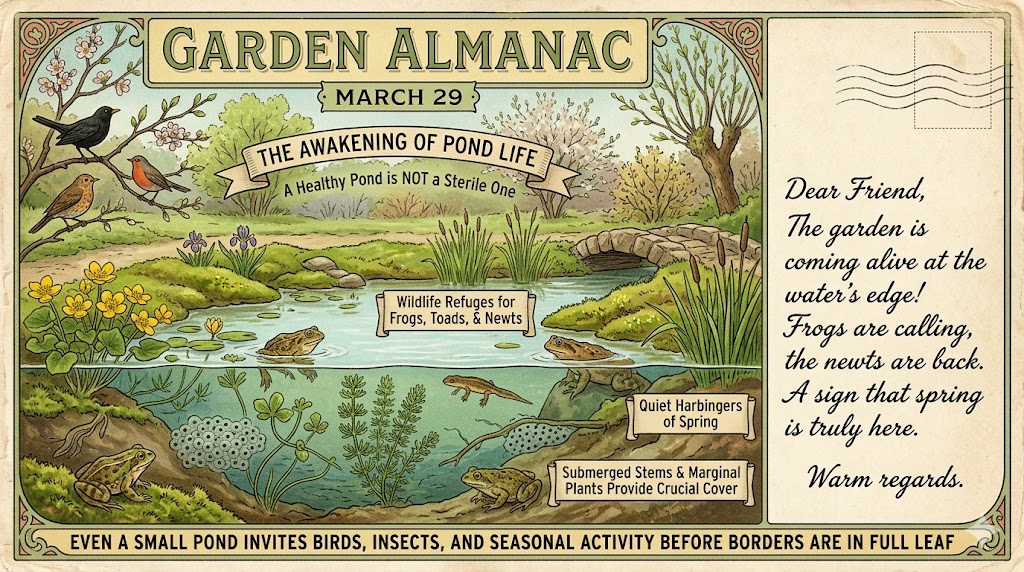

March 29 lends itself beautifully to an international spring theme that does not depend on a single local folk custom: the awakening of pond life. By late March, many gardens are still visually sparse, but water tells a different story. A pond, marshy edge, rain-filled hollow, or shaded wet corner can become one of the earliest places where the season feels fully alive.
This makes the date especially useful in a wider garden frame. Across countries and climates, small water features are among the richest habitats a garden can offer. They invite birds, insects, amphibians, and a whole layer of seasonal activity that often begins before borders are in full leaf.
Why Ponds Matter So Much
Wildlife organisations and garden charities repeatedly note that even a small pond can have outsized ecological value. In practical garden terms, water widens the meaning of cultivation. A garden stops being only a place of planting and becomes a place of refuge, breeding, drinking, cooling, and shelter.
That matters especially in spring, when frogs, toads, and newts begin to rely on accessible water for reproduction and early seasonal movement.
A Good Pond Is Not a Sterile One
One of the most important lessons of wildlife gardening is that a healthy pond should not be overtidied. In early spring, gardeners are often tempted to clear too much, too fast. But submerged stems, marginal plants, shallow ledges, and soft transitions between water and land all provide cover and access for animals that need them.
A pond made too neat can quickly become less alive.
Amphibians and the Edge of Spring
Frogs, toads, and newts are some of the quiet beneficiaries of a well-kept garden pond. They feed on a wide range of invertebrates and can thrive where water is available and at least one side allows easy movement between pond and dry land. Their appearance is one of spring’s most convincing signals: not dramatic, but unmistakable.
This is one reason late March feels like the right moment to pay attention to water. Even before the garden looks abundant, it may already be functioning as a living system.
What the Day Holds
In the Garden Almanac, March 29 becomes a day for listening as much as looking. It is about the murmur at the pond edge, the first amphibian stirrings, the importance of damp corners, and the generous idea that a garden should hold more life than the eye first notices.