
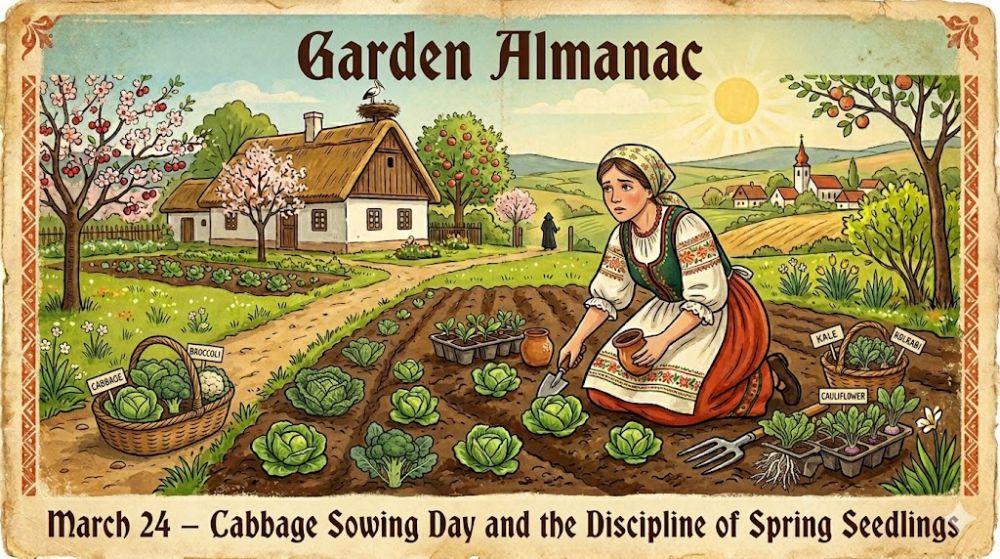

March 24 belongs to one of the most grounded moments in the spring garden year: sowing for substance. In Hungarian folk tradition, this day is associated with cabbage and other brassicas, and with the belief that timely sowing brings abundance.
Like so many old planting customs, it mixes practical observation with a layer of ritual unease — in this case, the warning that an ill-omened encounter on the road might spoil the promise of the crop.
Before the symbolism deepens, the gardening truth is simple enough. Cabbage is one of the defining plants of a serious food garden: useful, generous, storable, and deeply tied to household continuity. To begin cabbage well is to begin the productive season in earnest.
A Plant of Timing and Structure
In home gardens, cabbage is most often grown successfully from transplants rather than by direct sowing into open ground. Good seedlings need abundant light, steady moisture, and enough warmth for germination, followed by cooler, brighter conditions to keep them compact rather than leggy.
This is one of the quiet disciplines of spring. A sturdy seedling, with a healthy white root system and several true leaves, carries a very different future from one that has stretched weakly in indoor heat.
Hardening, Planting, and Patience
Early cabbages are often transplanted outdoors in late spring once the worst of the frost danger has eased, though the exact date always depends on local conditions. Because brassicas tolerate cool weather fairly well, gardeners can be tempted to hurry. But hardening off still matters. Plants raised under protection need time to adjust gradually to wind, stronger light, and the unpredictability of outdoor temperatures.
Late March is precisely the kind of season that rewards this patience. The days may look convincing while the nights still tell a different story.
The Garden Logic of Cabbage
Cabbage asks for fertile soil, steady moisture, generous spacing, and rotation. It responds well to compost and to ground that can hold water without becoming stagnant. It also reminds the gardener that abundance is rarely accidental. Good heads do not come only from sowing on the right day, but from the long chain of decisions that follow: spacing, watering, watching, protecting, and timing.
That is what makes the old custom feel so durable. Beneath the folklore lies a practical truth — that spring success depends on beginning carefully.
What the Day Holds
In the Garden Almanac, March 24 is a day of hopeful seriousness. The folklore gives it character, the seedlings give it shape, and the season gives it urgency. This is not yet the lush abundance of summer, but one of the quiet days on which abundance is decided.