
On a cold November morning, frost can reveal the invisible geography of a garden. The lawn turns silver, a sheltered border remains untouched, and beneath a scattering of fallen leaves the soil may still hold some warmth. What appears to be a garden settling into stillness is, in fact, a landscape full of small differences and ongoing changes.
November 27 takes us from the agricultural fields of Pennsylvania to the scientific world of eighteenth-century Sweden and the wonderfully distinctive Australian bush. It is a day for discovering how much can be learned from the land beneath our feet, the temperatures we record and the extraordinary details of familiar plants.
November 27, 1967 – The American President Who Wanted to Leave His Soil in Better Condition
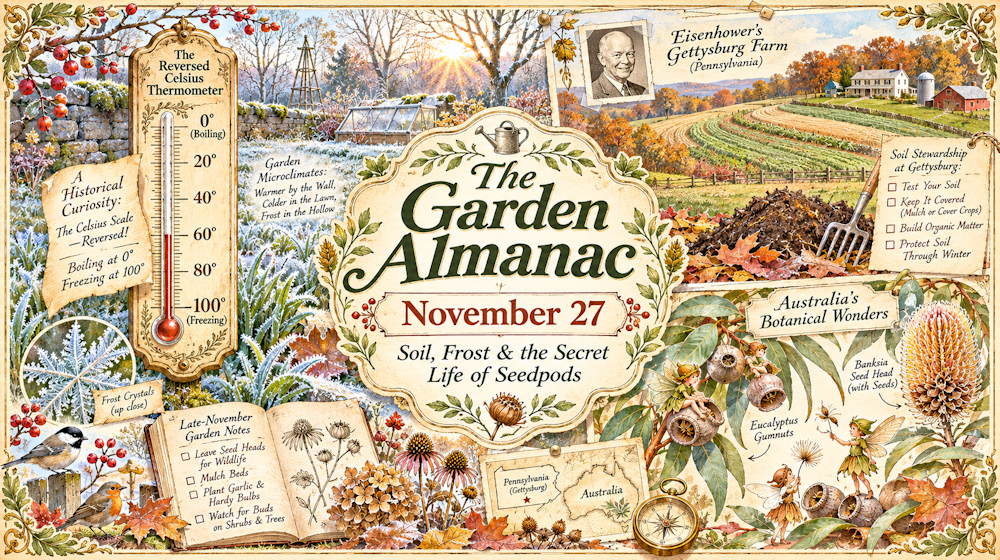
On November 27, 1967, former American president Dwight D. Eisenhower and his wife, Mamie, donated their Gettysburg farm in Pennsylvania to the United States government. The property became the Eisenhower National Historic Site. Yet beyond its political significance lay a less familiar story – that of a man who took an unusually personal interest in the condition of his farmland.
When the Eisenhowers acquired the property in 1951, years of intensive maize cultivation had depleted its soil. Eisenhower approached the problem systematically. He arranged for annual soil testing, used the results to guide soil improvements and worked with his farm managers to introduce crop rotation and contour farming. Alongside his interest in raising Aberdeen Angus cattle, he developed a genuine enthusiasm for restoring the productive capacity of the land.
What makes this chapter of Eisenhower’s life particularly interesting is that he regarded soil improvement as a long-term responsibility rather than a temporary agricultural adjustment. Contour farming, in which cultivation follows the natural curves of a hillside rather than running directly down the slope, helped reduce erosion. Areas of woodland were also allowed to develop into wildlife habitat, including shelter for quail. Today, parts of the historic property remain in agricultural use.
Late November offers gardeners an excellent opportunity to examine their own soil with a similar sense of purpose. Once summer vegetation has disappeared, compacted areas, poor drainage and exposed slopes become easier to identify. Rather than digging every empty vegetable bed, consider protecting the surface with mature compost or fallen leaves. On sloping ground, permanent vegetation and planting across the slope can help slow runoff and prevent valuable topsoil from washing away during winter rains.
Garden Reminder – Protect Your Soil Before Winter
In temperate Northern Hemisphere gardens, the weeks before winter provide an opportunity to protect the ground ahead of prolonged rain, frost and snow.
- Cover exposed soil. Apply a 5–8 cm layer of organic mulch around established plants, keeping it away from stems and woody trunks.
- Avoid working waterlogged ground. Digging or walking on saturated soil can damage its structure and create persistent compaction.
- Make use of autumn leaves. Shredded leaves provide a useful protective covering, while collected leaves can gradually develop into leaf mould.
- Arrange a soil test. Knowing your soil’s pH and nutrient levels can prevent unnecessary fertiliser applications next spring.
- Keep living roots where possible. Established winter-hardy cover crops help protect soil from erosion and support below-ground organisms.
A vegetable patch does not have to look immaculate in November. A protected, biologically active soil is a far more valuable starting point for spring than a perfectly tidy expanse of bare earth.
November 27, 1701 – When the Freezing Point Was 100 Degrees
Imagine looking at a thermometer on a frosty morning and watching the temperature climb towards 100. Strange as it sounds, this was precisely how the original temperature scale developed by the Swedish astronomer Anders Celsius worked. Born in Uppsala on November 27, 1701, Celsius would give the world one of its most familiar scientific measurements – although not quite in the form we recognise today.
In 1742, he introduced a scale based on the freezing and boiling points of water, dividing the interval between them into one hundred degrees. His original arrangement placed freezing at 100 degrees and boiling at zero. The scale was subsequently reversed into its familiar modern form. Perhaps even more remarkable was his commitment to recording weather conditions over extended periods. Temperature observations begun in Uppsala in 1722 developed into one of the world’s longest meteorological records.
For gardeners, the ability to measure temperature consistently transformed a largely intuitive understanding of seasonal change into something that could be recorded, compared and investigated. Yet even a modern weather forecast cannot describe every corner of a garden. Cold air accumulates in low-lying areas, masonry walls absorb and release heat, and exposed leaves can cool below the temperature of the surrounding air. Keeping a simple record of minimum temperatures in different parts of your garden may explain why one plant repeatedly suffers frost damage while another survives only a few metres away.
Garden Science – Why Does Frost Form When the Temperature Is Above Freezing?
Weather forecasts generally report air temperature at a standard height above the ground. Plant surfaces and the ground itself, however, can become considerably colder.
On clear, calm nights, surfaces lose heat through thermal radiation. Leaves, grass and other exposed objects may cool below 0°C (32°F) even when the measured air temperature remains slightly above freezing.
This explains why frost can appear on a lawn while a nearby thermometer still shows a positive reading. Cloud cover usually reduces this radiative cooling, while gentle air movement can limit the formation of particularly cold pockets.
Frost-sensitive plants are therefore not necessarily safe simply because the forecast predicts a minimum of 2°C or 3°C. Horticultural fleece, sheltered positions and appropriate plant selection can make a considerable difference on such nights.
November 27, 1969 – The Artist Who Found Fairy Tales in Australian Plants
A woody eucalyptus fruit may not seem an obvious starting point for a children’s fairy tale. Nor would many people immediately recognise a dried banksia flower head as a potential villain. For Australian author and illustrator May Gibbs, however, these botanical details became the inhabitants of an entire imaginary world.
Gibbs, who died in Sydney on November 27, 1969, had moved from England to Australia as a young child and developed a fascination with the country’s distinctive vegetation. Her illustrated book Gumnut Babies appeared in 1916, followed in 1918 by Snugglepot and Cuddlepie. The rounded fruits of eucalyptus trees inspired her little bush characters, while the rugged, woody structures of banksias became the unmistakable faces of her fearsome Banksia Men.
The enchantment of her illustrations came from close observation. Eucalyptus gumnuts are woody fruit capsules containing seeds, while the sculptural heads of banksias develop from flower spikes composed of numerous individual flowers. In gardens where Australian native species are suited to the local climate, these plants offer much more than visual interest, providing food and habitat for wildlife. Elsewhere, the same pleasure of botanical discovery can be found in native trees, unusual seed heads and dried fruits. A teasel, an alder cone or a poppy capsule can look remarkably different when examined with the curiosity of an illustrator.
Wildlife Note – A Flower’s Life Does Not End When Its Petals Fall
Banksia flowers are valuable nectar sources for many Australian insects, birds and nectar-feeding mammals. Their mature woody seed structures illustrate another important feature of plant life – the ecological and botanical significance of structures that remain after flowering.
In temperate autumn gardens, standing seed heads of coneflowers, teasels, ornamental grasses and other suitable plants can provide food for seed-eating birds. Hollow stems and sheltered plant debris may also offer overwintering sites for insects.
Removing every faded flower in autumn can eliminate resources that would otherwise remain available during the colder months. Where plants are healthy and do not present an invasive seeding problem, selective rather than complete cutting back allows the garden to retain its winter architecture and some of its wildlife value.
What to Observe Right Now – The Hidden Details of Late November
As bare branches and subdued colours reveal features that summer foliage once concealed, familiar plants become surprisingly rewarding subjects for observation.
In temperate Northern Hemisphere gardens, look for:
- Frost boundaries. Notice where frost disappears first and where it persists well into the morning. These patterns reveal the garden’s microclimates.
- Dormant tree buds. Compare the dark buds of ash, the pointed buds of beech and the plump buds of horse chestnut.
- Seed dispersal. Look for winged seeds, opened capsules and persistent berries, each revealing a different strategy for reaching new ground.
- Winter bird activity. Watch which shrubs, trees and standing perennials attract feeding birds.
- Leaf decomposition. Compare fresh leaves on the surface with the darker, softer material underneath, where decomposition is already well underway.
For readers in the Southern Hemisphere, November brings a different set of discoveries. Fresh growth, late-spring flowering and increasing pollinator activity offer equally rewarding opportunities to observe the relationships between plants, temperature and wildlife.
Looking Ahead
The changing season invites us to become more attentive gardeners, noticing not only what grows but also the conditions that allow it to thrive. Protecting the soil, recording local temperatures and recognising the value of a plant beyond its flowering season are small practices with lasting benefits. A garden diary, a handful of fallen leaves or a closer look at an unfamiliar seed capsule can open an entirely new field of discovery. There is still plenty to learn outdoors, even as the shortest days of the northern year approach.