
By late November, a garden begins to reveal things that summer abundance kept hidden. Beneath the fallen leaves, differences in soil and drainage become more noticeable, bare branches expose their carefully formed buds, and the last standing seedheads attract visitors that might otherwise escape our attention. What appears to be a season of retreat is, in many ways, a season of discovery.
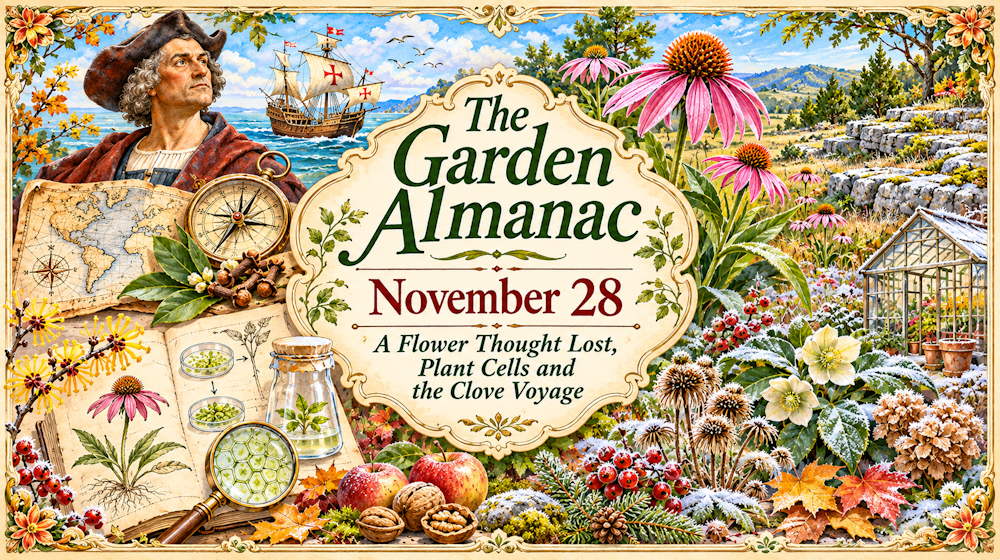
November 28 takes us from the limestone landscapes of Tennessee to the beginnings of modern plant biotechnology and across an ocean in pursuit of precious spices. Along the way, we discover why some wildflowers need surprisingly inhospitable ground, how a tiny fragment of a plant can produce an entirely new specimen, and why an unopened flower bud once helped reshape global trade.
November 28, 1910 – The Ecologist Who Helped Bring a Lost Wildflower Back
A rocky clearing with scarcely enough soil to cover its limestone surface might seem an unlikely place to search for botanical treasures. Yet these unusual landscapes, known as cedar glades, became the life’s work of American plant ecologist Elsie Quarterman, born on November 28, 1910, in Valdosta, Georgia. Her research in central Tennessee helped reveal the extraordinary biodiversity of habitats that could easily be dismissed as barren or unproductive land.
Despite their name, cedar glades are not simply woodlands filled with cedar trees. Their most distinctive areas are open, sunny expanses where shallow soils, exposed limestone and dramatic seasonal changes in moisture restrict the growth of many larger plants. Within these demanding conditions, highly specialised wildflowers have evolved. Among them was the Tennessee coneflower (Echinacea tennesseensis), a pink-flowered relative of the coneflowers familiar to gardeners, which had long been feared extinct.
In the late 1960s, Quarterman and her graduate student Barbara Turner rediscovered the species in its natural habitat. The finding helped set conservation efforts in motion, leading to federal protection in 1979 and the preservation and restoration of important cedar glade sites. In 2011, the Tennessee coneflower was removed from the United States’ federal endangered species list following its recovery – a remarkable outcome that Quarterman lived to witness.
What makes the cedar glades particularly fascinating is that their apparent limitations are essential to their biodiversity. Adding fertile topsoil, increasing irrigation or encouraging vigorous vegetation could actually disadvantage some of their specialist plants by allowing stronger competitors to take over. Before improving every patch of poor soil in your garden, consider whether it might instead support a sunny gravel garden, a collection of drought-tolerant native plants or a small wildflower habitat. Sometimes the most valuable characteristic of a growing site is precisely the one we are tempted to change.
Wildlife Note – Why Standing Seedheads Matter
The ecological value of coneflowers continues long after their colourful petals have disappeared. Their mature seedheads provide food for seed-eating birds, including American goldfinches in North America, while standing perennial stems and undisturbed plant debris can offer overwintering sites for insects and spiders.
Leaving selected areas of a flower border uncut until spring creates a more varied winter habitat. Remove diseased material where necessary, but remember that a brown, apparently lifeless perennial may still be supporting a surprising amount of life.
November 28, 1854 – Could an Entire Plant Grow from a Single Cell?
Long before laboratories could produce thousands of identical orchids or disease-tested young plants, an Austrian botanist began investigating a rather extraordinary possibility. Gottlieb Haberlandt, born on November 28, 1854, in what is now Mosonmagyaróvár, Hungary, wondered whether an individual plant cell could retain the ability to develop into an entire plant.
In experiments published in 1902, Haberlandt placed isolated plant cells in artificial nutrient solutions, attempting to sustain them independently of the parent plant. His experiments did not produce dividing cells or complete plants, but his underlying idea proved remarkably farsighted. Later discoveries about plant growth regulators, cell development and suitable growing media made plant tissue culture possible, transforming horticultural propagation, crop research and the conservation of rare plants.
Today, laboratories can multiply selected plants from tiny pieces of living tissue, producing large numbers of genetically similar specimens under controlled conditions. Gardeners encounter a simpler expression of this regenerative capacity whenever they propagate a plant from a cutting. Even as the outdoor growing season winds down, dormant roots and woody stems of suitable species can become the starting material for next year’s garden.
Garden Science – How Can a Root Cutting Produce New Leaves?
Roots normally absorb water and minerals, anchor plants and store energy. In certain species, however, living root tissues can also initiate new shoots.
Stored carbohydrates help sustain this development until the emerging leaves begin photosynthesising. Plant hormones and the developmental flexibility of certain cells influence whether new roots or shoots form.
This regenerative ability varies considerably between species, which explains why root cuttings work well for oriental poppies but are unsuitable for many other familiar garden plants. Successful propagation depends on choosing a method that matches the biology of the plant rather than simply applying the same technique to everything.
Garden Reminder – Propagation Jobs for Late November
In temperate Northern Hemisphere gardens, the dormant season offers several opportunities to increase your plant collection without buying new specimens.
- Take root cuttings from suitable dormant perennials, such as oriental poppies (Papaver orientale) and mulleins (Verbascum spp.). Plant sections of thicker roots upright in a free-draining propagation mix, keeping their original orientation.
- Prepare hardwood cuttings from healthy dormant shoots of blackcurrants, redcurrants and suitable dogwoods. Choose firm growth produced during the previous growing season.
- Avoid excessive watering. Unrooted cuttings are particularly vulnerable to decay in cold, saturated growing media.
- Label every cutting. Record the plant’s name and propagation date before placing it in a sheltered location appropriate to the species.
Wait until the soil is workable if your garden is already experiencing prolonged frost or waterlogging.
November 28, 1520 – When Flower Buds Were Worth Crossing an Ocean For
The cloves that give winter baking, mulled wine and festive preserves their distinctive fragrance were once among the most desirable commodities in international trade. On November 28, 1520, Ferdinand Magellan’s expedition emerged from the strait at the southern end of South America and entered the Pacific Ocean. Its commercial objective was to establish a westward sea route to the spice-producing islands of Southeast Asia.
Cloves had already travelled along Asian trading networks for centuries, but their restricted geographical origin made them particularly valuable to European merchants. The expedition eventually reached the Moluccas, now part of Indonesia, after Magellan’s death in the Philippines. When Juan Sebastián Elcano returned to Spain aboard the Victoria in 1522, completing the first circumnavigation of the globe, the ship carried a valuable cargo of spices. The extraordinary demand for these botanical products subsequently encouraged colonial competition, monopolies and the movement of spice-producing plants between tropical regions.
Botanically speaking, a clove is neither a seed nor a fruit. It is the dried, unopened flower bud of an evergreen tropical tree (Syzygium aromaticum), a member of the myrtle family. Its distinctive fragrance comes largely from eugenol, an aromatic compound also found in smaller quantities in some other plants. Although the clove tree is unsuitable for ordinary outdoor cultivation in temperate climates, gardeners can explore similarly fascinating aromatic chemistry through rosemary, sage, thyme and scented pelargoniums. Each releases its characteristic fragrance through compounds produced and stored within specialised plant tissues.
What to Observe Right Now – Discovering the Garden Beyond Its Flowers
In late November, when flowers become scarce in colder regions, other botanical details deserve closer attention.
- Aromatic evergreen foliage: gently brush against rosemary, thyme or sage and notice how their fragrance intensifies.
- Dormant buds: compare the size and shape of buds on lilac, magnolia and fruit trees. Some already contain next season’s developing flowers.
- Changing seedheads: observe how wind, rain and visiting birds gradually empty the seedheads of ornamental grasses and perennials.
- Contrasting microclimates: after a frosty morning, notice which areas thaw first and where ice persists. Walls, shelter and exposure can create remarkably different growing conditions within a small garden.
These quiet observations reveal characteristics that are easily overlooked during the more colourful months of the year.
Looking Ahead
As December approaches, resist the temptation to judge the garden solely by what is flowering. Its less conspicuous features – undisturbed habitats, dormant roots, protective buds and aromatic foliage – offer valuable clues about how plants survive, reproduce and interact with their surroundings. Use the quieter weeks ahead to identify areas where existing conditions could support greater biodiversity and to experiment with propagating a few favourite plants. There is still plenty to discover, even when the garden appears to be asleep.