
A dried flower can tell us what season it was more than three thousand years ago. A spoonful of honey can reveal something about the landscape surrounding a beehive, and the twisted trunk of an ancient olive tree can hold the history of generations of gardeners and farmers.
As November draws to a close and northern gardens settle into their winter rhythms, November 26 opens three fascinating windows into the living world. From the treasures of ancient Egypt to the microscopic study of pollen and the olive-growing landscapes of the Mediterranean, today’s almanac explores the remarkable stories that plants can preserve.
November 26, 1922 – The Pharaoh’s Flowers and a Spring Hidden for Millennia
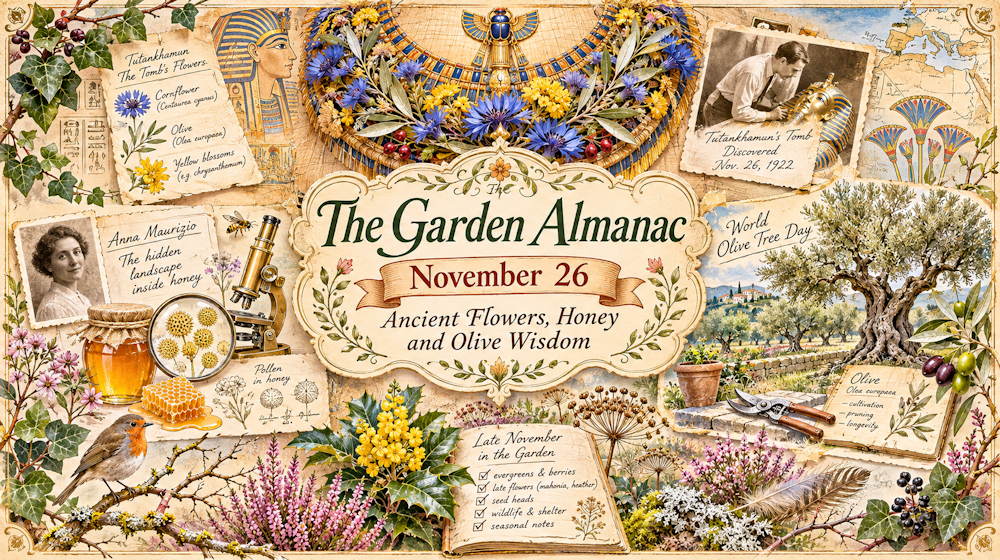
When Howard Carter first peered into the antechamber of Tutankhamun’s tomb on November 26, 1922, the glitter of gold was almost overwhelming. Yet among the extraordinary discoveries made during the excavation were treasures of a much more fragile nature. Leaves, flowers, fruits and other botanical remains had survived more than three thousand years in the dry conditions of ancient Egypt. Their scientific value would prove quite independent of their material worth.
The floral collars associated with Tutankhamun’s burial are particularly remarkable. Examples preserved in a separate funerary deposit incorporated blue cornflowers, olive leaves, yellow flowers, berries and decorative beads attached to a papyrus backing. The craftsmen even made use of the contrasting colours of olive foliage, arranging the darker upper surfaces and silvery undersides of the leaves to create decorative patterns. Nature supplied not only the materials but also the palette.
These botanical remains offered something that golden objects could not – clues to the season of the royal burial. By examining the flowering periods of the plants used in the funerary decorations, researchers suggested that the ceremonies probably took place between late February and mid-March. Taking the lengthy mummification process into account, this would place Tutankhamun’s death in early winter. An arrangement of flowers had become a calendar spanning millennia.
The same principle underlies phenology, the study of recurring seasonal events in nature. Gardeners can create their own phenological records by noting when snowdrops emerge, fruit trees blossom, leaves change colour or the first frost damages tender plants. Over several years, such observations reveal the distinctive seasonal rhythm of a garden and how it responds to changing weather and climate. A simple notebook of flowering dates can become a surprisingly valuable botanical archive.
Garden Science – Can Flowers Tell Us What Time of Year It Is?
Flowering is governed by a combination of environmental signals, including temperature, day length, moisture availability and, in certain species, exposure to a prolonged period of cold.
Some plants respond strongly to accumulated warmth, while others depend more heavily on changes in daylight. This explains why an unusually mild winter may bring certain flowers into bloom much earlier than expected without affecting all species in the same way.
Flowering dates are therefore valuable indicators of environmental change, particularly when observations are collected consistently over many years in the same location.
November 26, 1900 – The Scientist Who Discovered Landscapes in Honey
Honey may appear perfectly clear to the naked eye, yet under a microscope it can reveal an extraordinary collection of botanical signatures. Pollen grains of different shapes, sizes and surface patterns provide clues to the flowers visited by honeybees. Few scientists devoted themselves to understanding these tiny records as thoroughly as the Swiss biologist Anna Maurizio, born on November 26, 1900, in Zurich.
Working at a Swiss research institute in Liebefeld from 1928, Maurizio helped develop methods for analysing pollen in honey and became an influential researcher in melissopalynology – the scientific study of pollen found in honey. Her work also explored the relationship between pollen and bee nutrition. What might once have seemed like insignificant particles in a sweet substance became evidence of the botanical origins of honey and the intricate relationship between insects and flowering plants.
There is an important distinction here for anyone planting a pollinator-friendly garden. A flower may produce abundant nectar but relatively little pollen, or offer pollen without much nectar. Honeybees need carbohydrates from nectar as well as proteins, fats and other nutrients supplied by pollen. A garden containing several kinds of flowers with overlapping flowering periods can therefore offer a more varied food supply than one dominated by a single spectacular flowering species.
Wildlife Note – Do Bees Still Visit Gardens in November?
In regions with relatively mild winters, honeybees and some bumblebees may venture out during warm, sunny spells. Gardens containing late-flowering or winter-flowering plants can provide valuable food when other sources are scarce.
Among the plants worth watching are:
- Common ivy (Hedera helix) – mature flowering ivy can provide nectar and pollen well into autumn.
- Mahonia – early-flowering varieties offer conspicuous yellow flowers during late autumn and winter.
- Winter-flowering heathers (Erica species) – depending on the species and cultivar, these can provide food during the colder months.
- Winter-flowering clematis (Clematis cirrhosa) – a useful climber for sheltered gardens in suitable climates.
During colder periods, many wild bees remain dormant. Undisturbed leaf litter, sheltered ground and standing hollow stems can be just as important to their survival as flowering plants.
World Olive Tree Day – Celebrating a Tree That Outlives Generations
Few cultivated trees have shaped entire landscapes as profoundly as the olive (Olea europaea). In 2019, November 26 was established as World Olive Tree Day, recognising the cultural, environmental and agricultural importance of a tree that has accompanied Mediterranean civilisations for thousands of years. Its branches have become symbols of peace, while its fruit and oil have influenced everything from cooking and trade to medicine, religious ceremonies and traditional craftsmanship.
One of the most remarkable qualities of the olive tree is its capacity for regeneration. Even when an ageing trunk becomes hollow or damaged, new growth can emerge from its base. This ability helps explain why ancient olive groves can remain productive across generations. Individual trees become living monuments to agricultural continuity, although determining their precise age is often difficult because their oldest central wood may no longer survive.
The ecological value of an olive grove, however, depends on much more than the trees themselves. Traditional orchards containing wildflowers, grassy ground cover, dry-stone walls and patches of uncultivated vegetation can support a rich variety of insects, birds and other wildlife. Interestingly, olive trees are primarily wind-pollinated, yet their surroundings can provide valuable habitats for pollinating insects. In a domestic orchard, allowing suitable vegetation to grow between established fruit trees, rather than maintaining completely bare soil, can bring similar ecological benefits.
Garden Reminder – How to Protect Olive Trees in Winter
Late November is olive-harvesting season in many Mediterranean regions. In colder climates, however, gardeners growing olives primarily for their ornamental value should be preparing them for winter.
- Prioritise drainage. Olives dislike prolonged waterlogging, especially during cold weather. Raise containers on pot feet and ensure that drainage holes remain clear.
- Protect container-grown trees. Their roots are more exposed to freezing temperatures than those of trees growing in the ground. In particularly cold regions, move them to a bright, cool, frost-free location.
- Water sparingly. Keep the compost slightly moist throughout winter, but avoid keeping it constantly wet.
- Avoid heavy pruning now. Major pruning is better carried out in late spring or early summer, when the danger of damaging frosts has passed.
- Choose a sheltered position. A sunny location protected from cold winds provides more favourable conditions for overwintering.
If your tree has produced fruit, remember that freshly picked olives are naturally bitter because they contain compounds such as oleuropein. They require appropriate curing before they can be enjoyed at the table.
What to Observe Right Now – Reading the Late-November Garden
Even as the growing season comes to an end across much of the Northern Hemisphere, the garden remains full of small botanical and ecological discoveries.
- Silvery foliage: Look closely at lavender, sage and olive leaves. Fine surface hairs can reflect sunlight and contribute to adaptations that help plants cope with dry environments.
- Persistent seed heads: Notice which ornamental grasses and perennials retain their seeds longest and which attract feeding birds.
- Next year’s buds: Many deciduous trees and shrubs already carry the buds that will produce next spring’s leaves or flowers.
- Sheltered microclimates: Compare plants beside sunny walls with those in exposed parts of the garden. Frost damage, flowering activity and leaf retention may differ considerably over just a few metres.
- The disappearing autumn canopy: As deciduous trees shed their leaves, previously hidden lichens, bark patterns, nests and branch structures become easier to see.
For gardeners in the Southern Hemisphere, where November brings late spring rather than approaching winter, flowering sequences, insect activity and developing fruits offer an equally rewarding seasonal record.
Looking Ahead
The quieter months of the gardening year offer an opportunity to become more attentive observers of the living world. Recording flowering dates, planning a more diverse selection of pollinator-friendly plants and making room for wildlife beneath established trees are small decisions with lasting benefits. Even the most familiar garden contains botanical stories that become apparent only when we know what to look for. And the observations we make this November may help us understand the gardens of many seasons to come.