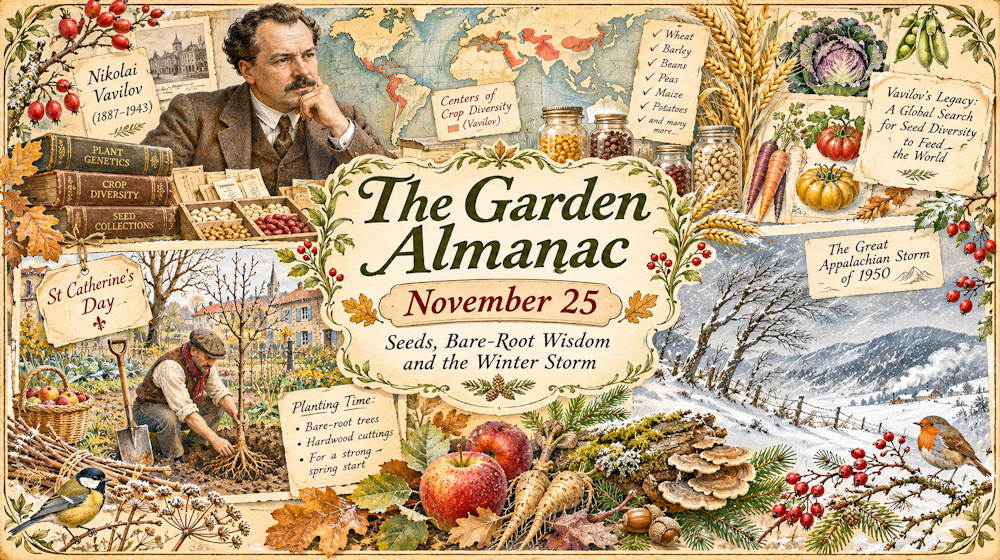

By late November, a garden can look almost empty. Leaves have fallen, flower beds have quietened, and the first serious frosts may already have arrived. Yet beneath the surface, roots can still grow, seeds hold the promise of future harvests, and the landscape is preparing for another season.
November 25 brings together three remarkable stories: a scientist who searched the world for the origins of our food, an old French tradition that reveals a surprising truth about planting, and a devastating storm that exposed the extraordinary power of winter weather.
November 25, 1887 – Nikolai Vavilov and the Seeds That Could Save the World
What if the future of agriculture depended on finding thousands of seemingly ordinary seeds scattered across remote mountains, village markets and traditional farms?
That question shaped the extraordinary career of Nikolai Vavilov, born in Moscow on November 25, 1887. The Russian botanist and geneticist believed that protecting humanity from hunger required understanding the enormous diversity of cultivated plants. Rather than concentrating only on improving existing crops, he travelled across continents in search of their wild relatives and traditional varieties, particularly in regions where generations of farmers had developed distinctive crops adapted to local conditions.
Vavilov recognised that the plants growing in different regions carried different genetic strengths. A wheat variety cultivated in a mountain valley might withstand cold that destroyed another variety. A wild relative of a familiar crop might possess resistance to a devastating disease. His research into the geographical centres of crop diversity helped transform plant breeding, while the seed collections assembled under his leadership became an important foundation for modern genetic conservation. Tragically, his scientific opposition to politically favoured agricultural theories led to his arrest in 1940. He died in prison in 1943, but the collections he helped establish survived.
One of the most remarkable episodes in this story occurred during the siege of Leningrad in the Second World War. Scientists protecting the institute’s priceless plant collections faced starvation, yet preserved seeds and edible crop samples rather than consuming them. Their determination safeguarded genetic material that might otherwise have disappeared. Today, Vavilov’s legacy can be recognised in seed banks, crop conservation projects and efforts to preserve traditional varieties. Even a small vegetable garden can contribute to this wider picture by growing locally adapted, open-pollinated varieties, saving seeds from healthy plants where appropriate, and keeping older cultivars in cultivation.
Garden Science – Why Does Genetic Diversity Matter in a Vegetable Garden?
Two tomato plants may look similar, yet their genetic differences can influence how they respond to drought, temperature changes or disease.
- Disease resistance: Different varieties may possess different levels of resistance to particular pathogens.
- Climate adaptation: Some cultivars perform better in cool, short seasons; others tolerate heat or dry conditions more successfully.
- Harvest security: Growing several suitable varieties can reduce the risk of losing an entire crop to one weather event or disease.
- Long-term conservation: Saving seeds from suitable open-pollinated varieties can help preserve useful characteristics, although cross-pollination must be managed when maintaining a variety’s identity.
A garden planted with several carefully chosen varieties is more than an attractive collection. It is also a small experiment in agricultural resilience.
November 25 – Saint Catherine’s Day and the Surprising Wisdom of Planting Bare-Root Trees
In France, November 25 has long been associated with a gardening proverb: À la Sainte-Catherine, tout bois prend racine – roughly translated as “On Saint Catherine’s Day, every piece of wood takes root.”
The saying belongs to the feast day of Saint Catherine of Alexandria, but its gardening significance comes from centuries of seasonal observation rather than religious history. By late November, many deciduous trees and shrubs have shed their leaves and entered dormancy. Their reduced demand for water makes this an excellent period for moving and planting bare-root specimens in suitable climates. Interestingly, the traditional proverb may originally have referred particularly to hardwood cuttings, rather than suggesting that every tree should be planted on one particular day.
The distinction matters. A dormant rose or currant cutting can sometimes form roots from a section of mature stem inserted into suitable soil, while a newly planted bare-root apple tree already possesses a root system that needs to establish contact with the surrounding ground. Both benefit from appropriate moisture and temperatures, but neither is guaranteed success by the calendar. In temperate regions, late autumn is often ideal for planting deciduous fruit trees, hedging plants and roses, provided the soil is neither frozen nor waterlogged. Planting early enough allows roots to settle before the demands of spring growth and summer heat.
Garden Reminder – What Should You Plant in Late November?
For gardeners in temperate Northern Hemisphere climates, this can be one of the most useful planting periods of the year.
- Plant bare-root fruit trees: Apples, pears and plums can establish well during dormancy, where winter conditions permit.
- Establish deciduous hedges: Hawthorn, hornbeam and other locally suitable species can be planted while dormant.
- Try hardwood cuttings: Currants, willows and some deciduous shrubs can be propagated from healthy, mature stems.
- Check planting depth: Keep the root flare of a tree near the finished soil surface and avoid burying the trunk.
- Water after planting: Even dormant plants need moisture to settle soil around their roots.
Avoid planting into frozen or saturated ground. In regions with severe winters, exposed sites or unsuitable soil conditions, spring planting may be safer.
November 25, 1950 – The Great Appalachian Storm and the Hidden Strength of Trees
On November 25, 1950, an extraordinary weather system struck the eastern United States. The Great Appalachian Storm brought a remarkable combination of snow, destructive winds, severe cold and coastal flooding. In parts of the Appalachian Mountains, snowfall reached exceptional depths, while other areas experienced violent winds that damaged buildings, infrastructure and trees.
The storm became especially memorable because its effects varied so dramatically from place to place. While some communities struggled under deep snow, others faced powerful winds and destructive flooding. Near Albany, New York, a wind gust of 83 miles per hour was recorded. The storm developed between powerful high-pressure systems, creating an intense pressure gradient. It demonstrated how one large weather event could produce several different hazards across an enormous landscape.
For gardeners and landscape managers, the event also illustrates why winter tree damage is rarely explained by wind speed alone. Species, crown shape, branch structure, rooting conditions and exposure all influence how a tree responds. Heavy, wet snow can overload branches, while saturated soil can reduce the stability of root systems during strong winds. A broad-canopied tree with structural weaknesses may suffer considerable damage even when a neighbouring specimen survives. In today’s gardens, maintaining healthy root zones, avoiding unnecessary soil compaction and inspecting trees for damaged or weakly attached branches are important parts of preparing for winter storms.
Wildlife Note – Why Dead Wood Can Be Valuable After a Storm
A fallen branch may look untidy, but it can become a miniature habitat.
Dead wood supports fungi, beetles and other organisms involved in decomposition. Many insects develop within decaying timber, while birds may search beneath loose bark for food. Over time, fallen wood contributes organic matter and nutrients to the soil.
Where space permits, leave a small pile of untreated branches in a quiet garden corner. Keep it away from paths and buildings, and remove any wood presenting an immediate safety risk. Standing dead trees should only be retained where they can be assessed and managed safely.
What to Observe Right Now – The Quiet Changes of Late November
November offers an excellent opportunity to notice details that are hidden during the growing season. The following observations are especially relevant in temperate Northern Hemisphere gardens.
- Winter buds: Look closely at the shape and arrangement of buds on leafless twigs. Opposite buds on maples and ashes contrast with the alternate arrangement typical of oaks.
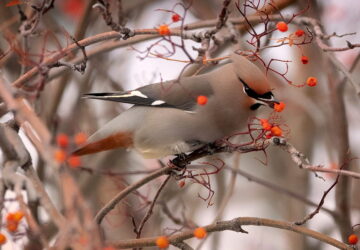
- Persistent fruits: Hawthorn berries, rose hips and other fruits may remain available to birds after many softer autumn fruits have disappeared.
- Frost patterns: Compare sheltered corners with exposed lawns. Frost may appear in one part of a garden while another remains unfrozen.
- Leaf litter: Lift a few leaves gently to see how moisture, fungi and decomposing plant material are changing the soil surface.
- Evergreen foliage: Observe how conifers and broadleaved evergreens retain their leaves while deciduous neighbours stand bare.
These small observations reveal how different plants and animals respond to shortening days, lower temperatures and changing food supplies.
Looking Ahead
The closing weeks of autumn are an opportunity to think beyond the next growing season. A carefully chosen fruit tree, a locally adapted vegetable variety or a small area left undisturbed for wildlife can have benefits that extend far into the future. Gardens become more resilient through thoughtful plant selection, healthy soil and attention to the conditions of each site. November 25 reminds us that even when growth seems to have stopped, the foundations of tomorrow’s garden are already taking shape.