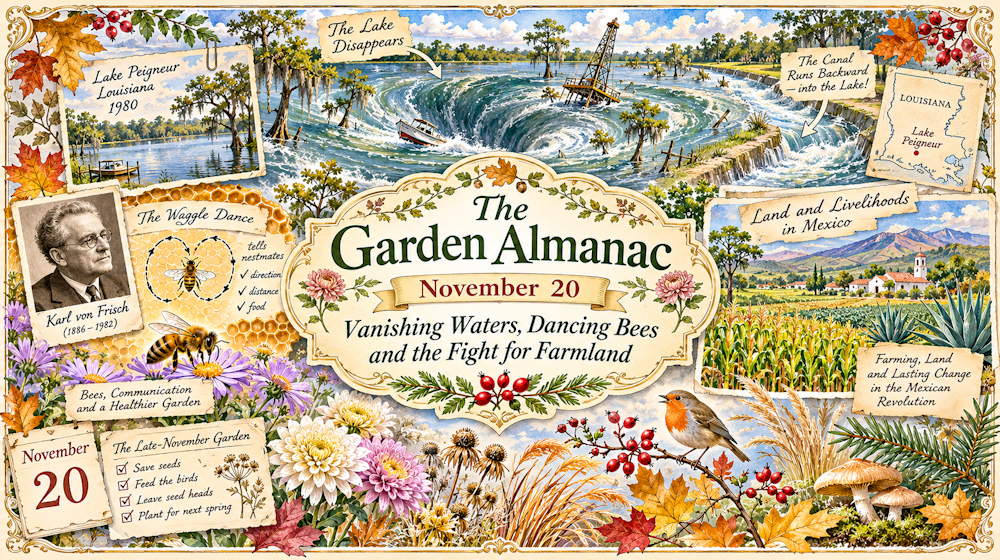

Imagine looking across a peaceful lake one morning and discovering that, within hours, the water has almost entirely disappeared. Or watching a honeybee perform a tiny dance that tells its companions where to find flowers. November 20 brings together stories that seem almost too extraordinary to belong to the same calendar date.
From a remarkable environmental disaster in Louisiana to the secret language of bees and the struggle for farmland in Mexico, today’s Garden Almanac explores three very different relationships between people and the natural world. As autumn deepens in Northern Hemisphere gardens, these stories offer fresh reasons to look more closely at the ground beneath our feet, the pollinators around us and the landscapes we depend upon.
November 20, 1980 – The Day a Louisiana Lake Disappeared into the Earth
On the morning of November 20, 1980, Lake Peigneur in Louisiana appeared to be an ordinary, shallow body of water. An oil-drilling platform stood above its surface, while nearby Jefferson Island was known for its historic house and beautiful gardens. Then something extraordinary happened. The drilling operation apparently breached the roof of an underground salt mine, allowing lake water to rush into the enormous cavities beneath it.
Within hours, a gigantic whirlpool developed, swallowing the drilling platform, barges, boats and large sections of the surrounding shoreline. Trees disappeared into the collapsing ground, and part of the landscaped gardens was destroyed. Perhaps the strangest development occurred when the Delcambre Canal, which normally carried water away from the lake towards the Gulf of Mexico, began flowing backwards. Water poured towards the emptying lake, temporarily creating a waterfall. Remarkably, the workers escaped and no lives were lost.
The disaster changed the lake itself. Once a relatively shallow freshwater environment, Lake Peigneur became a much deeper, saltier body of water as the underground cavities filled and water flowed in from connected coastal waterways. The change profoundly altered the conditions experienced by aquatic organisms. Fish, plants and microorganisms adapted to freshwater cannot necessarily tolerate increased salinity. A landscape that had seemed stable was transformed through the unexpected interaction of geology, engineering and water.
The story is particularly striking because a botanical garden was among the damaged landscapes. It also reminds us that the health of a garden depends on processes extending far below the visible soil surface. Underground drainage, groundwater movement and soil chemistry can determine whether plants flourish or struggle. Most gardeners will never experience anything resembling Lake Peigneur, but waterlogged roots, rising groundwater and salt accumulation can cause less dramatic problems. Understanding how water enters, moves through and leaves the soil is one of the foundations of successful gardening.
Garden Science – Why Can Too Much Water Kill Plant Roots?
Plants need water, but their roots also require oxygen for respiration.
In healthy, well-structured soil, some spaces between particles contain water while others contain air. When soil remains saturated, water fills these spaces and oxygen becomes scarce.
Without sufficient oxygen, roots cannot function normally. Nutrient uptake declines, and prolonged waterlogging can encourage root diseases.
How to recognise the problem:
- Leaves may turn yellow even though the soil is consistently wet.
- Growth becomes weak or stops altogether.
- Roots may appear dark, soft or damaged.
- Water remains on the soil surface long after rainfall.
Improving drainage, reducing unnecessary watering and avoiding soil compaction can help prevent these conditions. Raised beds may also be useful in persistently wet locations.
November 20, 1886 – The Scientist Who Discovered That Bees Could Give Directions
A honeybee returning to its hive sometimes performs a remarkable movement. It runs across the honeycomb while shaking its abdomen, turns in a loop, and repeats the sequence in a pattern resembling a figure eight. For a long time, such movements were poorly understood. Karl von Frisch, born in Vienna on November 20, 1886, eventually demonstrated that these dances were much more than expressions of excitement.
Through carefully designed experiments, von Frisch discovered that honeybees communicate information about the location of valuable resources. The angle of a bee’s waggle run indicates the direction of a food source relative to the sun, while the duration of the movement provides information about distance. Even more astonishingly, bees can communicate this directional information inside a dark hive, using the vertical surface of the honeycomb as their reference. Von Frisch received the Nobel Prize in Physiology or Medicine in 1973, sharing the award with Konrad Lorenz and Nikolaas Tinbergen.
His discovery transforms the way we might watch bees visiting garden flowers. A patch of lavender or a flowering fruit tree is not merely an isolated source of nectar or pollen. For honeybees, it can become a destination advertised to other workers through an elaborate communication system. Food availability across the wider landscape therefore matters enormously. A garden offering flowers throughout the growing season contributes more than a brief display of colour: it can provide part of a network of feeding opportunities used by pollinators. Different bee species have different foraging habits, so including varied flower shapes and suitable native plants helps support a wider range of insects.
Wildlife Note – Where Are the Bees in November?
In temperate Northern Hemisphere gardens, honeybee activity usually declines as temperatures fall and flowering becomes scarce.
Honeybee colonies generally survive winter together, relying on stored food. Bumblebees follow a different seasonal pattern: in many species, newly mated queens overwinter while the rest of the colony dies.
Solitary bees may survive winter as developing adults, larvae or other life stages within protected nesting sites, depending on the species.
How gardeners can help:
- Leave some hollow stems and undisturbed nesting areas through winter.
- Avoid unnecessary disturbance of bare soil where ground-nesting bees may be developing.
- Plan early spring flowers such as crocuses, suitable willows and native flowering shrubs.
- Choose plants with overlapping flowering periods to reduce gaps in nectar and pollen availability.
November may be quiet, but it is an excellent time to prepare a garden that will welcome pollinators next spring.
November 20, 1910 – When the Fight for Land Changed Mexico
On November 20, 1910, a call for rebellion against Mexican president Porfirio Díaz marked the beginning of the Mexican Revolution. Francisco I. Madero had urged an uprising against a political system that had concentrated power and wealth in relatively few hands. Yet beyond the struggle for political change lay a fundamental question about the countryside: who should control the land, and who had the right to cultivate it?
During the preceding decades, large estates had expanded while many rural communities lost access to lands they had traditionally farmed. For agricultural families, this was not an abstract political dispute. Losing land could mean losing food security, independence and the ability to maintain established farming traditions. Revolutionary leaders such as Emiliano Zapata made land redistribution central to their demands. His 1911 Plan of Ayala called for the restoration of lands taken from villages, and the Mexican Constitution of 1917 provided a legal foundation for subsequent agrarian reforms.
The revolution did not resolve every rural inequality, and land redistribution developed unevenly over many years. Nevertheless, its consequences reshaped agricultural ownership and communal farming arrangements. The ejido, a form of collectively held land with individual and communal use rights, became particularly important in post-revolutionary Mexico. The history offers a perspective often overlooked in gardening discussions: productive land is not only a collection of soil, crops and irrigation systems. It also depends on people’s access to those resources, the knowledge passed between generations and the ability of communities to maintain their agricultural landscapes.
Garden Inspiration – Why Do Community Gardens Matter?
Community gardens demonstrate how access to relatively small growing spaces can provide benefits beyond the harvest.
Shared plots allow people to grow vegetables and herbs, exchange practical knowledge and experiment with varieties suited to local conditions.
They can also create habitats for insects and birds, particularly when gardens include flowering borders, hedges and composting areas alongside productive beds.
Successful community gardens need clear arrangements for water, maintenance, soil safety and shared responsibilities. Where these conditions are met, even a modest urban site can become a productive and socially valuable green space.
Garden Reminder – Preparing Vegetable Beds for the Next Growing Season
The Mexican farming story offers a useful opportunity to think about how growing space can be managed sustainably.
Late November is a good time to review the layout and condition of vegetable beds, particularly in temperate climates.
- Protect exposed soil: Cover empty beds with compost, suitable mulch or winter-hardy cover crops where conditions allow.
- Plan crop rotation: Avoid repeatedly growing closely related crops in the same place when soilborne pests or diseases are a concern.
- Preserve useful varieties: Store properly dried seeds from suitable open-pollinated crops in cool, dry conditions.
- Improve access: Design paths so that beds can be reached without repeatedly stepping on cultivated soil.
Healthy soil and practical garden design make it easier to maintain productive growing areas over many seasons.
What to Observe Right Now – The Quiet Work of Late Autumn
As November advances, gardens reveal details that are easily overlooked during the growing season.
- Water movement: After rainfall, observe which areas drain quickly and where water collects.
- Soil structure: Look for crumbly, well-aerated soil beneath mulch and compare it with compacted, exposed ground.
- Overwintering insects: Notice hollow stems, fallen leaves and sheltered corners where insects may spend the colder months.
- Persistent flowers: In milder regions, observe which late-flowering plants still attract occasional bees or other insects on sunny days.
- Community green spaces: Look at nearby allotments, orchards and shared gardens, noting how their planting arrangements support food production and wildlife.
The approaching winter provides an opportunity to understand the garden as a system rather than simply a collection of individual plants.
Looking Ahead
November 20 reveals how much of the natural world depends on connections we cannot immediately see. A lake is shaped by the geology beneath it, a bee’s journey depends on flowers across the landscape, and a productive field depends on the people who can cultivate it. For gardeners, these stories encourage better water management, more thoughtful planting for pollinators and greater appreciation of shared growing spaces. As the season turns towards winter, even small decisions can help create healthier soils, richer habitats and more resilient gardens for the future.