
By mid-November, a garden in the Northern Hemisphere may seem to be retreating into silence. Fallen leaves cover the soil, seed heads stand against colder skies, and the last flowers have become precious exceptions. Yet beyond the garden gate, the natural world is full of stories that reach across centuries and continents.
November 16 offers three remarkable journeys: to a historic decision that changed how humanity protects its landscapes, to the agricultural ingenuity of the ancient Andes, and to a rainforest observatory that sent a description of life on Earth into space. Each reveals something unexpected about the living world we share.
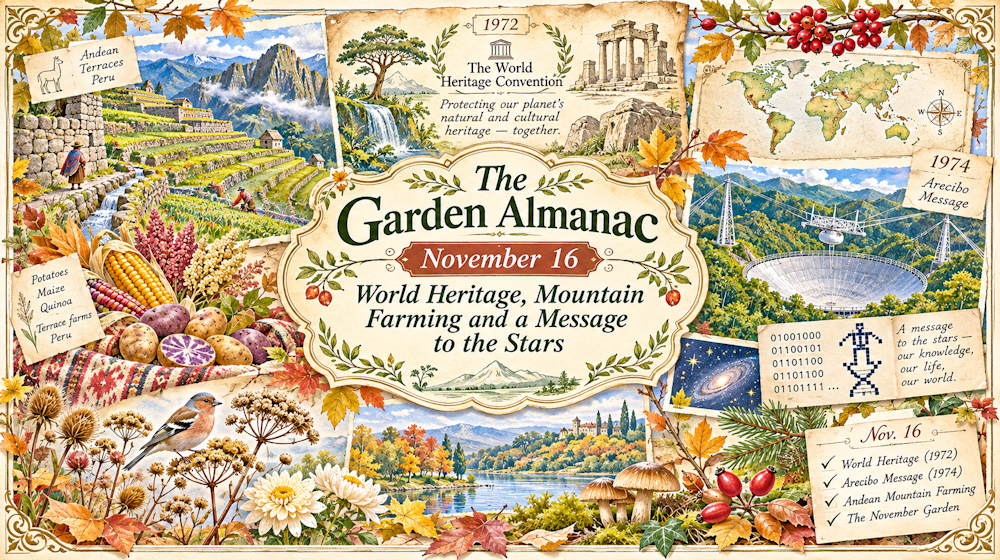
November 16, 1972 – When Nature and Human History Became One World Heritage
For centuries, extraordinary buildings and spectacular natural landscapes had largely been treated as separate kinds of treasures. A cathedral belonged to cultural history; a rainforest or mountain wilderness belonged to nature. On November 16, 1972, that distinction began to change when UNESCO adopted the World Heritage Convention in Paris.
The agreement introduced a remarkable international idea: certain places possess such exceptional value that their protection matters beyond national borders. More importantly, it brought cultural and natural heritage together within one framework. The concept had emerged from years of discussion, including proposals to protect historic monuments and exceptional natural areas through international cooperation. For the first time, a global treaty formally united these ambitions.
The implications extend far beyond famous monuments and national parks. Consider the rice terraces of the Philippine Cordilleras, where generations of farmers transformed steep mountain slopes into productive landscapes, or the cultural landscape of Bali, where traditional irrigation practices connect agriculture, communities and water management. Such places demonstrate that nature and human activity are not always opposing forces. Carefully maintained agricultural landscapes can preserve ecological knowledge, local crop varieties and relationships between people and their environment.
There is a smaller version of this story in almost every garden. An old orchard, a traditional hedgerow or a vegetable plot cultivated through generations can preserve living knowledge as well as plants. Mature trees may shelter wildlife, while established hedges form corridors connecting otherwise isolated habitats. Protecting these features, rather than automatically replacing them, can preserve ecological value that takes decades to develop.
Garden Reminder – What Should You Protect Before Winter?
Late autumn is an excellent time to assess which parts of a garden deserve preservation rather than clearance.
- Keep healthy mature trees and hedges where possible. Their roots, branches and accumulated leaf litter support established communities of organisms.
- Protect vulnerable perennial crowns. Apply approximately 5–7 cm of suitable mulch around susceptible plants, keeping it clear of stems to reduce the risk of rot.
- Avoid working waterlogged soil. Digging or walking on saturated beds can compact the ground and damage its structure.
- Record valuable plants. Label established varieties, note successful growing locations and save suitable seeds for future seasons.
A garden’s most valuable features are not necessarily its newest or most colourful.
November 16, 1532 – The Andean Empire That Farmed Mountains
On November 16, 1532, Spanish conquistador Francisco Pizarro captured the Inca ruler Atahualpa at Cajamarca, in present-day Peru. The ambush became a decisive moment in the Spanish conquest of the Inca Empire. Yet behind the dramatic political history was another extraordinary achievement: an agricultural civilisation that had learned to turn some of the world’s most difficult mountain terrain into productive farmland.
The Incas inherited and developed farming techniques refined by earlier Andean societies. Stone-walled terraces created level growing surfaces on steep slopes, while carefully constructed drainage and irrigation systems helped manage scarce or unpredictable water supplies. Farmers cultivated different crops at different elevations, taking advantage of variations in temperature, rainfall and growing conditions. Potatoes, maize and quinoa formed part of a remarkably diverse food system.
This was more than an ingenious way of finding space to grow food. By cultivating crops across different ecological zones, Andean communities reduced the risk of losing everything to a single frost, drought or other local disaster. Traditional terraces and irrigation channels remain part of living agriculture in the Andes today. The same principle applies on a smaller scale in modern gardens: a sheltered south-facing wall, an exposed vegetable bed and a cool, shaded corner can offer surprisingly different growing conditions. Understanding these microclimates helps gardeners choose suitable plants and reduce weather-related losses.
Garden Science – Why Can Two Beds in the Same Garden Have Different Temperatures?
A garden’s microclimate depends on more than the regional weather forecast.
- Aspect: South-facing slopes and walls receive more direct sunlight in the Northern Hemisphere, often warming earlier in spring.
- Cold-air drainage: Cold air can collect in low-lying areas, creating frost pockets even when nearby ground remains frost-free.
- Thermal mass: Stone and brick absorb heat during the day and release some of it after sunset.
- Wind exposure: Shelter can reduce drying winds, but enclosed spaces may also trap cold air.
Before moving a frost-sensitive plant, observe where frost first appears and where it lingers longest. These small differences can determine whether a plant survives a cold night.
November 16, 1974 – A Rainforest Telescope Sends Earth’s Biological Signature into Space
Deep in Puerto Rico’s tropical landscape, a giant radio telescope once occupied a natural depression surrounded by rainforest. On November 16, 1974, scientists at the Arecibo Observatory used it to send an extraordinary message towards the globular star cluster Messier 13, thousands of light-years away.
The transmission lasted less than three minutes and consisted of 1,679 binary digits. When arranged correctly, the information formed a simple picture containing numbers, the chemical elements essential to terrestrial life, the structure of DNA, a human figure and a representation of our solar system. The message was primarily a demonstration of the observatory’s upgraded capabilities, not a realistic expectation of receiving a reply.
One detail is particularly fascinating for anyone interested in plants: the scientists chose to describe life through its chemistry and genetic structure. The DNA represented in the message is not exclusively human. Plants, fungi, animals and countless microorganisms all depend on genetic information encoded in DNA. A garden filled with roses, mosses, vegetables and trees therefore contains astonishing biological diversity built upon a shared molecular foundation. Different varieties of the same crop can also carry useful genetic differences, including traits affecting disease resistance, growth and adaptation to changing conditions.
Wildlife Note – Who Is Sheltering in the November Garden?
As temperatures fall across temperate regions, many small garden inhabitants retreat into sheltered places.
Leaf litter can protect beetles, spiders and overwintering insects. Hollow stems may shelter certain insects, while seed heads provide food for finches and other seed-eating birds.
A wildlife-friendly autumn garden does not need to be neglected. Keep paths safe and lawns clear of thick leaf layers, but consider leaving undisturbed patches beneath shrubs and around healthy perennial plants. Avoid disturbing these shelters during winter.
What to Observe Right Now – The Hidden Life of Late Autumn
November offers particularly revealing observations in Northern Hemisphere gardens, although the timing varies with local climate.
- Leaf fall: Compare species that have already lost their foliage with those still retaining leaves.
- Persistent berries: Watch how birds use hawthorn, rose hips and other autumn fruits as food supplies change.
- Frost patterns: Notice whether sheltered beds, open lawns or low-lying corners freeze first.
- Evergreen plants: Observe how conifers, ivy and other evergreens maintain foliage while deciduous trees enter dormancy.
These details reveal that autumn is not a single event. Different organisms respond to declining daylight and falling temperatures in remarkably different ways.
Looking Ahead
A landscape protected for future generations, a mountain transformed into farmland and a message describing life to the stars offer very different ways of looking at our planet. In our own gardens, their relevance is wonderfully practical: preserve established habitats, learn from local growing conditions and value the biological diversity that makes living systems resilient. As the colder season approaches, thoughtful observation can be just as valuable as active gardening. Sometimes the best preparation for next spring begins with understanding what is already growing, sheltering and surviving around us.