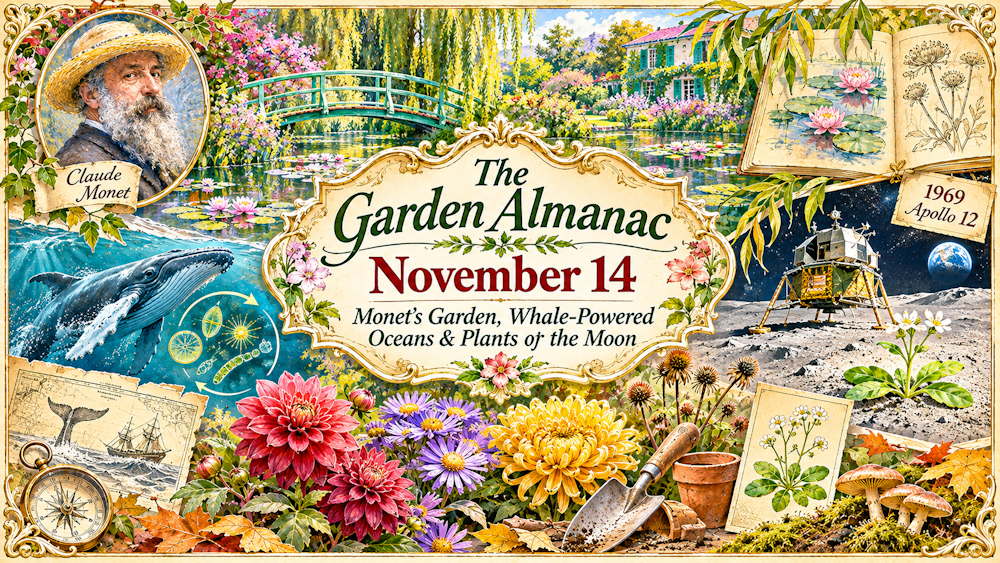

What if you could design a garden specifically to paint it? Or discover that a whale helps feed microscopic plants in the ocean? November 14 brings together three remarkable stories that change the way we look at the natural world.
As autumn settles over Northern Hemisphere gardens, the colours of the season are gradually giving way to bare branches, seed heads and quiet reflections on water. Today’s almanac travels from a painter’s extraordinary garden in France to the whaling seas of the nineteenth century, before leaving Earth altogether to explore a surprising experiment with lunar soil.
November 14, 1840 – Claude Monet, the Painter Who Grew His Own Masterpieces
Imagine spending years planting, pruning and reshaping a garden, not simply to enjoy its flowers, but to create the subjects of your paintings. This was the extraordinary approach of Claude Monet, born in Paris on November 14, 1840. The French Impressionist became one of the world’s most celebrated painters of nature, but his greatest horticultural achievement was a living landscape of his own making.
In 1883, Monet moved to Giverny, a small village in Normandy, where he gradually transformed the grounds surrounding his home. His flower garden, known as the Clos Normand, became a carefully composed display of colours, shapes and seasonal changes. Rather than relying on rigid Victorian-style bedding schemes, he combined flowers in generous drifts, creating contrasting and harmonious colour effects. Roses, irises, poppies, dahlias and numerous other plants contributed to a constantly changing composition. His garden was not merely a place to find inspiration – it was an artwork he could continually rearrange.
Then came an even more ambitious project. In 1893, Monet acquired land across the road and began creating a water garden, using water diverted from a nearby stream. He introduced water lilies, planted willows and other moisture-loving vegetation, and built the famous green Japanese-style bridge. Inspired partly by Japanese prints, he designed a landscape where reflections, plants and changing light became inseparable. The pond eventually inspired hundreds of paintings, including his monumental Water Lilies series. Monet had achieved something unusual: he had created the landscape first, then spent decades exploring it through art.
His garden remains a fascinating example of planting for visual experience rather than simply collecting attractive species. Colours change depending on their neighbours, flowers look different in morning and evening light, and water reflects the sky as well as surrounding foliage. Gardeners can borrow this approach without recreating Giverny. A narrow border planted with complementary colours, a small reflective water feature or a carefully positioned viewpoint can transform an ordinary space. November is an excellent time to study a garden’s underlying structure, when fading foliage reveals its paths, proportions and planting relationships. The most beautiful garden next summer may begin with a few thoughtful observations today.
Garden Inspiration – How Can You Create a Monet-Inspired Garden?
Monet’s approach offers practical ideas for gardens of almost any size.
- Plant in generous groups: Repeating a flower or colour creates a stronger visual effect than scattering individual plants throughout a border.
- Think about flowering seasons: Combine bulbs, perennials and late-flowering plants to maintain interest from spring into autumn.
- Use reflections: Even a modest wildlife pond can reflect trees, clouds and changing light.
- Create a viewpoint: Position a bench or path where several layers of planting can be appreciated together.
Choose plants appropriate to your climate and growing conditions rather than copying the exact species used at Giverny.
November 14, 1851 – Moby-Dick and the Surprising Way Whales Feed the Ocean
When Herman Melville’s novel Moby-Dick was published in the United States on November 14, 1851, it was far from an immediate success. The story of Captain Ahab’s obsessive pursuit of a white sperm whale eventually became one of the most famous novels in American literature. Its descriptions of whaling also preserve a vivid picture of an industry that once sent ships across the world’s oceans in pursuit of oil, valuable materials and profit.
During the nineteenth century, whales were primarily regarded as enormous economic resources. Commercial whaling eventually drove many populations towards collapse, long before scientists fully understood the animals’ ecological importance. Today, researchers know that whales do much more than occupy the upper levels of marine food webs. Through feeding, migration and the release of nutrients, they help influence the productivity of ocean ecosystems.
One particularly intriguing process is sometimes called the whale pump. Whales feeding at depth can release nutrient-rich waste nearer the surface, helping recycle nitrogen, phosphorus and iron into waters where sunlight supports the growth of phytoplankton. These microscopic photosynthetic organisms form the foundation of many marine food webs. Whales can therefore help support the very biological productivity on which ocean life depends. The process offers gardeners a surprisingly familiar ecological principle: nutrients are continually moved, recycled and made available through the activities of living organisms. In a garden, composting organisms, earthworms and decomposers perform different but equally important roles in keeping nutrients circulating. A fertile landscape is sustained not only by the plants growing in it, but by the wider community of organisms that supports them.
Garden Science – Why Does Recycling Nutrients Matter?
Plants need nutrients, but those nutrients are not always immediately available for absorption.
In gardens, bacteria, fungi and soil invertebrates help decompose organic material, gradually releasing nutrients into the soil. Some nutrients are temporarily held within living organisms or organic compounds before becoming available again.
Leaving suitable organic matter in place can support this natural process. Fallen leaves, compost and plant residues can contribute to soil fertility, although their decomposition rates depend on moisture, temperature, oxygen and the materials involved.
This is why maintaining healthy soil biology is often more valuable in the long term than relying exclusively on repeated fertiliser applications.
November 14, 1969 – Apollo 12 and the Soil That Could One Day Grow Plants
The journey began dramatically. On November 14, 1969, Apollo 12 launched from Cape Kennedy, Florida, carrying astronauts Charles Conrad, Richard Gordon and Alan Bean towards the Moon. Just 36 seconds after liftoff, lightning struck the Saturn V rocket. A second strike followed, temporarily disrupting electrical systems. Despite the alarming start, the crew continued their mission and reached lunar orbit safely.
On November 19, Conrad and Bean made a precision landing in the Ocean of Storms, while Gordon remained in lunar orbit. The astronauts collected rocks and surface material, deployed scientific experiments and inspected the nearby Surveyor 3 spacecraft, which had landed on the Moon in 1967. Among the samples they returned to Earth was lunar regolith – the loose layer of fragmented rock and dust covering the Moon’s surface. At the time, nobody knew whether such material might ever help support plant growth.
More than half a century later, that possibility became the subject of a remarkable experiment. In 2022, researchers successfully germinated Arabidopsis thaliana, a small flowering plant widely used in scientific research, in actual lunar regolith collected during Apollo 11, 12 and 17. The plants grew, but many showed serious stress, including slow development and stunted roots. The experiment demonstrated that lunar material can support germination, while also revealing how difficult successful cultivation would be without additional improvements and carefully controlled conditions. For terrestrial gardeners, the distinction is revealing: a material capable of holding roots is not necessarily healthy soil. Productive soil also depends on suitable chemistry, water, air and biological activity. Even the most ambitious future space garden will have to solve problems familiar to anyone who has struggled with poor growing conditions.
Garden Reminder – Preparing Healthy Soil Before Winter
Mid-November is an excellent time to protect garden soil for the following growing season.
- Add organic matter: Spread mature compost over suitable empty beds, allowing soil organisms and weathering to incorporate it gradually.
- Protect bare ground: Use leaf mould, straw or other appropriate organic mulches to reduce erosion and surface crusting.
- Avoid compaction: Keep off wet beds, especially where the soil contains a high proportion of clay.
- Check drainage: Persistent standing water may indicate a problem that needs addressing before spring planting.
- Plan soil testing: If plants have repeatedly struggled, test soil pH and nutrient levels rather than applying fertilisers without evidence of a deficiency.
Healthy garden soil takes time to develop, but protecting its structure and biological activity can make a substantial difference to future growth.
Wildlife Note – Who Benefits from a Less-Tidy November Garden?
In temperate Northern Hemisphere gardens, fallen leaves and fading perennial plants create important winter habitats.
Ground beetles, spiders, woodlice and other invertebrates shelter beneath leaf litter and among decaying plant material. Some solitary bees and other insects overwinter inside stems, while birds may feed on the seeds of teasels, sunflowers and other suitable plants.
Rather than cutting everything back, leave selected perennial stems standing and allow leaves to accumulate beneath shrubs where they will not smother vulnerable plants.
A garden can look cared for without removing every trace of the growing season. These sheltered spaces support the small organisms that contribute to its ecological health.
What to Observe Right Now – November’s Changing Colours and Hidden Life
November offers an opportunity to look at gardens with the same curiosity that inspired Monet’s paintings and generations of naturalists.
Watch the changing quality of light. The low autumn sun creates long shadows and can make pale grasses, coloured bark and remaining leaves particularly striking. Notice which plants catch the afternoon light.
Study reflections after rain. Puddles and garden ponds can reveal shapes and colours that are less noticeable when viewed directly. Reflection is an important part of how we experience a planted landscape.
Look beneath fallen leaves. In sheltered places, leaf litter may contain fungi, earthworms, beetles and other organisms involved in decomposition. Replace disturbed leaves after observing them.
Compare different soil surfaces. Bare, compacted ground often behaves differently from soil protected by mulch or vegetation. After rainfall, notice differences in water absorption and surface runoff.
Look for the last autumn flowers. In mild weather, asters, chrysanthemums and certain hardy perennials may continue blooming. Their remaining flowers can provide valuable resources for late-active insects.
Looking Ahead
November 14 shows how nature can inspire artistic creativity, reshape scientific understanding and challenge the limits of exploration. Monet’s garden demonstrates the power of thoughtful planting, the ecological role of whales reveals how living organisms sustain entire environments, and lunar experiments remind us how valuable healthy soil really is. These discoveries invite us to observe our gardens more carefully, protect their living systems and make better choices for the seasons ahead. Even as winter approaches, there is no shortage of possibilities waiting beneath the surface.