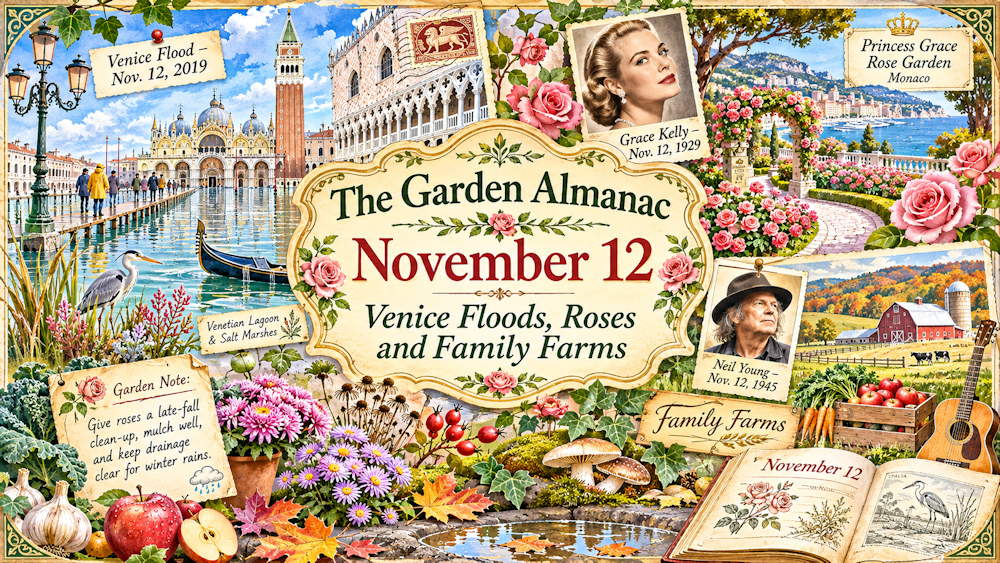

What connects a flooded Italian city, a rose garden built in memory of a princess and a rock musician fighting for family farms? November 12 opens three unexpectedly different chapters in the relationship between people and the landscapes they depend on.
As autumn rain falls and gardens prepare for winter, today’s stories take us from the vulnerable shores of the Adriatic to the Mediterranean sunshine of Monaco, then across the Atlantic to the agricultural heartlands of North America. Along the way, they reveal why water management, thoughtful planting and the future of farming matter far beyond the garden gate.
November 12, 2019 – The Night Venice Almost Disappeared Beneath the Water
On the evening of November 12, 2019, Venice experienced one of the most extraordinary floods in its modern history. Water surged through streets, entered historic buildings and covered much of St Mark’s Square. The tide reached 189 centimetres above the city’s local reference level, the second-highest measurement since systematic records began in 1872. More than 85% of the historic city’s pedestrian areas were flooded.
Venice has lived with acqua alta, or high water, for centuries. But this event was exceptional because several natural forces arrived together. Strong southeasterly winds pushed Adriatic seawater towards the lagoon, low atmospheric pressure raised water levels, and the storm surge coincided with an astronomical high tide. Researchers later identified another remarkable contribution: a rapidly moving weather system generated a wave-like disturbance resembling a small meteorological tsunami. The city was caught in a particularly unfortunate combination of atmospheric and marine conditions.
The disaster raised urgent questions about coastal protection and the future of historic cities as sea levels rise. Venice’s surrounding lagoon is not simply an expanse of water. Its salt marshes, mudflats and shallow channels form a complex ecosystem that influences water movement and supports specialised plants and wildlife. Salt-marsh vegetation can help stabilise sediment and reduce erosion, although no marsh alone could prevent a flood of this magnitude. Protecting such habitats is therefore part of a broader approach to coastal resilience.
For gardeners, Venice offers an important distinction between ordinary flooding and saltwater inundation. Freshwater flooding can deprive roots of oxygen, while seawater introduces salts that may remain in the soil long after the surface dries. Excess salt makes it harder for plants to absorb water and can damage their tissues. In coastal gardens, selecting salt-tolerant species, improving drainage and testing soil after seawater flooding are particularly important. Plants such as sea thrift, sea lavender and certain coastal grasses are naturally adapted to salty environments, but ordinary garden vegetables and many ornamentals are far less tolerant.
Garden Science – Why Can Plants Wilt in Wet, Salty Soil?
A plant growing in salty soil may suffer from water stress even when the ground is visibly moist.
Dissolved salts lower the soil water’s potential, making it more difficult for roots to take up moisture. At high concentrations, sodium and chloride can also damage plant tissues.
After seawater flooding:
- Test the soil: Check salinity before replanting sensitive crops.
- Restore drainage: Excess salts can be washed below the root zone only where drainage is adequate and suitable fresh water is available.
- Avoid unnecessary fertiliser: Fertilisers add dissolved salts and may worsen an existing problem.
- Choose appropriate plants: Salt-tolerant species are better suited to gardens exposed to regular sea spray or occasional saline flooding.
Where coastal groundwater is already salty or drainage is poor, specialist advice may be needed before attempting soil remediation.
November 12, 1929 – A Princess, a Rose Garden and an Unexpected Piece of Land
In Monaco, one of the world’s most celebrated rose gardens occupies a site with an unusual history. Its flowers grow on land that did not exist in its present form until the twentieth century. The Roseraie Princesse Grace, established in memory of Princess Grace of Monaco, stands in Fontvieille, a district created partly through land reclamation from the Mediterranean Sea.
Grace Kelly, born on November 12, 1929, became an internationally famous actress before marrying Prince Rainier III in 1956. After her death in 1982, the prince commissioned a rose garden in her memory. Inaugurated on June 18, 1984, it was designed to combine the romantic character of an English rose garden with Mediterranean features, including mature olive trees. Its original collection contained around 4,000 rose bushes representing 168 varieties.
What makes the garden especially interesting today is its evolution. Later improvements expanded the collection, introduced more sustainable management and made the garden more accessible to visitors. It now contains hundreds of rose varieties, including cultivars associated with the Grimaldi family. The garden demonstrates how ornamental horticulture can combine plant diversity, cultural memory and environmental responsibility. In milder Mediterranean climates, roses may continue flowering into autumn, although the timing depends on the cultivar and seasonal weather.
For gardeners in colder regions, November is usually less about admiring roses in bloom and more about preparing them for winter. Remove diseased fallen foliage where appropriate, avoid heavy feeding that encourages tender late growth, and check that the graft union of vulnerable roses is protected in climates with severe frost. Major pruning is generally best left until late winter or early spring in many temperate regions. The remarkable variety of roses in Monaco also offers a useful reminder: choosing cultivars suited to local climate, disease pressure and available space often matters more than choosing flowers solely for their appearance.
Garden Reminder – How Should Roses Be Prepared for Winter?
In temperate Northern Hemisphere gardens, mid-November is a useful time to check rose beds before persistent cold arrives.
- Clear diseased foliage: Remove leaves affected by serious fungal disease rather than adding them to a poorly managed compost heap.
- Protect vulnerable roots: Apply organic mulch around established plants, avoiding direct contact with stems.
- Secure climbing roses: Tie long, flexible shoots to their supports before winter winds cause damage.
- Avoid hard pruning too early: Save major structural pruning for the season appropriate to your climate and rose type.
- Check drainage: Roses generally dislike prolonged waterlogging, particularly in cold weather.
Healthy fallen leaves from other plants can still be retained beneath shrubs and in suitable garden areas to support overwintering wildlife.
November 12, 1945 – The Rock Star Who Helped Farmers Keep Their Land
A concert might seem an unlikely place to discuss soil conservation, crop production and the survival of family farms. Yet in September 1985, thousands of people gathered in Champaign, Illinois, for an event that would become a lasting part of American agricultural history: Farm Aid.
One of its founders was Canadian musician Neil Young, born on November 12, 1945. Alongside Willie Nelson and John Mellencamp, Young helped organise the original concert during a severe crisis for American family farmers. Falling land values, high interest rates, debt and low agricultural prices had pushed many farms towards foreclosure. The musicians wanted not only to raise money, but also to draw public attention to the social and economic pressures threatening rural communities.
What began as a benefit concert became a continuing movement supporting family farmers and a more resilient food system. Farm Aid has helped connect farmers with consumers, promoted local food networks and supported agricultural practices that protect soil, water and rural livelihoods. The underlying question remains relevant: when small and medium-sized farms disappear, what happens to the knowledge, diversity and community connections that have developed around them?
Gardeners encounter part of this question whenever they buy seeds, choose seasonal produce or visit a local market. Supporting farmers who use responsible land-management practices can help maintain regional food systems. Growing a few vegetables at home also offers an appreciation of the challenges involved in producing food: unpredictable weather, soil fertility, pests and the timing of harvests. Even a small vegetable patch can deepen our understanding of why healthy farmland and knowledgeable growers are worth protecting.
Garden Inspiration – What Can Home Gardens Learn from Sustainable Farming?
Several principles used in responsible agriculture also work remarkably well on a garden scale.
- Keep soil covered: Mulches and suitable cover crops reduce erosion and protect soil organisms.
- Rotate annual crops: Changing where vegetables are grown can help manage certain soil-borne pests and diseases.
- Encourage biodiversity: Flowering borders and mixed planting can support beneficial insects.
- Use water efficiently: Mulching, thoughtful irrigation and soil improvement can reduce unnecessary water loss.
A home garden cannot replace a working farm, but it can become a valuable place to understand the ecological foundations of food production.
Wildlife Note – Why Leave Some Autumn Plants Standing?
By mid-November, many gardeners are tempted to clear every faded stem and fallen leaf. Yet a garden that looks untidy by conventional standards may be providing valuable winter shelter.
Hollow stems can contain overwintering insects, while dry leaves protect ground-dwelling invertebrates from temperature extremes. Birds may feed on seeds retained by teasels, sunflowers and other suitable plants. Dense evergreen shrubs can also provide shelter when deciduous hedges have lost their foliage.
A practical compromise is to clear paths, vegetable beds and diseased plant material where necessary while leaving selected perennial borders and sheltered corners relatively undisturbed. Spring cleanup can then be carried out gradually as temperatures rise.
What to Observe Right Now – November’s Water, Soil and Plant Life
November is an excellent month to discover how the garden manages moisture, retains nutrients and prepares for colder weather.
Watch where rainwater collects. Puddles that remain long after rainfall may reveal compacted ground, poor drainage or a low-lying section of the garden. These observations are particularly useful before planning new beds or planting trees.
Examine your rose bushes. Some varieties retain flowers and leaves much longer than others. Compare their condition after the first frosts and note which cultivars appear best adapted to your local climate.
Look for fungi among fallen leaves. Mushrooms and other visible fungal structures are signs of activity in the wider decomposer community. Many fungi help break down dead plant material and contribute to nutrient cycling.
Notice the remaining sources of wildlife food. Ivy berries, rose hips and other autumn or winter fruits can become important resources for birds, although their ripening times vary by species and location.
Looking Ahead
November 12 offers three very different ways to think about the future of our gardens and landscapes. Venice highlights the growing importance of water management, Monaco’s roses demonstrate how thoughtfully designed green spaces can evolve, and Farm Aid reminds us that sustainable growing depends on the people who care for the land. Each story offers practical inspiration, whether we are improving drainage, choosing resilient plants or supporting responsible food production. As winter approaches, these choices can help prepare both our gardens and the wider living world for the seasons ahead.