

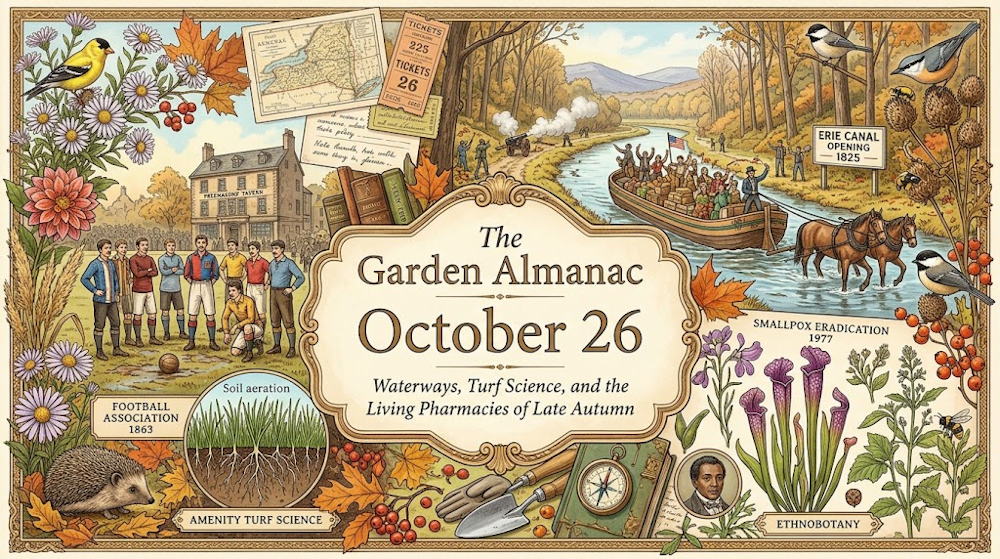

When late October arrives, the garden retreats into a quieter rhythm. The morning frost dusts the remaining perennial foliage, while fallen leaves carpet the damp soil in warm tones of copper and gold. October 26 sits at a pivotal juncture in the autumn calendar – a day when the earth cools, root systems expand beneath the surface, and gardeners prepare their plots for the coming chill.
Looking back through history, this day reminds us how deeply human decisions, infrastructure, and culture intersect with the natural world. From grand engineering feats that altered river basins to the scientific refinement of living green turf and the botanical discoveries behind global medicine, October 26 offers remarkable insights into how we observe, cultivate, and steward our landscapes today.
October 26, 1825 – The Erie Canal and the Aquatic Highways of Seed Dispersal
On October 26, 1825, guns boomed sequentially along the Hudson River to signal the official opening of the Erie Canal. Stretching 363 miles across New York State, this artificial waterway connected the Atlantic Ocean to the Great Lakes, fundamentally changing North American commerce, settlement patterns, and agricultural logistics. Yet, while engineers celebrated a marvel of human ingenuity, ecological systems experienced an immediate shift. The canal carved an uninterrupted aquatic trench through dense forests and wetlands, permanently altering regional watersheds and redrawing the botanical map of a continent.
The true significance of the Erie Canal lay not merely in moving grain and lumber, but in creating an unprecedented vector for seed dispersal. Barges laden with hay, crops, and livestock carried hitchhiking weed seeds across hundreds of miles, while undisturbed canal banks provided ideal corridors for opportunistic pioneer plants. Water flow, boat hulls, and draft animal hooves accelerated the migration of both native and non-native botanical species at speeds nature could never match on its own. It demonstrated how human transportation networks unintentionally function as giant biological conduits, fundamentally reshaping regional plant communities.
For today’s gardener, this historic transformation underscores the profound relationship between water movement and seed migration within our own backyards. Runoff from autumn rains, downspouts, and sloped pathways creates localized micro-canals that carry weed seeds, soil pathogens, and valuable organic mulch across garden beds. By designing rain gardens, swales, and permeable ground covers, home horticulturists can manage water flow effectively, capturing moisture for deep root systems while preventing invasive seeds from washed-out soils from taking hold in disturbed ground.
Garden Science: How Autumn Soil Hydrology Dictates Root Resilience
As air temperatures drop in late October, soil retains solar heat much longer than the atmosphere. This thermal imbalance creates ideal conditions for root expansion, provided soil moisture remains balanced. Excess water in compacted late-autumn soil starves roots of oxygen, leading to fungal rot, while overly dry soil subjects fine root hairs to desiccation during sudden winter freezes. Incorporating well-rotted compost now optimizes soil pore space, allowing autumn rain to hydrate root zones while maintaining crucial air pockets for underground respiration.
October 26, 1863 – The Birth of the Football Association and the Science of Amenity Turfgrass
On the evening of October 26, 1863, representatives from eleven London clubs gathered at Freemasons’ Tavern to form The Football Association, drafting the first standardized rules for modern soccer. Beyond creating the world’s most popular sport, this meeting unwittingly launched a revolution in agricultural science and amenity turfgrass management. Before codification, matches were played on rutted, mud-soaked pastures or uneven commons that quickly deteriorated into degraded clay pits under heavy foot traffic during humid British winters.
The demand for durable, uniform playing surfaces forced botanists and land managers to look closely at grass physiology, soil compaction, and drainage dynamics. Maintaining a resilient greensward required moving away from random pasture mixes toward specialized breeding of dwarf perennial ryegrass (Lolium perenne), slender creeping red fescue (Festuca rubra), and smooth-stalked meadow grass (Poa pratensis). Agronomists pioneered subsurface tile drainage, sand-cushioned rootzones, and core aeration techniques – innovations that gradually moved from elite athletic grounds into public parks and residential garden design.
This turfgrass legacy highlights the delicate balance between soil structure and plant health under heavy physical use. Compaction from frequent foot traffic squashes soil pores, cutting off air and water from grass roots and allowing shallow-rooted weeds like dandelion and moss to dominate. In late October, home gardeners can rejuvenate high-traffic lawn areas by hollow-tine aerating, spreading a thin top-dressing of sharp sand and organic matter, and allowing grass crowns to build energy reserves before the lawn enters winter dormancy.
Garden Reminder: Essential Late-October Soil and Turf Preparation
- Aerate Compacted Paths: Core-aerate heavily walked lawn sections and garden pathways before winter rains consolidate the soil.
- Top-dress with Compost: Spread a thin 0.5-inch layer of screened compost over lawns and dormant perennial borders to feed beneficial earthworms.
- Mulch Exposed Soil: Cover bare vegetable patches with shredded autumn leaves or straw to stop winter rain from splashing away topsoil.
- Clean Lawn Mower Blades: Raise mower blade height by half an inch for the final cuts of the season, leaving grass leaves slightly taller to absorb late sunlight.
October 26, 1977 – Smallpox Eradication and the Living Library of Ethnobotany
On October 26, 1977, medical history reached a monumental threshold in the Merka district of Somalia when Ali Maow Maalin was diagnosed with the world’s last naturally occurring case of Variola minor smallpox. His successful treatment marked the final step in humanity’s triumph over one of the most devastating infectious diseases in history. While modern vaccines delivered the final victory, the journey toward immunology was built upon centuries of botanical exploration, herbal ethnobotany, and plant-derived therapeutic compounds observed across global cultures.
Throughout history, herbalists relied on plants like purple pitcher plant (Sarracenia purpurea) and various medicinal herbs to alleviate smallpox symptoms and manage skin infections, sparking early scientific curiosity into plant secondary metabolites. The global campaign to eradicate smallpox highlighted how human survival depends on understanding bio-active chemical compounds synthesized by plants as natural defense mechanisms against viruses, fungi, and insect herbivores. It proved that protecting global plant diversity is not merely an aesthetic choice, but a fundamental biological safeguard for human health.
This landmark anniversary reminds us that every home garden is a living sanctuary of complex plant chemistry and biodiversity. Cultivating aromatic herbs, native perennials, and berry-producing shrubs provides essential habitats for beneficial organisms while preserving genetic diversity within our local ecosystems. Leaving seed heads on echinacea, wild bergamot, and sage over the winter months protects vital plant oils and natural defenses, while feeding beneficial garden wildlife during the leanest months of the year.
Wildlife Note: Preserving the Winter Pantry for Backyard Birds
Late October is the critical window when non-migratory birds, such as goldfinches, chickadees, and nuthatches, shift their diets from insects to energy-rich seeds and berries. Resist the urge to cut down standing seed heads of sunflowers, rudbeckia, and ornamental grasses during fall cleanup. These dried seed structures serve as natural, elevated feeding stations that keep seed heads dry and accessible above snow cover, while hollow plant stems provide overwintering shelter for beneficial solitary bees and ladybugs.
What to Observe Right Now: Microclimates and Seed Dispersal in Late Autumn
- Wind and Water Pathways: Watch how fallen autumn leaves collect in specific corners of your yard, marking natural wind corridors and moisture collection points.
- Late-Season Seed Mechanisms: Examine how exploding seed pods of witch hazel (Hamamelis) or burrs of native perennials hitch rides on animal fur or garden gloves.
- Bark and Lichen Textures: Notice how damp autumn air accentuates bright lichens and mosses on tree trunks, signaling clean air and high humidity.
- Root Zone Respiration: Check soil moisture two inches down after autumn rains to identify areas where water drains well versus spots that stay waterlogged.
Looking Ahead
The historical events of October 26 show us that human progress, landscape stewardship, and ecological health are inextricably bound together. Whether managing water movement along soil contours, nurturing resilient turfgrass through soil aeration, or safeguarding biodiversity as a living reservoir of natural defenses, our gardens mirror the wider world. As autumn deepens and the earth slumbers, the choices we make today set the foundation for spring’s renewal. Step outside this afternoon, observe the quiet transformations taking place in your soil and plants, and take pride in cultivating a patch of land that nurtures both nature and the human spirit.